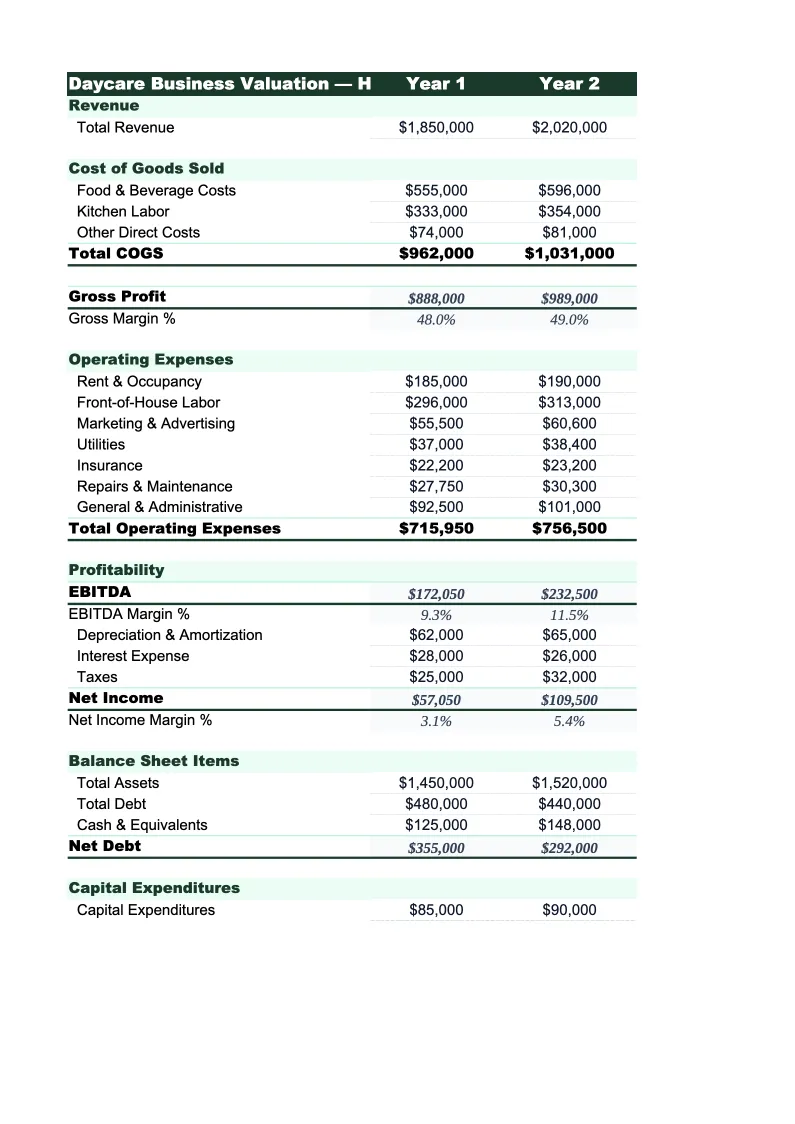
Daycare Valuation Template
Value your daycare center using SDE multiples, an enrollment and subsidy stability scorecard, and a license transferability analysis — with benchmarks built around how childcare businesses actually sell.
What's Inside This Daycare Valuation Template
This template includes 6 worksheets, each designed for a specific part of your daycare financial workflow:
Business Inputs
The data foundation for the entire model.
SDE Multiple Approach
The primary valuation method for owner-operated and small-to-mid-size childcare centers.
Asset-Based Valuation
Calculates the tangible asset floor of the daycare — the minimum value no rational seller should accept.
Enrollment Multiple Check
A secondary validation method using revenue and enrollment multiples, which business brokers use as a quick market-based cross-check when valuing childcare centers.
Value Drivers Scorecard
A structured scoring model for the qualitative and operational factors that most directly influence where a daycare center lands within its SDE multiple range.
Valuation Summary
A single-page output consolidating all valuation methods into one view across conservative, base, and optimistic scenarios.
Daycare Valuation Template Features
- SDE calculation with owner-director compensation normalization and childcare-specific add-backs
- Enrollment and subsidy stability scorecard scoring occupancy rate, private-pay mix, and subsidy contract stability
- Asset inventory covering classroom equipment, playground structures, vehicles, and intangibles including licensed capacity and accreditation
- Value drivers scorecard scoring license transferability, staff credentials, director dependence, and enrollment trends
- Enrollment multiple and per-licensed-slot cross-check calibrated to childcare market transaction benchmarks
- Three-scenario valuation summary with real estate separated from business value and SDE sensitivity table
How to Use This Childcare Business Valuation Spreadsheet
Start with the Business Inputs sheet. Pull your trailing twelve-month revenue from your accounting software, broken out by source — tuition by age group, government subsidies, and any ancillary revenue like enrichment programs or summer camps. You'll also need your annual expense breakdown, owner compensation including any personal expenses through the business, your licensed capacity and current enrollment by age group, and a note on whether you own or lease your facility. If your books don't separate tuition from subsidy revenue clearly, your childcare management software (Procare, Brightwheel, HiMama) will have that data — subsidy revenue as a percentage of total is one of the most important inputs in the model.
Work through the SDE Multiple Approach and Value Drivers Scorecard together. The SDE normalization is critical for childcare because owner-directors frequently pay themselves below the market rate for a replacement director, or run personal vehicle and phone expenses through the center. The replacement director wage used in the model defaults to $55,000–$65,000, which reflects what a qualified, licensed childcare director with center management experience earns in most U.S. markets — adjust this to your local market if needed. The Value Drivers Scorecard is where childcare centers either earn or lose their premium: license transferability alone can swing the multiple by half a turn, and buyers consistently cite staff credential depth and occupancy rate as the two factors that most affect their offer. Work through each scoring dimension honestly, as this is what a buyer and their broker will verify during due diligence.
Know what your daycare is worth before you sell
Enter your enrollment, tuition revenue, subsidies, and staff details — and get a defensible valuation range with the SDE multiple, asset floor, and value drivers that buyers will use to make their offer.
How Daycare Centers Are Valued When They Sell
Daycare business valuations are shaped by three factors that don't exist in most other service businesses: licensed capacity, regulatory compliance history, and subsidy dependency. Licensed capacity is worth real money — in many markets, obtaining a new childcare license takes 12–24 months of inspections, facility modifications, and compliance documentation. A buyer acquiring an existing licensed center is also acquiring that regulatory history. But the license is only as valuable as it is transferable: some state licenses are tied to the director's credentials or the physical facility configuration, and a sale that requires a full new license application carries transition risk that buyers discount heavily. Centers where the license transfers cleanly to a new owner with qualified staff in place command meaningfully higher prices than those where the buyer faces a licensing gap.
The typical SDE multiple range for profitable daycare centers is 2.0–3.5x, but most transactions close between 2.2–3.0x. Centers above 90% of licensed capacity, with a majority of private-pay enrollment (rather than subsidy-dependent), NAEYC accreditation, and a teaching staff that isn't likely to leave in the transition routinely reach the upper end of that range. Subsidy revenue itself is not a disqualifier — many highly profitable centers run 40–50% subsidy enrollment — but buyers want to see long-term contracts or stable participation history with the subsidy program, not annual renewals that depend on state budget cycles. Gross margins in well-run daycare centers typically run 30–50%, and net margins land around 10–16% for owner-operators. SDE as a percentage of revenue often falls in the 15–25% range for centers that sell at the high end of the multiple.
Daycare Industry at a Glance
Financial templates built for daycare centers and childcare providers — pre-loaded with tuition billing categories, subsidy tracking, and the KPIs that determine whether a center is actually making money.
Revenue Drivers
- Weekly/monthly tuition by age group
- Government subsidies and voucher programs
- Before/after school care
- Drop-in and part-time care
- Enrichment classes and summer programs
Key Cost Categories
- Payroll and benefits (50-70% of revenue)
- Rent and occupancy
- Food and meals program
- Supplies and curriculum materials
- Insurance and licensing
- Utilities
- Marketing and enrollment
Typical Margins
Gross: 30-50% · Net: 10-16%
Seasonality
Peak enrollment in August-September (school year start) and January-February. Summer dip for school-age programs. Revenue is more stable than attendance because most centers bill flat tuition regardless of days attended.
Key Performance Indicators
Daycare Business Valuation FAQ
More Daycare Templates
Daycare Balance Sheet Template for Excel
$29
Daycare Budget Template for Excel
$29
Daycare Business Plan Template for Excel
$39
Daycare Cash Flow Template for Excel
$29
Daycare Expense Tracker Template for Excel
$29
Daycare Financial Model Template for Excel
$29
Daycare Income Statement Template for Excel
$29
Daycare Invoice Template for Excel
$29
Daycare KPI Dashboard Template for Excel
$29
Daycare P&L Template for Excel
$29
Daycare Pro Forma Template for Excel
$29
Daycare Project Budget Template for Excel
$29
Daycare Sales Forecast Template for Excel
$29
Daycare Valuation Template
$29