Daycare Pro Forma Template
Project your daycare's revenue, staffing costs, and break-even before you open the doors — built around enrollment capacity, age-group tuition tiers, and licensing ratios.
What's Inside This Daycare Pro Forma Template
This template includes 7 worksheets, each designed for a specific part of your daycare financial workflow:
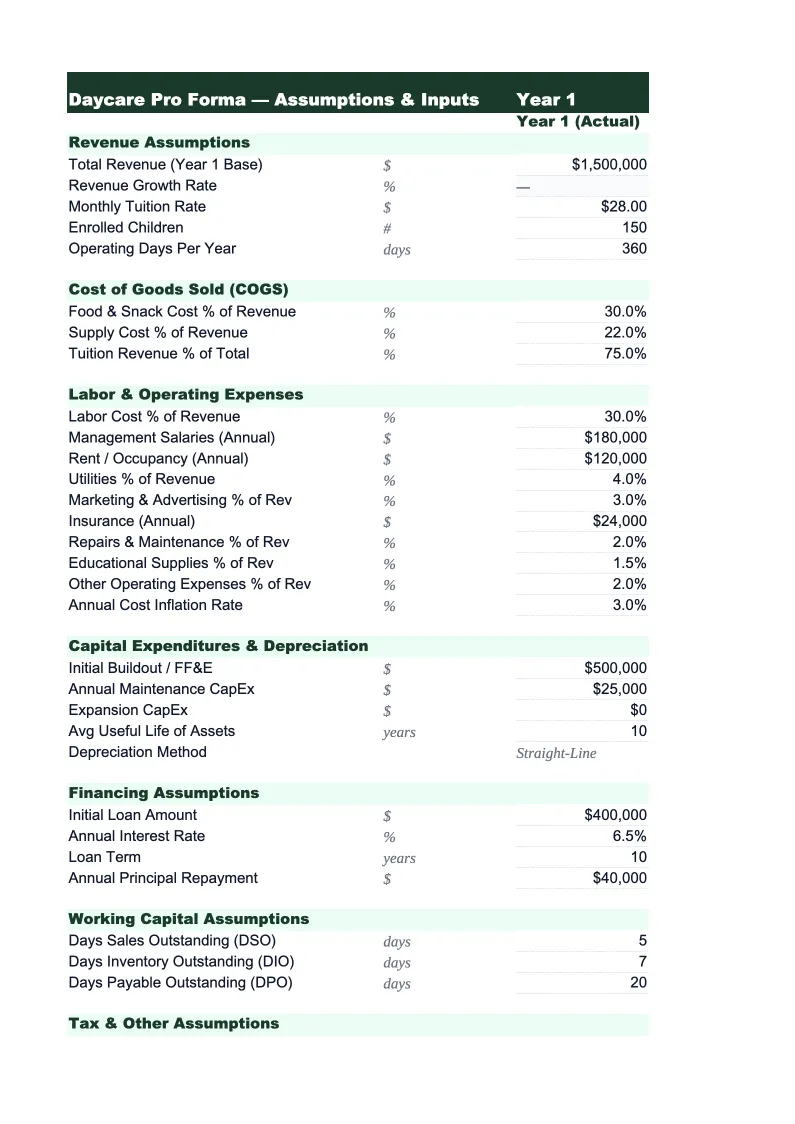
Assumptions
The control panel for the entire model.
Enrollment Projections
A month-by-month enrollment forecast for Years 1 through 3, broken out by age group.
Revenue Projections
Projects monthly and annual revenue from tuition, government subsidies, before and after school programs, drop-in care, and enrichment classes.
Expense Projections
A detailed 3-year expense forecast organized by the cost categories that matter most for childcare operations.
Pro Forma Income Statement
A 3-year projected profit and loss statement summarizing the revenue and expense projections into a clean annual view.
Break-Even Analysis
Calculates exactly how many enrolled children you need to cover your fixed and variable costs at each stage of operations.
Startup Costs
A one-time summary of the capital required to open the center, including leasehold improvements and classroom buildout, furniture and equipment, playground installation, initial curriculum and supply inventory, licensing and inspection fees, working capital reserve, and pre-opening marketing.
Daycare Pro Forma Template Features
- Enrollment ramp-up model by age group with occupancy rate tracking
- Payroll projections that scale with enrollment and state licensing ratios
- CACFP food program reimbursement included as a revenue line
- Break-even analysis showing the enrolled-child threshold by month
- 3-year pro forma P&L formatted for SBA and lender review
- Startup cost summary with financing structure breakdown
How to Use This Daycare Pro Forma Spreadsheet
Start with the Assumptions sheet. Enter your licensed capacity for each room type, the weekly tuition rates you plan to charge by age group, and your expected enrollment pace for the first 12 months. If you don't have firm numbers yet, start with the defaults — they reflect typical market rates for a mid-size urban or suburban center — and adjust from there. The Assumptions sheet controls everything else in the model, so spending 20 minutes getting those inputs right before touching any other sheet will save you a lot of time later.
Once your assumptions are set, review the Enrollment Projections and Revenue sheets to make sure the numbers look realistic. A common mistake is modeling full occupancy too quickly — most centers take 12–18 months to reach 85% capacity even with strong marketing. Stress-test your revenue by lowering the enrollment ramp in the conservative scenario and checking whether you still have enough cash to get through Year 1. The Break-Even Analysis sheet will show you exactly which month you cross into positive cash flow under each scenario.
Know your break-even before you sign the lease
Download the template, plug in your capacity and tuition rates, and see exactly how many enrolled children you need — and when you'll get there.
Why Every Daycare Needs a Pro Forma Before Opening
Opening or expanding a daycare center requires more upfront capital and more careful financial planning than most small businesses. A new center typically needs $150,000 to $500,000 just to open — buildout, equipment, licensing, and working capital — before a single tuition payment arrives. Banks and SBA lenders require projections before approving financing, and landlords of commercial space often ask for financial statements to evaluate whether you can sustain the lease. A well-built pro forma is not optional; it's the document that determines whether the project moves forward.
The financial structure of a daycare is driven by two variables more than any others: licensed capacity and occupancy rate. Licensed capacity sets your revenue ceiling — a center licensed for 80 children can only generate tuition from 80 children, no matter how efficient your operations are. Occupancy rate determines how close you get to that ceiling. Most centers operate between 75% and 90% occupancy once stabilized; getting there typically takes 12–24 months. Your pro forma needs to model this ramp-up period honestly, because it's during those early months — before enrollment is full but while payroll and rent are running — that cash flow is most vulnerable.
Daycare Industry at a Glance
Financial templates built for daycare centers and childcare providers — pre-loaded with tuition billing categories, subsidy tracking, and the KPIs that determine whether a center is actually making money.
Revenue Drivers
- Weekly/monthly tuition by age group
- Government subsidies and voucher programs
- Before/after school care
- Drop-in and part-time care
- Enrichment classes and summer programs
Key Cost Categories
- Payroll and benefits (50-70% of revenue)
- Rent and occupancy
- Food and meals program
- Supplies and curriculum materials
- Insurance and licensing
- Utilities
- Marketing and enrollment
Typical Margins
Gross: 30-50% · Net: 10-16%
Seasonality
Peak enrollment in August-September (school year start) and January-February. Summer dip for school-age programs. Revenue is more stable than attendance because most centers bill flat tuition regardless of days attended.
Key Performance Indicators
Daycare Pro Forma Template FAQ
More Daycare Templates
Daycare Balance Sheet Template for Excel
$29
Daycare Budget Template for Excel
$29
Daycare Business Plan Template for Excel
$39
Daycare Cash Flow Template for Excel
$29
Daycare Expense Tracker Template for Excel
$29
Daycare Financial Model Template for Excel
$29
Daycare Income Statement Template for Excel
$29
Daycare Invoice Template for Excel
$29
Daycare KPI Dashboard Template for Excel
$29
Daycare P&L Template for Excel
$29
Daycare Project Budget Template for Excel
$29
Daycare Sales Forecast Template for Excel
$29
Daycare Business Valuation Template for Excel
$29
Daycare Pro Forma Template
$29