Healthcare Business Plan Template
A complete business plan template for healthcare providers, medical practices, and clinics. Model patient volume and revenue per visit, forecast startup costs and facility requirements, and project EBITDA across three years.
What's Inside This Healthcare Business Plan Template
This template includes 5 worksheets, each designed for a specific part of your healthcare financial workflow:
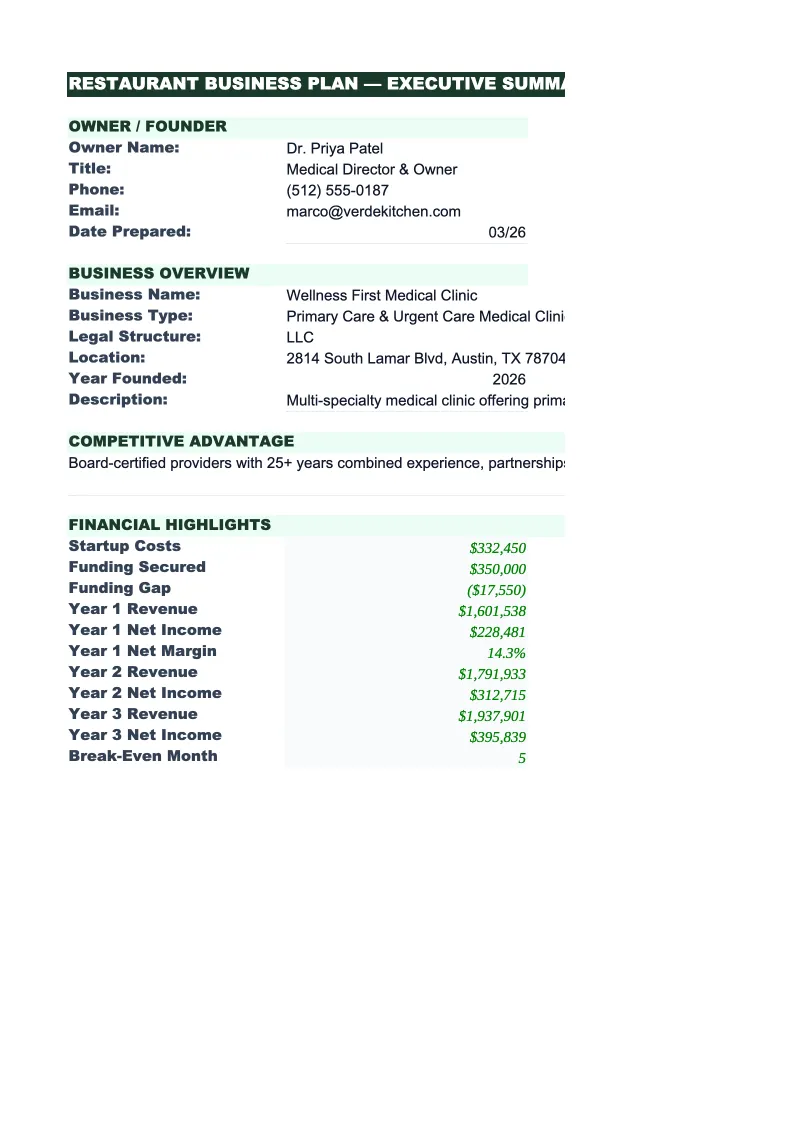
Executive Summary
The one-page snapshot of your healthcare business, ideal for SBA lenders and medical equipment finance partners.
Startup Costs & Funding
Breaks down the investment required to launch a healthcare practice: facility buildout and compliance (medical office design, EHR-ready infrastructure), medical equipment (diagnostic equipment, furniture, supplies), EHR and practice management software setup, licensing and credentialing (medical licenses, DEA licenses, insurance credentialing), initial staffing and training, malpractice insurance, and working capital for operating expenses during the ramp-up.
Revenue Forecast
A 12-month patient volume forecast broken by payer type (Medicare, Medicaid, private insurance, self-pay, and cash-pay).
Projected P&L
Annual projections for years 1, 2, and 3 showing total patient revenue (by payer mix), operating expenses including provider compensation (W-2 salary + bonus), clinical staff salaries, facility costs (rent, utilities, maintenance), medical supplies and equipment depreciation, malpractice insurance, EHR and billing software, marketing, and administrative overhead.
Dashboard
A visual summary of your healthcare practice's financial and operational health.
Healthcare Business Plan Template Features
- Patient volume forecast by payer type (Medicare, Medicaid, private insurance) with realistic reimbursement rates
- Revenue model built from average visits per provider, visit frequency, and reimbursement mix
- Startup costs for facility, medical equipment, EHR, credentialing, and compliance
- 3-year P&L with provider compensation, clinical staff, facility costs, malpractice insurance, and software
- Payer mix tracking—shows revenue and margin by patient type (Medicare, Medicaid, commercial, self-pay)
- Dashboard with patient acquisition metrics, staffing efficiency, accounts receivable tracking, and profitability trajectory
How to Use This Healthcare Business Plan Spreadsheet
Start with the Executive Summary. Define your practice type (family medicine, orthopedics, urgent care, telehealth, etc.), the patient population you'll serve, and your provider and clinical staffing model. Then move to the Startup Costs & Funding sheet. Estimate facility costs (rent, build-out, medical-grade infrastructure), medical equipment (EHR-ready exam tables, diagnostic equipment), EHR and practice management software, credentialing and licensing, and three to six months of working capital for payroll and supplies. Healthcare practices typically need $150,000–$500,000+ in startup capital depending on practice type and location.
Next, go to the Revenue Forecast sheet. Enter your expected patient visits per month by payer type (Medicare, Medicaid, commercial insurance, self-pay). Research your local market's average reimbursement rates for your specialty—Medicare rates are published online; Medicaid rates vary by state; commercial rates depend on your contracts. Calculate average revenue per visit by blending your expected payer mix. The model includes a ramp-up schedule for months 1–8 as you build referral relationships and patient volume grows. Adjust the ramp percentages to match your patient acquisition strategy.
From patient volume plan to lender-ready business plan in under an hour
Enter your patient population, visit volume, payer mix, and provider staffing. The template builds your 3-year financial projections, overhead ratios, and profitability trajectory automatically.
Why Healthcare Practices Need a Solid Business Plan
A healthcare business plan is critical for both regulatory and financial credibility. Lenders want to see that you understand your payer mix and reimbursement environment—a plan that assumes all cash-pay patients or doesn't account for insurance denials will be rejected. Hospitals and health systems that might acquire your practice want to see stable patient volume, controlled overhead, and a clear path to the profitability margins they operate at (typically 15–25% EBITDA). A plan that shows realistic reimbursement rates, conservative patient ramp-up, and disciplined overhead will secure both bank financing and potential acquisition interest.
The three metrics that define healthcare practice financial health are average revenue per patient visit (which varies widely by specialty and payer mix), patient acquisition cost and retention rate (how many new patients you recruit monthly and what percentage return), and overhead ratio (operating expenses as a percentage of revenue). A primary care practice with $120 average revenue per visit, a 3% monthly patient growth rate, and 35% overhead can hit 15% EBITDA at maturity. A specialty practice with $400 average revenue per visit but 45% overhead and slow patient growth won't be profitable until patient volume reaches critical mass.
Healthcare Industry at a Glance
Financial templates built for healthcare practices — from private clinics and therapy offices to specialty practices and medical groups. Pre-loaded with billing categories, insurance reimbursement tracking, and healthcare-specific KPIs.
Revenue Drivers
- Insurance reimbursements
- Patient copays and coinsurance
- Out-of-pocket self-pay
- Capitation payments
Key Cost Categories
- Clinical staff salaries
- Administrative and billing staff
- Medical supplies
- Malpractice insurance
- EMR/EHR software
- Facility rent and occupancy
Typical Margins
Gross: 45-65% · Net: 10-25%
Seasonality
Higher patient volume in fall/winter flu season; slower in summer. End-of-year spike as patients meet deductibles.
Key Performance Indicators
Healthcare Business Plan Template FAQ
More Healthcare Templates
Healthcare Balance Sheet Template for Excel
$29
Healthcare Budget Template for Excel
$29
Healthcare Cash Flow Template for Excel
$29
Healthcare Expense Tracker Template for Excel
$29
Healthcare Financial Model Template for Excel
$29
Healthcare Income Statement Template for Excel
$29
Healthcare Invoice Template for Excel
$29
Healthcare KPI Dashboard Template for Excel
$29
Healthcare P&L Template for Excel
$29
Healthcare Pro Forma Template for Excel
$29
Healthcare Project Budget Template for Excel
$29
Healthcare Sales Forecast Template for Excel
$29
Healthcare Practice Valuation Template for Excel
$29
More Business Plan Templates
Healthcare Business Plan Template
$39