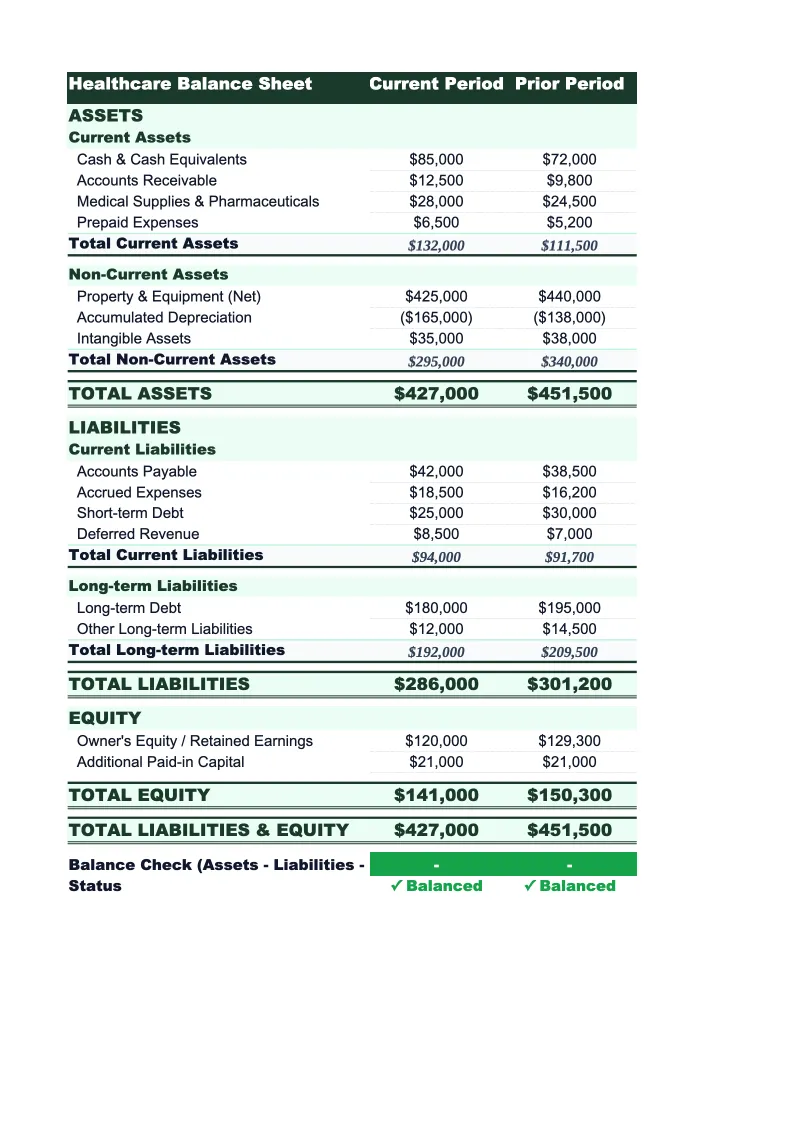
Healthcare Balance Sheet Template
See exactly what your practice owns, owes, and is worth — a balance sheet built for healthcare with insurance AR aging, medical equipment depreciation, patient refund liabilities, and malpractice prepaid tracking.
What's Inside This Healthcare Balance Sheet Template
This template includes 4 worksheets, each designed for a specific part of your healthcare financial workflow:
Balance Sheet
The core financial statement organized around the medical practice chart of accounts.
AR Aging
A detailed accounts receivable aging tracker that separates insurance AR from patient AR and breaks each into aging buckets — current (0–30 days), 31–60 days, 61–90 days, and 90+ days.
Fixed Assets
A fixed-asset register tracking every major piece of medical equipment, diagnostic technology, clinical furniture, and leasehold improvement the practice owns.
Period Comparison
A side-by-side view of two balance sheet dates — typically the current period-end against the prior year-end — showing dollar and percentage change for every line item across assets, liabilities, and equity.
Healthcare Balance Sheet Template Features
- Insurance AR aging broken out by payer class — Medicare, Medicaid, commercial, and self-pay
- Patient refund liability tracked as a separate current liability for overpayments and insurance credits
- Fixed asset register with depreciation schedules for medical equipment, diagnostic devices, and leasehold improvements
- Net collection rate and days in AR calculated automatically from the AR aging tracker
- Accounting equation check — automatically flags any imbalance between assets and liabilities plus equity
- Period-over-period comparison for lender reporting, practice valuations, and ownership reviews
How to Use This Healthcare Balance Sheet Spreadsheet
Start with the Fixed Assets sheet before entering anything else. Pull your depreciation schedule from last year's tax return or your accountant's records and list every major asset: clinical and diagnostic equipment, exam room buildout, computers, and any vehicles. Enter the original cost, purchase date, and useful life for each item — the sheet handles depreciation calculations and produces category totals that feed into the balance sheet automatically. Medical equipment is often the largest asset category for a private practice, and having it properly depreciated on the balance sheet is important for both accurate financials and practice valuation conversations.
Next, complete the AR Aging sheet. Pull your accounts receivable aging report from your billing system or EHR and enter outstanding balances by payer class and aging bucket. The sheet calculates your net collectable AR and feeds the realistic AR balance into current assets — not the gross billed amount, which overstates the asset. Then fill in the rest of the balance sheet: cash from your bank statement, prepaid malpractice insurance from your premium schedule, patient refund liability from your billing system's credit balance report, and accounts payable from your vendor aging. Payroll accruals typically come from your payroll processor.
15 minutes from download to your first practice balance sheet
Download the template, enter your accounts and AR aging, and see your healthcare practice's full financial position — assets, liabilities, patient refund obligations, and owner's equity included.
Why Every Medical Practice Needs a Balance Sheet Template
Most independent practices live in their P&L and rarely look at the balance sheet. The income statement tells you whether you collected more than you spent last month; the balance sheet tells you what the practice is worth and whether it's financially stable enough to handle a bad quarter, a payer dispute, or a major equipment purchase. Healthcare practices face a unique balance sheet complexity that most other businesses don't: the difference between gross AR (what you billed) and net AR (what you'll actually collect) can be enormous, and presenting the wrong number on a balance sheet overstates assets significantly. Insurance contracts, contractual adjustments, and denial rates mean a practice might carry $400,000 in gross claims while only expecting to collect $260,000 of it.
Three items on a healthcare practice balance sheet require particular attention. The first is AR presentation: insurance receivables should be shown net of contractual adjustments and an allowance for uncollectible amounts based on historical collection rates by payer — not at gross billed charges. The second is patient refund liability: when a patient or insurer overpays, that credit balance is a liability you owe until it's refunded or applied — and practices with active billing operations can carry thousands of dollars in credit balances that belong on the liability side of the balance sheet. The third is malpractice insurance prepaid: annual malpractice premiums for physicians can run $10,000 to $50,000 or more per provider, and the unused portion at any balance sheet date is a real current asset that should be recognized.
Healthcare Industry at a Glance
Financial templates built for healthcare practices — from private clinics and therapy offices to specialty practices and medical groups. Pre-loaded with billing categories, insurance reimbursement tracking, and healthcare-specific KPIs.
Revenue Drivers
- Insurance reimbursements
- Patient copays and coinsurance
- Out-of-pocket self-pay
- Capitation payments
Key Cost Categories
- Clinical staff salaries
- Administrative and billing staff
- Medical supplies
- Malpractice insurance
- EMR/EHR software
- Facility rent and occupancy
Typical Margins
Gross: 45-65% · Net: 10-25%
Seasonality
Higher patient volume in fall/winter flu season; slower in summer. End-of-year spike as patients meet deductibles.
Key Performance Indicators
Healthcare Balance Sheet Template FAQ
More Healthcare Templates
Healthcare Budget Template for Excel
$29
Healthcare Business Plan Template for Excel
$39
Healthcare Cash Flow Template for Excel
$29
Healthcare Expense Tracker Template for Excel
$29
Healthcare Financial Model Template for Excel
$29
Healthcare Income Statement Template for Excel
$29
Healthcare Invoice Template for Excel
$29
Healthcare KPI Dashboard Template for Excel
$29
Healthcare P&L Template for Excel
$29
Healthcare Pro Forma Template for Excel
$29
Healthcare Project Budget Template for Excel
$29
Healthcare Sales Forecast Template for Excel
$29
Healthcare Practice Valuation Template for Excel
$29
More Balance Sheet Templates
Healthcare Balance Sheet Template
$29