Healthcare Cash Flow Template
Track and project cash flow for your medical practice — with insurance reimbursement timing, AR aging, and payer-by-payer collection built in.
What's Inside This Healthcare Cash Flow Template
This template includes 5 worksheets, each designed for a specific part of your healthcare financial workflow:
13-Week Cash Flow
A rolling 13-week view of your practice's cash inflows and outflows — the standard short-term planning window for healthcare operations.
Monthly Cash Flow
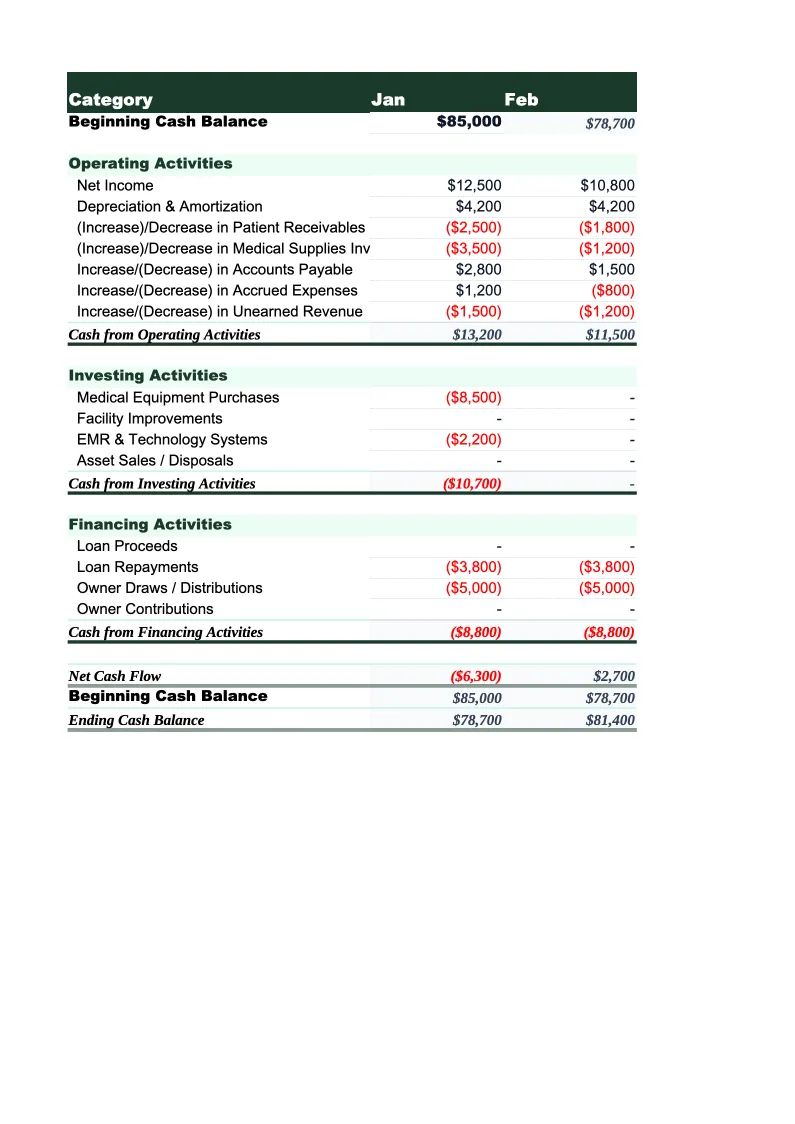
A full indirect-method cash flow statement organized into the three standard categories: operating, investing, and financing activities.
AR Aging Tracker
A dedicated worksheet for tracking accounts receivable by payer and aging bucket — current, 30 days, 60 days, 90 days, and 90+ days.
Annual Summary
A 12-month rollup of your operating cash flow, broken down by revenue category and major expense line.
Dashboard
A visual overview with four pre-built charts: monthly cash inflows vs.
Healthcare Cash Flow Template Features
- 13-week rolling cash flow view with insurance collection timing
- AR aging tracker split by Medicare, Medicaid, commercial, and self-pay
- Indirect-method monthly cash flow statement with AR adjustments
- Net collection rate and days-in-AR calculations built in
- Annual cash runway projection based on average burn
- Payer mix dashboard showing collections by insurance category
How to Use This Medical Practice Cash Flow Spreadsheet
Download the .xlsx file and open it in Excel or Google Sheets. Start with the 13-Week Cash Flow sheet — this is the most immediately useful view for day-to-day practice management. Review the payer categories in the revenue rows and rename them to match your actual payer mix. Most practices keep Medicare, Medicaid, and commercial insurance as separate rows, with self-pay as a fourth. Enter your expected collections for the coming 13 weeks, using your current AR aging report and average collection timelines by payer as your guide. Then fill in your weekly expense estimates for payroll, supplies, and fixed costs.
Once the short-term view is set up, move to the Monthly Cash Flow and AR Aging sheets. The AR Aging Tracker is the most important diagnostic tool in the file: enter your outstanding claims by payer bucket each month and watch the days-in-AR metric. For most practices, days in AR should stay below 40 — if it climbs above 50 for a specific payer, that's a signal to follow up on outstanding claims or review your billing workflow for that payer category. The Monthly Cash Flow sheet is where you record what actually happened, building an auditable 12-month record that flows into the Annual Summary automatically.
15 minutes from download to your first cash flow projection
Download the template, enter your payer mix and AR aging data, and see your practice's full cash picture — 13-week projection, monthly statement, and AR tracker included.
Why Healthcare Practices Need a Dedicated Cash Flow Template
Healthcare practices face a cash flow problem that almost no other industry deals with: the work is done on Tuesday, but the cash might not arrive until six or eight weeks later — and only if the claim was filed correctly, the payer processed it on schedule, and no authorization issue caused a denial. For a busy primary care practice or specialty clinic, that lag between service and payment is constant, and managing it requires a different set of tools than a typical small business cash flow statement.
The two metrics that matter most in healthcare cash flow are days in accounts receivable and net collection rate. Days in AR tells you how long it takes to turn a billed claim into cash — the industry benchmark is under 40 days for commercial payers, though many practices run 45–60. Net collection rate, which is cash collected divided by net charges after contractual adjustments, tells you whether your billing team is capturing everything you're owed. A practice with 95%+ net collection rate is leaving almost nothing on the table; anything below 90% usually signals claim denial issues, aging write-offs, or gaps in self-pay follow-up. Tracking both numbers consistently is the foundation of sustainable cash flow management.
Healthcare Industry at a Glance
Financial templates built for healthcare practices — from private clinics and therapy offices to specialty practices and medical groups. Pre-loaded with billing categories, insurance reimbursement tracking, and healthcare-specific KPIs.
Revenue Drivers
- Insurance reimbursements
- Patient copays and coinsurance
- Out-of-pocket self-pay
- Capitation payments
Key Cost Categories
- Clinical staff salaries
- Administrative and billing staff
- Medical supplies
- Malpractice insurance
- EMR/EHR software
- Facility rent and occupancy
Typical Margins
Gross: 45-65% · Net: 10-25%
Seasonality
Higher patient volume in fall/winter flu season; slower in summer. End-of-year spike as patients meet deductibles.
Key Performance Indicators
Healthcare Cash Flow Template FAQ
More Healthcare Templates
Healthcare Balance Sheet Template for Excel
$29
Healthcare Budget Template for Excel
$29
Healthcare Business Plan Template for Excel
$39
Healthcare Expense Tracker Template for Excel
$29
Healthcare Financial Model Template for Excel
$29
Healthcare Income Statement Template for Excel
$29
Healthcare Invoice Template for Excel
$29
Healthcare KPI Dashboard Template for Excel
$29
Healthcare P&L Template for Excel
$29
Healthcare Pro Forma Template for Excel
$29
Healthcare Project Budget Template for Excel
$29
Healthcare Sales Forecast Template for Excel
$29
Healthcare Practice Valuation Template for Excel
$29
Healthcare Cash Flow Template
$29