Roofing Business Plan Template
Build a complete financial roadmap for your roofing business with startup costs, job assumptions, and 3-year P&L projections — pre-built for residential, commercial, and specialty roofing services.
What's Inside This Roofing Business Plan Template
This template includes 5 worksheets, each designed for a specific part of your roofing financial workflow:
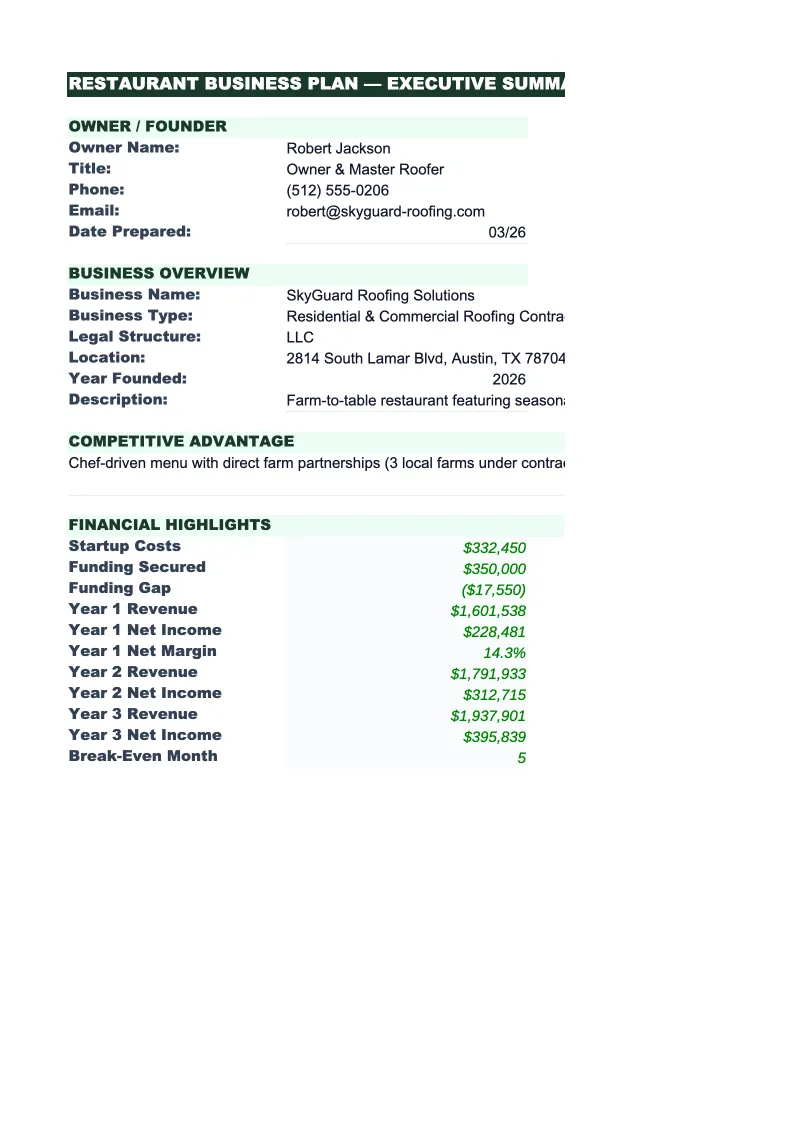
Executive Summary
A one-page overview of your roofing business showing your service offerings (residential repairs, full replacements, commercial, specialty work), target market, and key financial metrics.
Startup Costs & Funding
A detailed tracker for your initial investment including vehicle/truck purchase or lease, equipment and tools (scaffolding, safety gear, roofing equipment, diagnostic tools), licensing and insurance (liability, workers comp—highest cost), bonding, initial materials inventory, office setup, and working capital.
Revenue Forecast
Projects monthly revenue based on number of roofing jobs per month, average job revenue, and job type (residential repairs, residential replacements, commercial, specialty).
Projected P&L
Annual and monthly profit & loss statement showing revenue, cost of goods sold (roofing materials, labor for crew, subcontractors, equipment depreciation), gross profit, and operating expenses (licensing/permits, insurance, vehicle costs, office staff, marketing, continuing education).
Dashboard
A visual overview of key metrics including total revenue, profit, jobs per month, average revenue per job, gross margin, net margin, break-even analysis, and profitability timeline.
Roofing Business Plan Features
- Startup costs for vehicle, equipment, licensing, insurance, bonding, and working capital
- Revenue model based on job volume, average job size, and job type mix
- Seasonal ramp schedule—roofing peaks spring-fall, slow in winter
- Labor and material cost tracking with gross margin by job type
- 3-year P&L with EBITDA and net margin showing path to profitability
- Break-even analysis showing job volume and fees needed to cover fixed costs
How to Use This Business Plan Spreadsheet
Start with the Startup Costs sheet and list every expense: vehicle/truck (budget $25,000–$50,000), roofing equipment and safety gear ($5,000–$15,000), liability and workers compensation insurance (this is major—budget $5,000–$20,000 for the first year), bonding ($1,000–$5,000), licensing/contractor license ($500–$3,000 depending on state), initial materials inventory ($3,000–$8,000), office setup, and 3–4 months working capital ($8,000–$15,000). Most roofing contractors need $45,000–$100,000 total. Insurance is the largest variable cost: a solo operator with no employees might pay $4,000–$8,000/year; a contractor with 5 employees might pay $15,000–$30,000/year. Get insurance quotes early as this significantly impacts your startup costs.
Move to the Revenue Forecast sheet and set your assumptions: how many roofing jobs per month you can realistically complete in month one (2–3), how you'll ramp to mature capacity (5–8 jobs per month by month 12), and your average revenue per job by type. Residential roof repairs: $500–$3,000. Residential full replacements: $5,000–$25,000. Commercial roofing projects: $10,000–$100,000+ depending on size. Most roofing contractors build a mix of repair and replacement work, with replacement jobs providing higher revenue but longer project timelines. Account for seasonal variation: 70–80% of annual roofing work happens March–October; winter months are 20–30% of revenue. Once you set these assumptions, revenue builds automatically.
From launch to investor-ready business plan in one sitting
Enter your startup costs, insurance estimates, average job size, and job targets—the model projects your 3-year revenue, profitability, and cash runway automatically.
Why Roofing Contractors Need a Business Plan
Roofing is a high-revenue service business with significant startup costs and capital requirements. Your profitability depends on: job volume (how many projects you complete per month), average job size (residential repairs vs. full replacements), gross margin (materials + direct labor vs. price), and overhead (insurance is the killer for many roofing startups). A contractor doing 4 residential replacements per month at $12,000 average generates $48,000/month revenue. If materials and labor cost $7,000 per job, gross margin is 42% ($5,000 per job). With $15,000/month overhead (insurance $8,000, vehicle $2,000, payroll $5,000), your net margin is 10–15%. The same contractor scaling to 8 jobs/month nearly doubles profit even with higher insurance costs.
Insurance and bonding are unique challenges in roofing because of liability exposure. General liability insurance is essential (covers injuries, property damage); workers compensation is required if you hire employees (cost scales with payroll and safety record). Many small roofing contractors get surprised by insurance costs: $4,000–$10,000/year for a solo operator, $15,000–$30,000 for a 5-person crew. Some states require roofing contractors to be licensed and bonded, adding $1,000–$5,000 in startup costs. Your business plan must account for the full cost of insurance and bonding—it's often 15–25% of revenue for a new contractor. As you build a clean safety record and scale, your insurance cost per dollar of revenue decreases.
Roofing Industry at a Glance
Financial templates built for roofing contractors — from owner-operators running residential crews to multi-crew companies handling commercial projects. Pre-loaded with materials, labor, and job-cost categories specific to the roofing industry.
Revenue Drivers
- Residential re-roofing (full replacements)
- Roof repairs and patching
- Commercial roofing projects
- Gutter installation and repair
- Insurance claim work
- Emergency repairs
Key Cost Categories
- Roofing materials (shingles, underlayment, flashing)
- Subcontractor and crew labor
- Disposal and dumpster rental
- Permit fees
- Equipment and tools
- Insurance (liability, workers comp)
- Vehicle and transportation
- Overhead and office costs
Typical Margins
Gross: 25-40% · Net: 6-15%
Seasonality
Peak season runs spring through early fall (April–October); storm events drive unpredictable surges year-round. November through March is the slow season in northern markets, though southern markets work year-round.
Key Performance Indicators
Roofing Business Plan FAQ
More Roofing Templates
Roofing Balance Sheet Template for Excel
$29
Roofing Budget Template for Excel
$29
Roofing Cash Flow Template for Excel
$29
Roofing Expense Tracker Template for Excel
$29
Roofing Financial Model Template for Excel
$29
Roofing Income Statement Template for Excel
$29
Roofing Invoice Template for Excel
$29
Roofing KPI Dashboard Template for Excel
$29
Roofing P&L Template for Excel
$29
Roofing Pro Forma Template for Excel
$29
Roofing Project Budget Template for Excel
$29
Roofing Sales Forecast Template for Excel
$29
Roofing Business Valuation Template for Excel
$29
More Business Plan Templates
Roofing Business Plan Template
$39