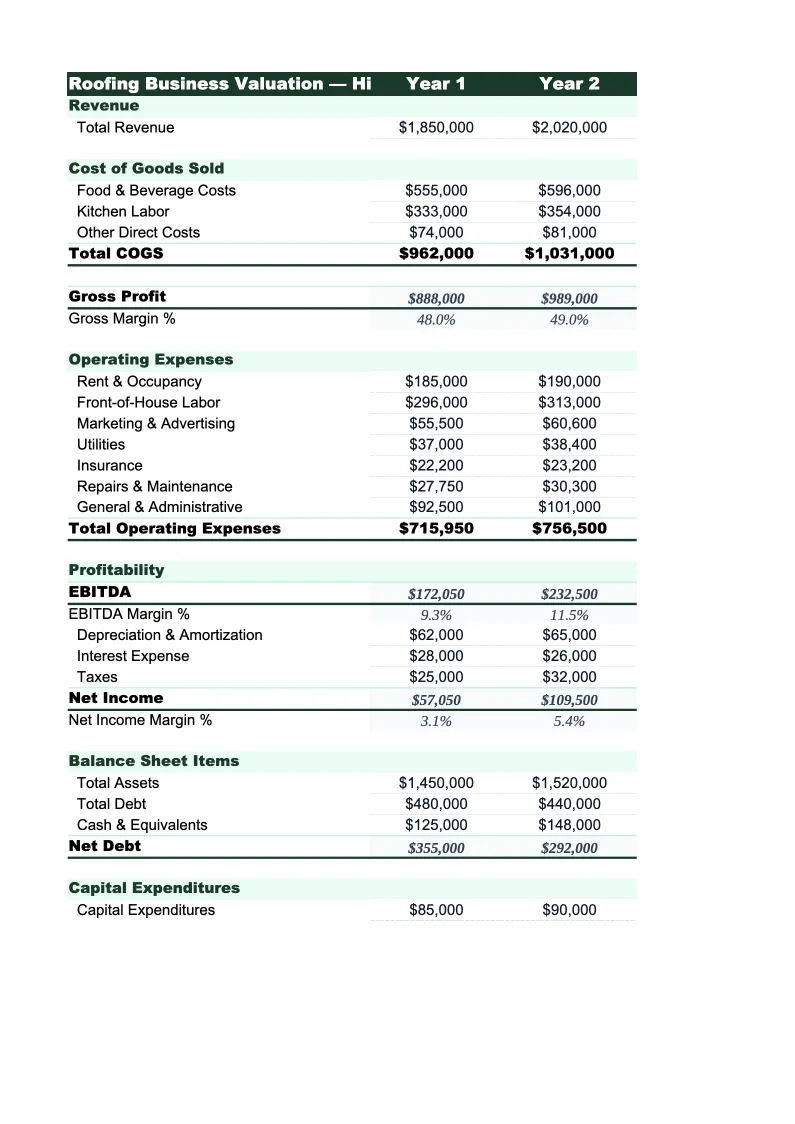
Roofing Valuation Template
Value your roofing business using SDE or EBITDA multiples, a backlog and revenue mix analysis separating storm-driven and recurring commercial work, an equipment and fleet asset approach, and a buyer-type comparison — built around the factors that residential roofing contractors, commercial roofers, and acquisition buyers actually use when pricing roofing company transactions.
What's Inside This Roofing Valuation Template
This template includes 5 worksheets, each designed for a specific part of your roofing financial workflow:
Business Inputs
The data entry foundation for the entire valuation model.
Revenue Quality Analysis
A structured breakdown of the roofing company's revenue by stability and predictability, because buyers apply very different multiples to different revenue types in roofing transactions.
Earnings Multiple Approach
Roofing business valuations apply different frameworks depending on the size of the operation and whether it functions as an owner-operated job or a managed business.
Asset-Based Approach
A floor-value calculation based on the tangible assets a buyer would be acquiring in a roofing contractor transaction.
Valuation Summary
A single-page output consolidating the earnings multiple approach and the asset-based floor into one view across conservative, base, and optimistic scenarios.
Roofing Valuation Template Features
- Revenue Quality Analysis sheet categorizing trailing revenue into four buckets — recurring commercial, relationship-driven, project-based non-storm, and storm/insurance-dependent — with a quality mix score that directly determines the applicable multiple range
- Dual earnings multiple framework covering SDE multiples for owner-operated residential contractors (2.0–3.5x) and EBITDA multiples for managed operations (3.5–5.5x), with a five-factor scoring matrix including revenue quality, owner dependency in estimating, crew retention, EMR history, and commercial relationship documentation
- Storm revenue normalization section adjusting trailing twelve-month revenue for unusually high or low weather events, preventing buyers from pricing storm windfalls as permanent recurring earnings or discounting operations unfairly in low-storm years
- Asset-Based Approach capturing vehicles, equipment trailers, boom lifts, pneumatic tool inventory, fall protection equipment, material inventory, contractor license value, and subcontractor relationship intangibles — the full tangible asset floor buyers verify in due diligence
- Workers' compensation EMR impact analysis estimating the insurance cost differential a buyer would face based on the current experience modification rate, and its effect on post-acquisition earnings and the supportable multiple
- Three-scenario Valuation Summary with individual versus strategic buyer comparison, seller-financing deal structure modeling, storm revenue normalization, and earnings multiple sensitivity table calibrated to revenue quality mix and owner dependency score
How to Use This Roofing Business Valuation Spreadsheet
Start with the Business Inputs sheet. Pull your trailing twelve-month revenue by work category from your job management software or accounting system — separating residential re-roofing, repairs, commercial work, and insurance claim revenue matters because buyers evaluate these categories differently. For the expense section, pull actual costs from your P&L; the material cost percentages and workers' comp premiums are the line items buyers scrutinize most closely. Enter owner compensation fully and accurately — salary, vehicle, health insurance, and any personal expenses running through the business. For the vehicle and equipment section, list each vehicle and piece of major equipment with year and estimated resale value; a quick search on equipment dealer sites gives reasonable estimates for most roofing equipment. Be honest about the storm revenue component — if the past year included an unusually large hail event or significant storm chasing activity, the Revenue Quality Analysis sheet has a normalization section for exactly this.
The Revenue Quality Analysis sheet requires careful, honest categorization. Go through your trailing twelve-month job list and sort each job into one of the four revenue buckets: recurring commercial maintenance, relationship-driven referral work, project-based non-storm sales, and storm or insurance-driven work. If you have commercial maintenance agreements, document them — contract copies, annual billing amounts, and renewal dates are something buyers will ask for, and having them organized before a sale saves weeks of due diligence scrambling. Calculate your current backlog: signed contracts not yet started plus estimates submitted and awaiting a decision. A documented backlog of four to eight weeks of revenue at a typical sales pace tells a buyer that the pipeline doesn't collapse when the seller steps back. Review the revenue quality mix percentage the sheet produces and compare it honestly to the multiple range — if 55% of your revenue came from a single storm season, that's information a buyer will uncover and price in regardless, and your multiple should reflect it.
Know what your roofing company is worth before you sell
Enter your revenue by work category, storm exposure, backlog, owner compensation, and equipment — and get a defensible valuation range with the earnings multiple approach, revenue quality analysis, storm normalization, and workers' comp impact that buyers use to structure their offer.
How Roofing Contractors Are Valued When They Sell
Roofing contractor valuations are more complex than most trades because revenue quality varies so dramatically within the same business. Two roofing companies each generating $2 million in annual revenue can sell at very different multiples depending on how that revenue was earned: a company with $800,000 in commercial maintenance contracts and referral-driven residential work is fundamentally more valuable than one that earned the same revenue chasing hail storms across three states. Buyers — whether individual contractors looking to acquire a book of business, commercial roofing companies acquiring market share, or private equity-backed platforms looking for geographic expansion — evaluate roofing companies first on the stability and predictability of the revenue base, and second on the operational systems that exist independent of the selling owner. Understanding this framework before beginning a sale process is the difference between a realistic negotiation and a frustrating one.
The specific variables that move a roofing company's multiple up or down are well understood by experienced roofing industry brokers and buyers. Revenue quality and storm dependency are the primary driver: a company generating 60% or more of revenue from commercial contracts, property manager relationships, and repeat residential customers will consistently command a premium over an operation that requires active door-knocking after weather events to fill the schedule. Owner dependency in estimating and sales is the second major factor — if the owner is the primary estimator, the insurance supplement negotiator, or the relationship holder for the top five commercial clients, buyers will apply a meaningful discount and often require an extended earnout tied to revenue retention. Workers' compensation history, captured in the Experience Modification Rate, has a direct financial impact: a roofing company with an EMR above 1.0 will cost a buyer more to insure post-acquisition than one with an EMR below 1.0, and buyers who understand roofing will calculate that differential and reduce what they're willing to pay. Crew and subcontractor stability matters because qualified roofing labor is genuinely scarce in most markets — a company with established crew relationships that have worked together for multiple seasons is worth more than one with constant crew turnover, and buyers will ask specifically about crew continuity as a condition of their offer.
Roofing Industry at a Glance
Financial templates built for roofing contractors — from owner-operators running residential crews to multi-crew companies handling commercial projects. Pre-loaded with materials, labor, and job-cost categories specific to the roofing industry.
Revenue Drivers
- Residential re-roofing (full replacements)
- Roof repairs and patching
- Commercial roofing projects
- Gutter installation and repair
- Insurance claim work
- Emergency repairs
Key Cost Categories
- Roofing materials (shingles, underlayment, flashing)
- Subcontractor and crew labor
- Disposal and dumpster rental
- Permit fees
- Equipment and tools
- Insurance (liability, workers comp)
- Vehicle and transportation
- Overhead and office costs
Typical Margins
Gross: 25-40% · Net: 6-15%
Seasonality
Peak season runs spring through early fall (April–October); storm events drive unpredictable surges year-round. November through March is the slow season in northern markets, though southern markets work year-round.
Key Performance Indicators
Roofing Business Valuation FAQ
More Roofing Templates
Roofing Balance Sheet Template for Excel
$29
Roofing Budget Template for Excel
$29
Roofing Business Plan Template for Excel
$39
Roofing Cash Flow Template for Excel
$29
Roofing Expense Tracker Template for Excel
$29
Roofing Financial Model Template for Excel
$29
Roofing Income Statement Template for Excel
$29
Roofing Invoice Template for Excel
$29
Roofing KPI Dashboard Template for Excel
$29
Roofing P&L Template for Excel
$29
Roofing Pro Forma Template for Excel
$29
Roofing Project Budget Template for Excel
$29
Roofing Sales Forecast Template for Excel
$29
Roofing Valuation Template
$29