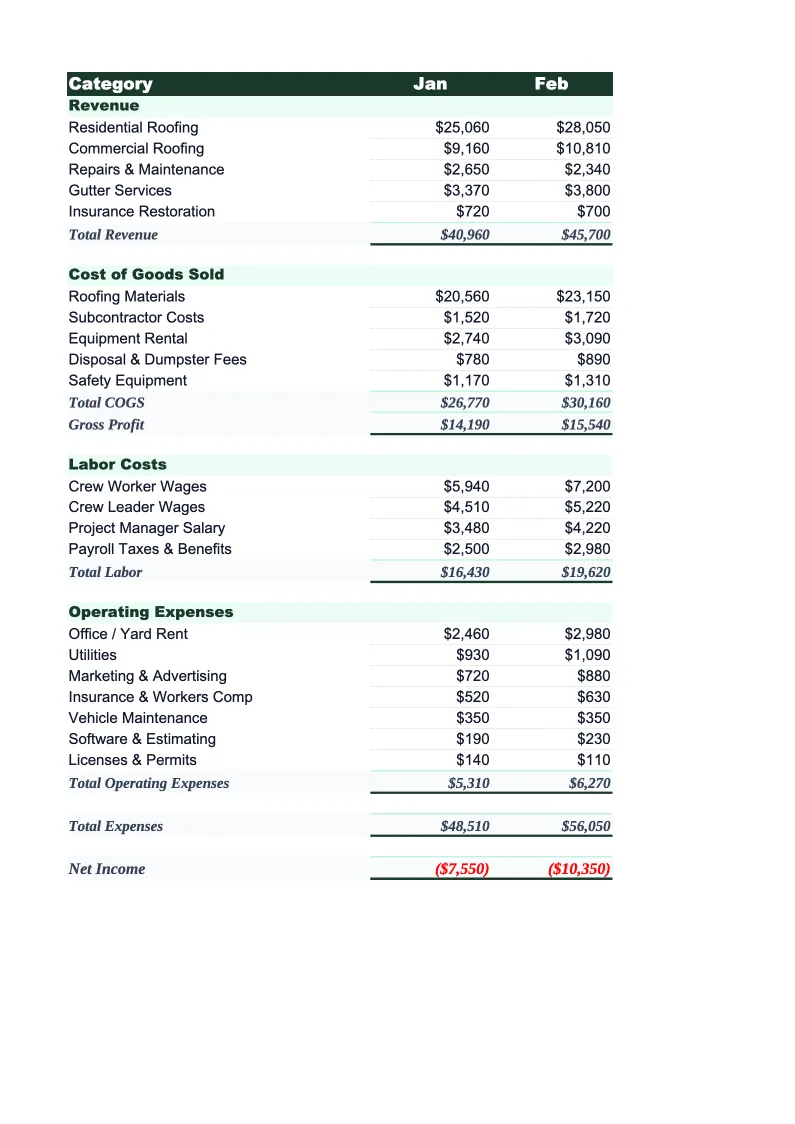
Roofing Budget Template
Plan and track your roofing company's finances with a budget template built for contractors — pre-loaded with materials, labor, and job cost categories used across the roofing industry.
What's Inside This Roofing Budget Template
This template includes 5 worksheets, each designed for a specific part of your roofing financial workflow:
Monthly Budget
The core planning worksheet where you project each month's revenue and expenses using categories specific to roofing contractors.
Annual Summary
A 12-month rollup that pulls from each monthly sheet automatically.
Budget vs Actual
Compare your planned numbers to what you actually spent each month.
Job Cost Tracker
A worksheet for tracking estimated versus actual costs on individual jobs.
Dashboard
A visual summary with pre-built charts showing revenue by job type, monthly gross margin percentage, materials cost as a percentage of revenue, and cumulative year-to-date performance.
Roofing Budget Template Features
- Revenue categories for residential, commercial, repairs, and insurance claim work
- Materials split by type: shingles, underlayment, flashing, decking, and fasteners
- Crew labor and subcontractor cost tracking with percentage-of-revenue formulas
- Job cost tracker: estimated vs. actual with variance and margin per job
- 12-month annual summary with seasonal revenue pattern visibility
- Visual dashboard with gross margin percentage and revenue by job type
How to Use This Roofing Budget Spreadsheet
Download the .xlsx file and open it in Excel or Google Sheets — no macros or add-ins needed. Start with the Monthly Budget sheet and review the pre-loaded categories. Most roofing contractors find the material and labor categories accurate to their chart of accounts, though you may want to rename a line item or two to match your bookkeeping software. If you run primarily residential work, you can hide the commercial project rows; if insurance claims are a major part of your revenue, make sure that line stays front and center.
Enter your revenue projections by job type and your expected costs for materials, labor, and overhead. If you don't have targets yet, pull your numbers from last year's records as a baseline. The Annual Summary sheet will show you how the full year shapes up across all months — pay attention to how the numbers change once you account for your slow season. Copy your monthly structure forward, adjusting projections for months you know will be heavy or light, and the budget is built.
15 minutes from download to your first roofing budget
Download the template, plug in your numbers, and see your roofing company's full financial picture — monthly budget, job cost tracking, and annual rollup included.
Why Every Roofing Contractor Needs a Budget Template
Roofing contractors face a financial structure that makes informal money management unusually risky. Revenue is project-based, meaning it arrives in chunks tied to job completion rather than in predictable monthly installments. Material costs — shingles, underlayment, and flashing — move with commodity prices and can spike after a storm event right when demand is highest. And net margins in roofing typically run 6–15%, which means a few material overruns or slow months can quickly erase what looked like a strong quarter. Without a budget, most of that risk is invisible until the bank account says otherwise.
A roofing budget that actually works is built around the categories that drive your costs, not generic small-business categories. Materials should be split by type because shingles are your largest variable cost and need to be tracked separately from smaller materials to spot price increases. Labor needs to separate crew payroll from subcontractor costs, since they behave differently — your crew is a fixed cost most weeks, while subs scale with job volume. Overhead should include insurance (which is substantial in roofing, given liability and workers' comp rates), vehicle costs, and equipment maintenance, all tracked monthly so you can see if any of these lines are growing out of proportion to revenue.
Roofing Industry at a Glance
Financial templates built for roofing contractors — from owner-operators running residential crews to multi-crew companies handling commercial projects. Pre-loaded with materials, labor, and job-cost categories specific to the roofing industry.
Revenue Drivers
- Residential re-roofing (full replacements)
- Roof repairs and patching
- Commercial roofing projects
- Gutter installation and repair
- Insurance claim work
- Emergency repairs
Key Cost Categories
- Roofing materials (shingles, underlayment, flashing)
- Subcontractor and crew labor
- Disposal and dumpster rental
- Permit fees
- Equipment and tools
- Insurance (liability, workers comp)
- Vehicle and transportation
- Overhead and office costs
Typical Margins
Gross: 25-40% · Net: 6-15%
Seasonality
Peak season runs spring through early fall (April–October); storm events drive unpredictable surges year-round. November through March is the slow season in northern markets, though southern markets work year-round.
Key Performance Indicators
Roofing Budget Template FAQ
More Roofing Templates
Roofing Balance Sheet Template for Excel
$29
Roofing Business Plan Template for Excel
$39
Roofing Cash Flow Template for Excel
$29
Roofing Expense Tracker Template for Excel
$29
Roofing Financial Model Template for Excel
$29
Roofing Income Statement Template for Excel
$29
Roofing Invoice Template for Excel
$29
Roofing KPI Dashboard Template for Excel
$29
Roofing P&L Template for Excel
$29
Roofing Pro Forma Template for Excel
$29
Roofing Project Budget Template for Excel
$29
Roofing Sales Forecast Template for Excel
$29
Roofing Business Valuation Template for Excel
$29
Roofing Budget Template
$29