Roofing Pro Forma Template
Project a roofing company's revenue, job costs, overhead, and net income across 5 years — with pre-built formulas for crew capacity, average job size, seasonal revenue patterns, and break-even analysis.
What's Inside This Roofing Pro Forma Template
This template includes 7 worksheets, each designed for a specific part of your roofing financial workflow:
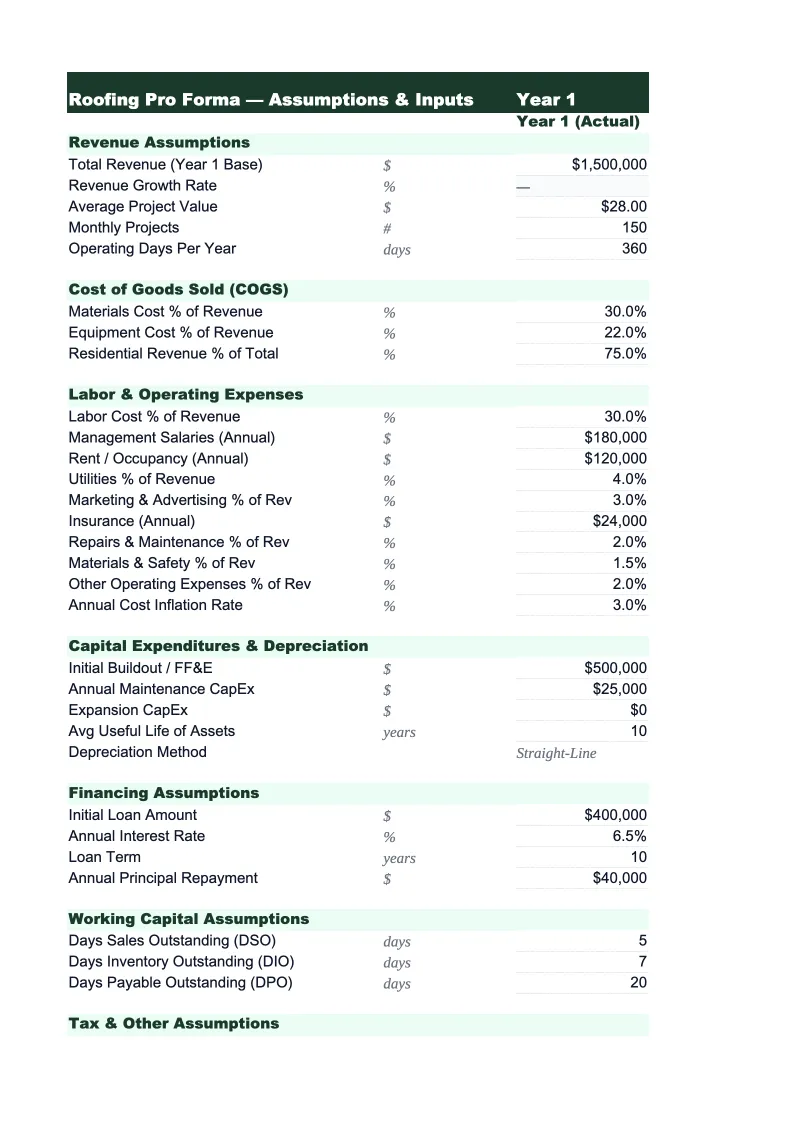
Assumptions
The control panel for the entire model.
Revenue Projections
Projects total roofing revenue by month for year one and annually through year five.
Job Cost Model
Breaks out direct project costs by the categories that determine gross margin on a roofing job: roofing materials (shingles, underlayment, flashing, fasteners, ice and water shield), subcontractor and crew labor, disposal and dumpster rental, permit fees, and equipment and tool costs.
Overhead & G&A
Covers all costs that don't get allocated to a specific job: office and shop rent, sales and estimating staff salaries, office administration, vehicles and fuel for non-billable trucks, general liability and workers' compensation insurance (typically 15–25% of labor revenue for roofing), bonding premiums, accounting and legal fees, software subscriptions (CRM, estimating software like EagleView or AccuLynx), and marketing and lead generation costs.
5-Year P&L Summary
An annual summary showing total revenue, total job costs, gross profit, gross margin percentage, total overhead, EBITDA, and net income side by side for each of the five projected years.
Cash Flow Projection
A monthly cash flow model for year one and an annual summary through year five, built for the cash patterns specific to roofing.
Break-Even Analysis
Calculates the annual revenue a roofing company needs to cover all fixed and variable costs.
Roofing Pro Forma Template Features
- Revenue model by service type (residential replacement, commercial, repairs, gutters, emergency) with average job size and seasonal factors
- Job cost breakdown by materials, crew labor, disposal, permits, and equipment as % of job revenue
- Overhead model separating fixed and variable costs with overhead-as-percent-of-revenue calculation
- Monthly cash flow with storm surge and insurance claim timing adjustments
- 5-year annual P&L summary with gross margin, EBITDA, and net margin by year
- Break-even analysis showing minimum revenue and jobs-per-year required to cover all costs
How to Use This Roofing Pro Forma Spreadsheet
Start with the Assumptions sheet. Enter your company's current crew count, average jobs per crew per week at full capacity, and your average job size for each service category — residential replacement is typically $8,000–$18,000 per job depending on roof size and market, while commercial roofing runs much higher and repairs average $500–$2,500. Set your close rate on estimates (most roofing companies close 35–55% of leads that result in an estimate visit), and enter the seasonal split that matches your geography. If you operate in a market with hard winters, your Q1 revenue may be 20–30% of Q3. If you're in the Sun Belt, apply a smaller seasonal factor.
Once the assumptions look right, review the Job Cost Model sheet and adjust material and labor percentages to match your actual job history. The default percentages are industry averages — materials typically run 35–45% of job revenue for a full replacement, crew labor runs 15–25%, and disposal plus permits add another 5–8%. But these numbers shift based on your material tier, whether you use subcontractors or in-house crews, and your local permitting fees. Enter your real numbers here before using the model in any presentation. Then review the Overhead & G&A sheet and enter your actual fixed costs: your trucks, your insurance premiums (workers' comp rates for roofing are among the highest of any trade, often $20–$40 per $100 of labor), and your office and sales costs.
From download to lender-ready projections in under an hour
Enter your crew count, average job sizes, and cost structure — the model builds your 5-year revenue, gross margin, overhead, and cash flow analysis automatically.
Why Every Roofing Company Needs a Pro Forma
Roofing is a high-revenue-per-job trade where the difference between a profitable company and one that's always short on cash often comes down to two numbers: gross margin on jobs and whether overhead stays proportional to revenue. The industry's average net margin of 6–15% means there isn't much room for surprises. A roofing company doing $1.5 million in annual revenue with 30% gross margins and 22% overhead earns about $120,000 in pre-tax profit. Increase overhead to 26% — a few extra trucks, a salesperson who underperforms, or a slow season that doesn't reduce fixed costs — and that same company breaks even or loses money. A pro forma is the tool that shows you, in advance, how thin those margins are and what revenue you need to support the cost structure you're building.
The cost structure of a roofing company has a few levers that matter more than everything else. Workers' compensation insurance is a major cost driver — roofing is one of the highest-risk trades, and WC premiums can run $20–$40 per $100 of direct labor wages, which means a crew with $50,000 in annual wages costs $10,000–$20,000 in WC premiums alone. General liability insurance is a second major overhead item, often running 3–6% of revenue for residential contractors. The combination means a roofing company's insurance burden can be 8–12% of revenue before touching a single shingle. Any pro forma that doesn't model insurance carefully will underestimate the true cost of growth — because every additional crew member adds another insurance cost layer that scales at a faster rate than the revenue they generate in their first year.
Roofing Industry at a Glance
Financial templates built for roofing contractors — from owner-operators running residential crews to multi-crew companies handling commercial projects. Pre-loaded with materials, labor, and job-cost categories specific to the roofing industry.
Revenue Drivers
- Residential re-roofing (full replacements)
- Roof repairs and patching
- Commercial roofing projects
- Gutter installation and repair
- Insurance claim work
- Emergency repairs
Key Cost Categories
- Roofing materials (shingles, underlayment, flashing)
- Subcontractor and crew labor
- Disposal and dumpster rental
- Permit fees
- Equipment and tools
- Insurance (liability, workers comp)
- Vehicle and transportation
- Overhead and office costs
Typical Margins
Gross: 25-40% · Net: 6-15%
Seasonality
Peak season runs spring through early fall (April–October); storm events drive unpredictable surges year-round. November through March is the slow season in northern markets, though southern markets work year-round.
Key Performance Indicators
Roofing Pro Forma Template FAQ
More Roofing Templates
Roofing Balance Sheet Template for Excel
$29
Roofing Budget Template for Excel
$29
Roofing Business Plan Template for Excel
$39
Roofing Cash Flow Template for Excel
$29
Roofing Expense Tracker Template for Excel
$29
Roofing Financial Model Template for Excel
$29
Roofing Income Statement Template for Excel
$29
Roofing Invoice Template for Excel
$29
Roofing KPI Dashboard Template for Excel
$29
Roofing P&L Template for Excel
$29
Roofing Project Budget Template for Excel
$29
Roofing Sales Forecast Template for Excel
$29
Roofing Business Valuation Template for Excel
$29
Roofing Pro Forma Template
$29