Wedding Planning Business Plan Template
Build a complete financial roadmap for your wedding planning business with startup costs, wedding booking assumptions, and 3-year P&L projections — pre-built for full-service planning, month-of coordination, or day-of management.
What's Inside This Wedding Planning Business Plan Template
This template includes 5 worksheets, each designed for a specific part of your wedding planning financial workflow:
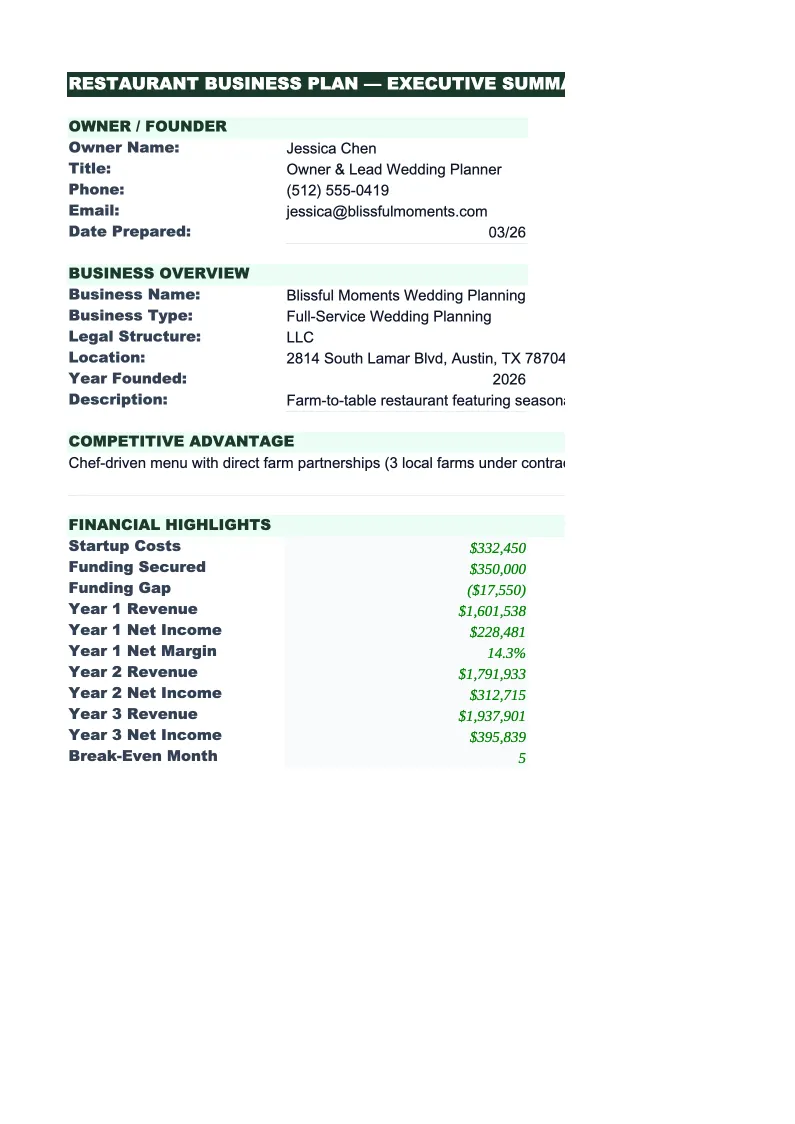
Executive Summary
A one-page overview of your wedding planning business showing your specializations (full planning, month-of coordination, day-of management, destination weddings), target market (budget-conscious couples, luxury weddings, specific styles), and key financial metrics.
Startup Costs & Funding
A detailed tracker for your initial investment including business licensing and permits, website and online portfolio hosting, branding and marketing materials, event planning software (planning tools, client management, contracts), portfolio shoots and samples, business insurance and liability bonding, networking events and vendor relationships, and working capital.
Revenue Forecast
Projects monthly revenue based on number of weddings booked, average wedding planning fee, and service type.
Projected P&L
Annual and monthly profit & loss statement showing revenue, cost of goods sold (freelance coordinator fees, sample styling shoots, proposal materials, vendor commissions/rebates), gross profit, and operating expenses (software subscriptions, website hosting, insurance, marketing, client entertainment, professional development, travel).
Dashboard
A visual overview of key metrics including total revenue, profit, weddings booked per month, average revenue per wedding, customer lifetime value, break-even analysis, and profitability timeline.
Wedding Planning Business Plan Features
- Startup costs for licensing, website, branding, software, and working capital
- Revenue model based on weddings booked, service type, and seasonal booking patterns
- Seasonal ramp schedule—wedding planners book 50% of mature capacity in year one
- Gross margin tracking including coordinator costs and vendor relationships
- 3-year P&L with EBITDA and net margin showing path to profitability
- Break-even analysis showing number of weddings and fees needed to cover fixed costs
How to Use This Business Plan Spreadsheet
Start with the Startup Costs sheet and list every expense: business registration and licensing ($200–$500), website and online portfolio ($500–$2,000), branding (logo, business cards, templates—$500–$2,000), event planning software like Airtable, HoneyBook, or Asana ($30–$150/month), portfolio shoot and sample designs ($1,000–$3,000 if doing your own styling, $2,000–$5,000 if hiring a photographer), business liability insurance ($500–$1,500/year), initial marketing and networking ($1,000–$2,000), and 3 months working capital ($2,000–$4,000). Most wedding planning startups launch with $8,000–$20,000. If working from home and leveraging personal photography or design skills, you can launch for under $10K. This takes 30 minutes and shows you exactly how much capital you need.
Move to the Revenue Forecast sheet and set your assumptions: how many weddings you'll book in month one (realistically 0–1 for a new planner), how you'll ramp to mature capacity (1–2 per month by month 6, 3–4 per month by month 12), and your average revenue per wedding by service type. Full-service wedding planning: $3,500–$8,000+. Month-of coordination: $1,500–$3,000. Day-of management: $800–$2,000. Destination wedding premium: add 25–50%. Start with service types you specialize in or are comfortable offering. Wedding planning revenue is heavily seasonal: 60–70% of annual revenue books January–May for summer weddings; 20–30% books September–October for fall/winter weddings. Model this seasonality in your forecast.
From launch to investor-ready business plan in one sitting
Enter your startup costs, service types, average wedding fee, and booking targets—the model projects your 3-year revenue, profitability, and cash runway automatically.
Why Wedding Planners Need a Business Plan
Wedding planning is a service business with high margins but lumpy revenue. Unlike event planning for corporate clients, wedding planning is heavily seasonal: 60–70% of bookings happen January–March for summer weddings, with a secondary peak in September–October for fall/winter events. This creates significant cash flow variation. Month one might have $0 revenue; month 3 might have $15,000 from three booked weddings (even though you won't perform the services and get paid until June–August). Your business plan must account for this: you need 6–8 months of working capital to cover overhead during the lean booking months, even though you'll have significant revenue in the peak season.
The second critical decision is service model: full-service planning ($5,000–$12,000+), month-of coordination ($1,500–$3,500), day-of management ($800–$2,000), or a hybrid mix. Full planning has the highest fee but requires 8–15 hours per wedding (more work, higher gross cost); day-of management is lower fee but only 4–8 hours (higher margins per hour). Most successful planners offer all three and let couples choose based on their needs. A planner doing 4 full-service weddings per month at $6,000 average generates $24,000/month revenue; a planner doing 6 day-of weddings at $1,500 generates $9,000/month. Build a mix that maximizes profit and fits your capacity and preferences.
Wedding Planning Industry at a Glance
Financial templates built for wedding planners and coordinators — from day-of coordinators to full-service agencies. Pre-loaded with fee structures, payment milestone tracking, and vendor pass-through categories.
Revenue Drivers
- Full-service planning fees
- Day-of coordination packages
- Vendor referral commissions
- Vendor pass-through markups
- Add-on services (rehearsal dinner, elopements)
Key Cost Categories
- Assistant coordinator wages
- Contractor/sub-planner fees
- Vendor pass-through costs
- Marketing (Knot/WeddingWire listings)
- Planning software subscriptions
- Professional liability insurance
- Transportation and mileage
Typical Margins
Gross: 55-70% · Net: 15-25%
Seasonality
Peak weddings in May-June (spring) and September-October (fall). January-February slowest for events but highest for new bookings from holiday-engaged couples.
Key Performance Indicators
Wedding Planning Business Plan FAQ
More Wedding Planning Templates
Wedding Planning Balance Sheet Template for Excel
$29
Wedding Planning Budget Template for Excel
$29
Wedding Planning Cash Flow Template for Excel
$29
Wedding Planning Expense Tracker Template for Excel
$29
Wedding Planning Financial Model Template for Excel
$29
Wedding Planning Income Statement Template for Excel
$29
Wedding Planning Invoice Template for Excel
$29
Wedding Planner KPI Dashboard Template for Excel
$29
Wedding Planner P&L Template for Excel
$29
Wedding Planning Pro Forma Template for Excel
$29
Wedding Planning Project Budget Template for Excel
$29
Wedding Planning Sales Forecast Template for Excel
$29
Wedding Planning Business Valuation Template for Excel
$29
More Business Plan Templates
Wedding Planning Business Plan Template
$39