Wedding Planning Income Statement Template
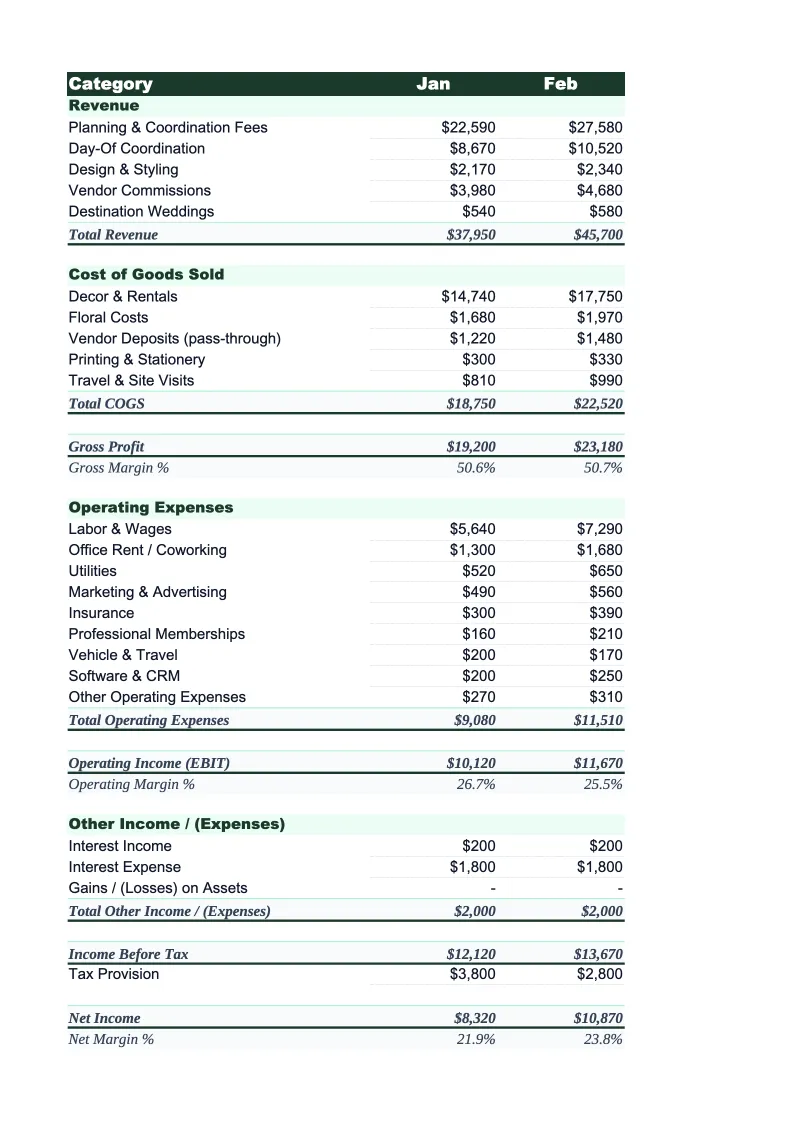
Track your wedding planning business's revenue and expenses with an income statement built around how planners actually earn — planning fees, vendor pass-throughs, commissions, and coordination packages — so you know your real margin per event.
What's Inside This Wedding Planning Income Statement Template
This template includes 4 worksheets, each designed for a specific part of your wedding planning financial workflow:
Monthly Income Statement
The core worksheet where you record each month's revenue and expenses using wedding planning-specific line items.
Annual Summary
A 12-month rollup that pulls data from each monthly sheet automatically and presents your full year at a glance.
Year-over-Year Comparison
Compare this year's income statement line by line against last year's actuals.
Dashboard
A single-page visual summary with pre-built charts covering revenue by service type, direct event costs versus gross profit, and net income trend across the calendar year.
Wedding Planning Income Statement Template Features
- Revenue lines for planning fees, day-of coordination, vendor commissions, and pass-through markups
- COGS section for assistant wages, sub-planner fees, and direct event costs
- Marketing expense tracking for The Knot, WeddingWire, and social ad spend
- Gross margin per event and net margin auto-calculations
- 12-month rollup with year-over-year comparison to track growth across booking seasons
- Dashboard with revenue-by-service breakdown and seasonal income trend chart
How to Use This Wedding Planning Income Statement Spreadsheet
Getting started takes about 15 minutes. Download the .xlsx file and open it in Excel or Google Sheets — no plugins or macros needed. Open the Monthly Income Statement sheet and review the pre-loaded revenue and expense categories. Most wedding planners keep the core structure and adjust a few line items to match their specific service mix — for example, adding a destination wedding premium line, removing vendor commissions if you don't charge them, or splitting day-of coordination into tiered packages.
Once the categories reflect your business, enter revenue and expenses for the current month. If you don't track in real time, pull your bank statements and credit card records for the month and work through each category. The COGS section is where the detail matters most for planners — enter assistant wages, any sub-planner or contractor fees, and the actual cost of vendor services you passed through to clients. The formulas calculate gross profit, operating income, and net income automatically. Repeat the process as each month closes.
15 minutes from download to your first income statement
Download the template, enter your planning fees and event costs, and see your wedding business's gross margin, net income, and revenue per wedding in one place.
Why Every Wedding Planner Needs an Income Statement
Wedding planning sits in an unusual financial position: most of the revenue that flows through a planning business isn't actually the planner's to keep. Vendor pass-throughs, florist payments, and catering deposits can make gross revenue look large while actual planning income — the fees you set and keep — is much smaller. A proper income statement that separates planning service revenue from pass-through activity, and direct event costs from operating overhead, is the only way to see what the business actually earns. Planners who rely on bank balance to judge profitability often underestimate how much of that balance belongs to vendors, not to them.
The margins that define a healthy wedding planning business are gross margin (revenue minus direct event costs like assistant pay and vendor pass-throughs) and net margin after all operating expenses. Gross margin in wedding planning typically runs between 55% and 70%, with full-service planners on the lower end — where the complexity justifies higher fees but also more assistant hours — and day-of coordinators on the higher end where direct costs are minimal. Net margin after marketing, software, insurance, and owner compensation usually falls between 15% and 25%. If your net margin is consistently below 15%, the culprit is almost always either marketing spend that isn't converting to bookings or pricing that hasn't kept pace with the cost of doing business.
Wedding Planning Industry at a Glance
Financial templates built for wedding planners and coordinators — from day-of coordinators to full-service agencies. Pre-loaded with fee structures, payment milestone tracking, and vendor pass-through categories.
Revenue Drivers
- Full-service planning fees
- Day-of coordination packages
- Vendor referral commissions
- Vendor pass-through markups
- Add-on services (rehearsal dinner, elopements)
Key Cost Categories
- Assistant coordinator wages
- Contractor/sub-planner fees
- Vendor pass-through costs
- Marketing (Knot/WeddingWire listings)
- Planning software subscriptions
- Professional liability insurance
- Transportation and mileage
Typical Margins
Gross: 55-70% · Net: 15-25%
Seasonality
Peak weddings in May-June (spring) and September-October (fall). January-February slowest for events but highest for new bookings from holiday-engaged couples.
Key Performance Indicators
Wedding Planning Income Statement Template FAQ
More Wedding Planning Templates
Wedding Planning Balance Sheet Template for Excel
$29
Wedding Planning Budget Template for Excel
$29
Wedding Planning Business Plan Template for Excel
$39
Wedding Planning Cash Flow Template for Excel
$29
Wedding Planning Expense Tracker Template for Excel
$29
Wedding Planning Financial Model Template for Excel
$29
Wedding Planning Invoice Template for Excel
$29
Wedding Planner KPI Dashboard Template for Excel
$29
Wedding Planner P&L Template for Excel
$29
Wedding Planning Pro Forma Template for Excel
$29
Wedding Planning Project Budget Template for Excel
$29
Wedding Planning Sales Forecast Template for Excel
$29
Wedding Planning Business Valuation Template for Excel
$29
More Income Statement Templates
Accounting Firm Income Statement Template for Excel
$29
Auto Repair Income Statement Template for Excel
$29
Car Wash Income Statement Template for Excel
$29
Church Income Statement Template for Excel
$29
Cleaning Service Income Statement Template for Excel
$29
Coffee Shop Income Statement Template for Excel
$29
Wedding Planning Income Statement Template
$29