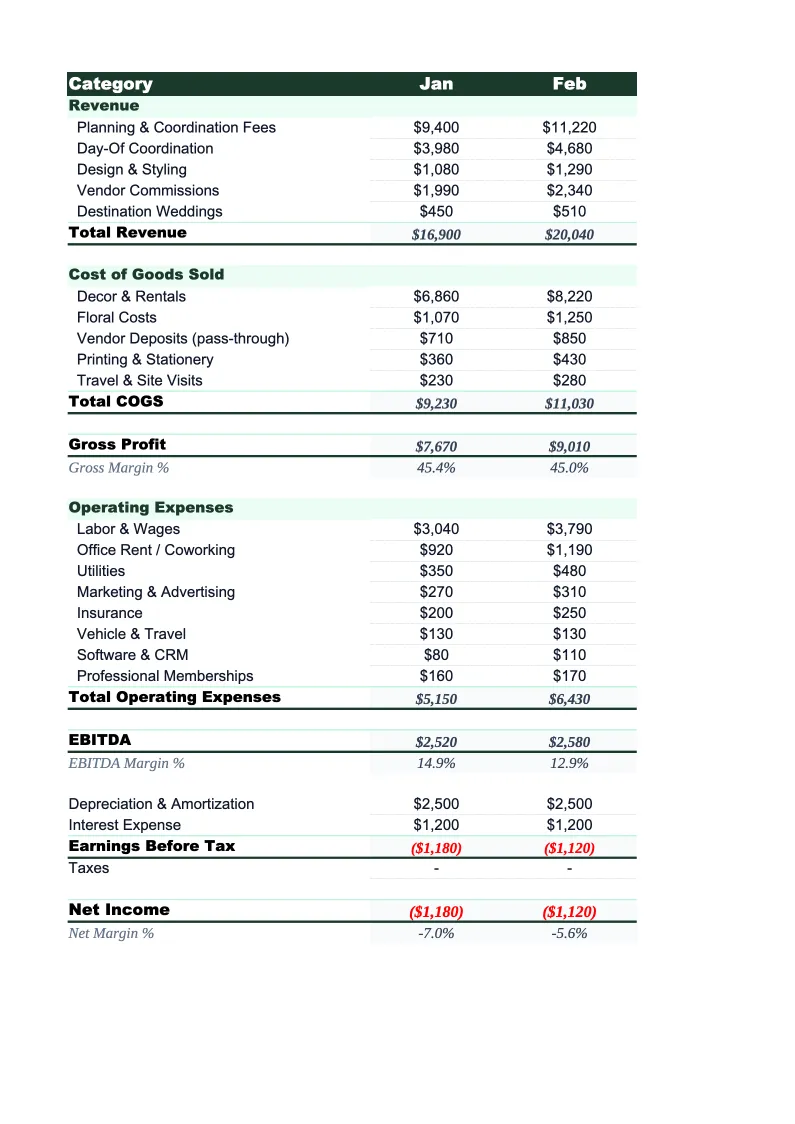
Wedding Planning P&L Template
Track your wedding planning business's revenue, vendor pass-throughs, and operating expenses with a P&L built for planning firms — not a generic spreadsheet that lumps your fees and client reimbursements together.
What's Inside This Wedding Planner P&L Template
This template includes 4 worksheets, each designed for a specific part of your wedding planning financial workflow:
Monthly P&L
The core worksheet where you record each month's revenue and expenses for your wedding planning business.
Annual P&L
A full 12-month view that pulls data from the Monthly P&L sheet automatically, with no additional data entry required.
Event Profitability
A per-wedding breakdown that tracks the revenue, direct costs, and gross profit for each event you complete.
Dashboard
A one-page summary with charts and key financial metrics for quick review or client-facing presentations.
Wedding Planner P&L Template Features
- Revenue split between planning fees, day-of coordination, and vendor pass-through markups
- Event Profitability sheet tracking gross margin per individual wedding
- Sub-planner and assistant contractor costs tracked as direct cost of services
- Gross margin percentage calculated automatically each month
- Marketing spend tracking for Knot, WeddingWire, and social advertising
- Annual 12-month view with seasonal revenue pattern visibility
How to Use This Wedding Planning P&L Spreadsheet
Download the .xlsx file and open it in Excel or Google Sheets — no macros or plugins needed. Start with the Monthly P&L sheet and review the pre-loaded revenue and expense categories. Most wedding planning businesses can use 80–90% of the categories as-is. The main customization is on the revenue side: rename the package tiers to match your actual service offerings (full-service, partial planning, day-of, elopement) and add any income categories specific to your business model, such as destination wedding premiums or rehearsal dinner coordination fees. Initial setup takes about 15–20 minutes.
After each month, enter your revenue by source and your actual expenses by category. For revenue, pull from your invoicing tool or accounting software. For direct costs like sub-planner fees, match them to the events they supported using the Event Profitability sheet — enter each completed wedding's fee, the hours or flat cost of any assistants, and any vendor pass-through handling. For monthly operating expenses like software subscriptions, marketing spend, and insurance, enter those in the Monthly P&L sheet. The formulas calculate gross profit and net profit automatically.
15 minutes from download to your first P&L
Download the template, enter last month's fees and expenses, and see your wedding planning business's gross margin and net profit — with per-event profitability calculated automatically.
Why Every Wedding Planning Business Needs a P&L Template
Wedding planning businesses have a financial structure that doesn't fit generic service business templates. Revenue comes from at least two distinct sources — direct planning fees earned for your time and expertise, and vendor pass-throughs or commissions that flow through your business as a function of client relationships. Treating these as a single revenue line hides your actual service margin. A wedding planner billing a client $8,000 for full-service planning and passing through $40,000 in vendor costs isn't a $48,000 revenue business — understanding the difference between those two streams is the foundation of sound financial management for this industry.
Gross margins in wedding planning typically run 55–70% on service fees, but the number that matters most for profitability is the net margin after all operating costs. With net margins typically landing between 15–25%, a well-run planning firm can be quite profitable — but those margins are easy to erode through underpriced packages, overuse of sub-planners without adequate markup, and marketing spend that doesn't convert to bookings. The Event Profitability sheet in this template addresses the first issue directly: tracking gross margin per wedding reveals whether certain package types (often day-of coordination) are priced below what they actually cost to deliver when you account for the full time investment.
Wedding Planning Industry at a Glance
Financial templates built for wedding planners and coordinators — from day-of coordinators to full-service agencies. Pre-loaded with fee structures, payment milestone tracking, and vendor pass-through categories.
Revenue Drivers
- Full-service planning fees
- Day-of coordination packages
- Vendor referral commissions
- Vendor pass-through markups
- Add-on services (rehearsal dinner, elopements)
Key Cost Categories
- Assistant coordinator wages
- Contractor/sub-planner fees
- Vendor pass-through costs
- Marketing (Knot/WeddingWire listings)
- Planning software subscriptions
- Professional liability insurance
- Transportation and mileage
Typical Margins
Gross: 55-70% · Net: 15-25%
Seasonality
Peak weddings in May-June (spring) and September-October (fall). January-February slowest for events but highest for new bookings from holiday-engaged couples.
Key Performance Indicators
Wedding Planner P&L Template FAQ
More Wedding Planning Templates
Wedding Planning Balance Sheet Template for Excel
$29
Wedding Planning Budget Template for Excel
$29
Wedding Planning Business Plan Template for Excel
$39
Wedding Planning Cash Flow Template for Excel
$29
Wedding Planning Expense Tracker Template for Excel
$29
Wedding Planning Financial Model Template for Excel
$29
Wedding Planning Income Statement Template for Excel
$29
Wedding Planning Invoice Template for Excel
$29
Wedding Planner KPI Dashboard Template for Excel
$29
Wedding Planning Pro Forma Template for Excel
$29
Wedding Planning Project Budget Template for Excel
$29
Wedding Planning Sales Forecast Template for Excel
$29
Wedding Planning Business Valuation Template for Excel
$29
Wedding Planning P&L Template
$29