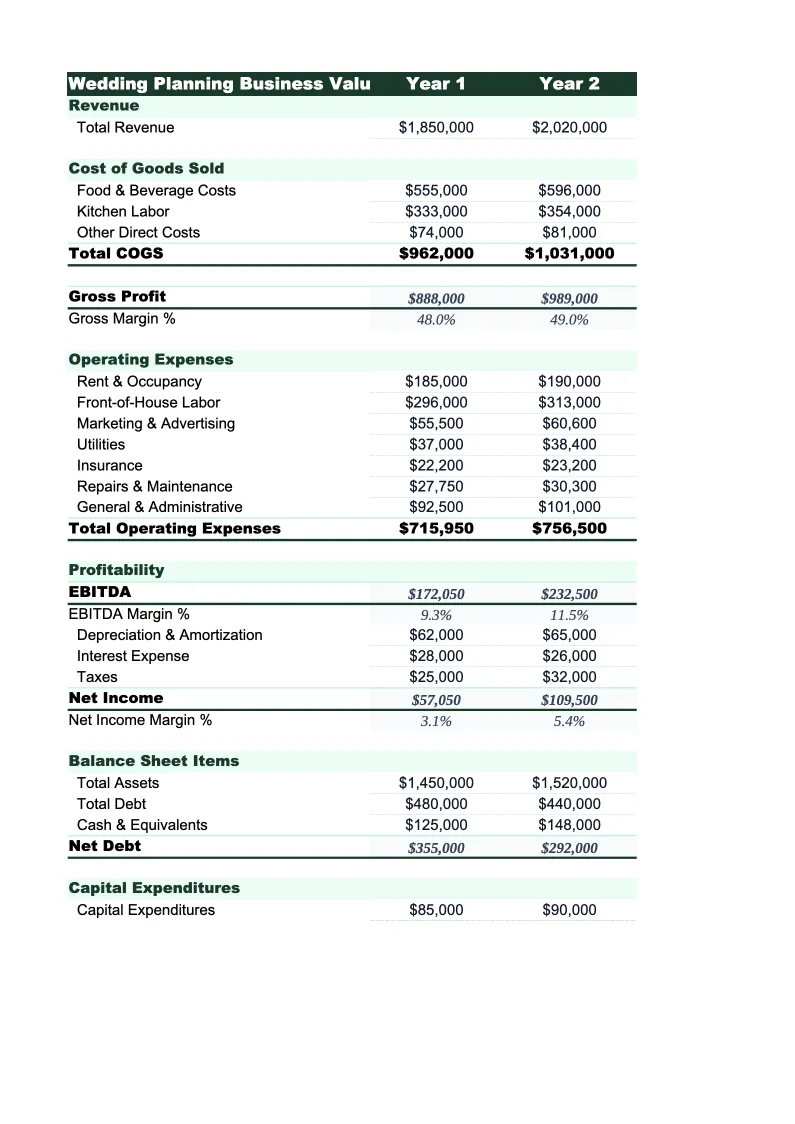
Wedding Planning Valuation Template
Calculate what your wedding planning business is worth using SDE multiples, revenue multiples, intangible asset scoring for your referral network and brand — all in one structured spreadsheet built for planners and coordinators.
What's Inside This Wedding Planning Valuation Template
This template includes 5 worksheets, each designed for a specific part of your wedding planning financial workflow:
Business Inputs
The foundation sheet where you enter three years of financial and operational data to drive every valuation method in the template. Revenue inputs are organized by service type: full-service planning fees (broken out by package tier if you offer multiple), day-of and month-of coordination packages, partial planning or design-only engagements, vendor referral commissions received, and vendor pass-through revenue with corresponding pass-through costs entered separately so gross margin per revenue stream is calculated correctly. Expense inputs cover all operating costs: assistant and sub-planner wages and contractor fees, office and studio rent if applicable, professional liability and business insurance, marketing and directory listing costs (Knot, WeddingWire, Instagram advertising), planning software subscriptions, transportation and mileage, continuing education and industry association fees, and owner compensation. The template separates owner compensation from operating profit because wedding planning businesses are almost always owner-operated small businesses where the SDE (seller's discretionary earnings) calculation requires adding back owner salary, personal benefits, and non-recurring owner expenses to normalize earnings for a potential buyer. Operational metrics include total weddings booked per year, average contract value by service tier, booking lead time (months from inquiry to contract), referral rate (percentage of bookings sourced from past client referrals versus paid directories or social media), and current pipeline — confirmed bookings and their contract values for the next 12–18 months.
SDE & Income Approach
The primary valuation method for owner-operated wedding planning businesses, built around seller's discretionary earnings — the true economic benefit a single full-time owner-operator derives from the business, which is what buyers of small service businesses actually pay multiples on. The SDE calculation starts with net income from the Business Inputs sheet, then adds back owner salary and payroll taxes, owner health and retirement benefits charged to the business, personal vehicle expenses and any personal expenses run through the business, depreciation and amortization, non-recurring expenses (legal fees, equipment purchases, COVID-period disruptions), and interest expense on any business debt. The resulting SDE represents what the business puts in an owner-operator's pocket annually. Industry SDE multiples for wedding and event planning businesses typically range from 1.5x to 3.5x, with the multiple driven by business size, client concentration, staff depth, contract pipeline visibility, and how owner-dependent the business is — a firm with a trained associate planner who handles client communication independently commands a higher multiple than one where the owner is the only planner and every client relationship is personal. The template applies a multiple range with a scoring tool that adjusts the applicable multiple up or down based on specific risk and value factors. A discounted cash flow section projects three years of earnings based on your current trajectory and applies a terminal value, giving you an income-based reference point to compare against the multiple-based estimate.
Market Multiples
A market approach analysis applying revenue multiples and EBITDA multiples observed in comparable business sale transactions for wedding and event planning firms. Wedding planning businesses at the smaller end (under $300K annual revenue) trade primarily on SDE multiples because EBITDA is minimal after owner compensation, but mid-sized and larger firms with multiple planners on staff trade on revenue and EBITDA multiples that are more comparable to professional service firm transaction data. The revenue multiple section applies a range of 0.4x to 1.2x annual revenue, with the applicable multiple driven by factors including revenue per wedding (higher revenue per event indicates premium positioning), gross margin percentage (55–70% is typical for planning-fee-focused firms; lower margins indicate heavy vendor pass-through activity that is not recurring), and contract backlog as a percentage of annual revenue. A firm entering a sale with 60–80% of next year's revenue already under signed contract is worth meaningfully more than one with an empty pipeline, because the buyer's primary risk — revenue continuity during transition — is already mitigated. The EBITDA multiple section is most relevant for planning firms with $500K+ in revenue and at least one full-time non-owner planner, where the business has demonstrably moved beyond pure owner-operator dependency. Comparable transaction multiples for small professional service firms in the events and hospitality sector have historically ranged from 3x to 6x EBITDA. The sheet calculates your current EBITDA and applies the range so you can see where your business falls under the market approach.
Intangible Asset Assessment
A scoring and valuation framework for the intangible assets that represent the most meaningful value in a wedding planning business — assets that don't appear on a balance sheet but drive the premium buyers pay above the underlying cash flow. Wedding planning is an extreme reputation-and-referral business: a planner with ten years of relationships with top photographers, florists, caterers, and venues in their market has an asset that took a decade to build and cannot be replicated by a buyer starting from scratch. The referral network score evaluates the depth and transferability of vendor relationships across five categories: preferred vendor status with category-leading vendors (highest value, especially with venues), reciprocal referral relationships with photographers and other non-competing vendors, direct inquiry referrals from past clients, venue recommendation referral relationships where venue coordinators recommend the planner to newly engaged couples, and listing visibility on high-traffic platforms. The brand and reputation score evaluates the online review profile across Google, WeddingWire, The Knot, and Yelp including review count and average rating, social media following and engagement rate on Instagram which is the primary discovery platform for wedding vendors, any editorial features in regional wedding publications or vendor awards, and website domain authority and organic search visibility for local wedding planner keyword searches. The client database section quantifies the active client list (weddings booked but not yet occurred), the past client list available for referral solicitation, and the inquiry database of couples who contacted the business but did not book. Each asset category receives a score that feeds a total intangible asset premium adjustment applied to the income and market approach valuations.
Valuation Summary
A single-page output consolidating the SDE income approach, market multiples approach, and intangible asset assessment into a weighted average valuation range and central estimate. Three valuation methods are presented in a side-by-side summary: the SDE capitalization value, the revenue multiple value, and the EBITDA multiple value where applicable. Each method produces a low, central, and high estimate. Default weighting applies the most weight to the SDE approach for businesses under $400K revenue and shifts weight toward the market multiples approach for larger multi-planner firms, but the weights are fully adjustable to reflect the specific circumstances of your valuation. The intangible asset premium calculated in the previous sheet is presented as an additive adjustment to the blended base valuation, with a breakdown of which intangible asset categories are driving the premium — a planner with a dominant referral network and a 4.9-star 200-review profile commands a meaningful premium over a planner with equivalent cash flow but limited digital presence or vendor relationships. A business risk assessment section presents five key factors that buyers and lenders evaluate when assessing transition risk: owner dependency (how much business depends on the current owner's personal relationships), contract pipeline coverage (percentage of next twelve months already under signed contract), geographic concentration (whether the business operates in a single market or has expanded across multiple cities or regions), team depth (whether the business can operate if the owner is unavailable for a wedding weekend), and revenue diversification (whether revenue comes from multiple service tiers or is concentrated in one package type). The summary also includes a note on deal structure considerations relevant to wedding planning acquisitions: earn-out structures based on retained client bookings and referral continuity, non-compete agreement scope and its effect on valuation, and whether the business's online presence and vendor relationships are legally transferable to a buyer.
Wedding Planning Business Valuation Template Features
- SDE (seller's discretionary earnings) calculation with owner add-back worksheet — the primary valuation metric for owner-operated planning businesses — with a scoring tool that adjusts the applicable multiple based on owner dependency, pipeline visibility, and staff depth
- Revenue multiple and EBITDA multiple market approach applying transaction data ranges from comparable wedding and event planning firm sales, with the applicable multiple adjusted for gross margin, revenue per wedding, and contract backlog percentage
- Intangible asset assessment scoring the referral network depth across vendor categories, brand strength across review platforms and social media, and client database size — the assets that drive premium above base cash flow value
- Discounted cash flow section projecting three years of normalized earnings with terminal value, providing an income-based reference point alongside the multiple-based estimates
- Weighted valuation summary combining all three methods into a low/central/high range with adjustable method weights and a deal structure notes section on earn-outs, non-competes, and online presence transferability
- Business risk assessment scoring owner dependency, pipeline coverage, team depth, geographic concentration, and revenue diversification — the five factors that determine where in the multiple range your business falls
How to Use This Wedding Planning Valuation Spreadsheet
Start with the Business Inputs sheet. Pull three years of revenue and expense data from your accounting software or tax returns — the template needs P&L data, not just top-line revenue, because normalized earnings are the foundation of every method. If you don't have clean books, use your bank statements to reconstruct annual revenue and categorize expenses by type. The owner add-back section in the SDE sheet is where most planners underestimate their business's value: every dollar of personal benefit you've run through the business — salary, car, health insurance, retirement contributions, personal subscriptions — adds back to the SDE that a buyer is purchasing. Enter your current pipeline of signed contracts with their dollar values and expected wedding dates, because contract backlog visibility is one of the biggest drivers of where your multiple lands.
Work through the Intangible Asset Assessment before you look at the Valuation Summary numbers. The referral network and brand scores feel qualitative, but they directly affect the multiple range that applies to your business — a planner with a preferred vendor relationship at three top venues, 150+ five-star reviews, and a strong Instagram following with consistent inquiry flow is a different asset than one with equivalent revenue but no documented referral infrastructure. Score each category honestly. If you're preparing for an actual sale, document the referral relationships with specific names and how long they've been in place, because buyers will ask and lenders will care. If you're doing this for internal planning or a partnership buyout, the intangible asset scoring helps you understand what you've actually built and where the gaps are.
The Valuation Summary gives you a range, not a single number — and that range is useful. The low end reflects what a buyer with limited capital and maximum caution would pay; the high end reflects what a strategically motivated buyer (a larger event company expanding into your market, a planner acquiring a competitor to consolidate market share) might offer. Most wedding planning business transactions fall somewhere in the middle, adjusted heavily by how the transition is structured: an earn-out where the seller stays involved for 12–18 months and receives additional payment for retained client bookings de-risks the buyer significantly and usually closes a portion of the gap between the low and high estimate. Use the deal structure notes section to understand which arrangement makes sense for your situation before you start any acquisition conversation.
Know what your wedding planning business is actually worth
Enter your revenue, expenses, pipeline, and referral network data — and get a complete valuation range with the SDE multiple, revenue multiple, and intangible asset premium calculated in one place.
How Wedding Planning Businesses Are Valued
Wedding planning businesses are valued almost entirely on intangibles — reputation, referral relationships, and the predictability of the booking pipeline — because the tangible asset base is minimal. Most planning businesses own a laptop, some décor samples, and office supplies. The real asset is the network: the preferred vendor status at the top venues in your market, the photographers and florists who send inquiries your way, the hundreds of past client reviews that generate organic inquiry flow without paid advertising, and the brand identity built over years of consistent service delivery. These assets are real, they took years to build, and they are genuinely valuable to a buyer — but they also carry transition risk, because they are largely relationship-dependent and can transfer incompletely when the founding planner steps away. Understanding how buyers think about that risk is the starting point for understanding how your business is valued.
The SDE multiple is the dominant valuation method for independent wedding planning businesses below $500K in annual revenue. SDE — what the owner actually earns from the business after all operating expenses but before owner compensation — typically falls between $40,000 and $150,000 for a solo or small-team planning business, and buyers apply a multiple of 1.5x to 3.5x to that figure depending on how transferable the business is. Owner dependency is the biggest discount factor: a business where the seller is the only planner, handles all client communication personally, and has relationships built around her individual brand will trade at 1.5–2x SDE because the buyer faces substantial risk that clients won't re-book and vendors won't refer with equal frequency after the transition. A business with an associate planner who independently manages client relationships, a team-branded identity rather than a personal brand identity, and documented vendor relationships that are formal enough to transfer commands 2.5–3.5x SDE. Gross margin percentage also matters: a planning business doing $300K revenue with 65% gross margin has more earnings quality than one doing $400K revenue with 45% gross margin heavily weighted toward vendor pass-throughs that may not renew with a new owner.
The practical workflow for using a valuation in a wedding planning business context is usually one of three scenarios: a sole proprietor planning an exit within 2–5 years who needs to understand what the business is worth and what she should be doing now to maximize that value; a partnership buyout where one planner is buying out another and both parties need a defensible number to negotiate from; or a strategic acquisition where a larger events company or hospitality group is acquiring a planning business for market access. Each scenario involves the same financial analysis but different deal structure considerations. Exit planning valuations are most valuable when they identify the gap between where the business is today and where it needs to be — specifically, whether the owner needs to hire and develop an associate planner, build a more transferable brand identity, or systematize the vendor referral relationships into documented formal agreements before a sale is viable. Partnership buyouts require the intangible asset scoring to be particularly careful and honest, because the departing partner's individual relationships may or may not transfer to the remaining partner without explicit client and vendor communication. Strategic acquisitions typically involve the highest multiples but the most complex structures, including earn-outs tied to client retention and vendor referral continuity through the transition period.
Wedding Planning Industry at a Glance
Financial templates built for wedding planners and coordinators — from day-of coordinators to full-service agencies. Pre-loaded with fee structures, payment milestone tracking, and vendor pass-through categories.
Revenue Drivers
- Full-service planning fees
- Day-of coordination packages
- Vendor referral commissions
- Vendor pass-through markups
- Add-on services (rehearsal dinner, elopements)
Key Cost Categories
- Assistant coordinator wages
- Contractor/sub-planner fees
- Vendor pass-through costs
- Marketing (Knot/WeddingWire listings)
- Planning software subscriptions
- Professional liability insurance
- Transportation and mileage
Typical Margins
Gross: 55-70% · Net: 15-25%
Seasonality
Peak weddings in May-June (spring) and September-October (fall). January-February slowest for events but highest for new bookings from holiday-engaged couples.
Key Performance Indicators
Wedding Planning Business Valuation FAQ
More Wedding Planning Templates
Wedding Planning Balance Sheet Template for Excel
$29
Wedding Planning Budget Template for Excel
$29
Wedding Planning Cash Flow Template for Excel
$29
Wedding Planning Financial Model Template for Excel
$29
Wedding Planning Income Statement Template for Excel
$29
Wedding Planning Invoice Template for Excel
$29
Wedding Planner KPI Dashboard Template for Excel
$29
Wedding Planner P&L Template for Excel
$29
Wedding Planning Pro Forma Template for Excel
$29
Wedding Planning Project Budget Template for Excel
$29
Wedding Planning Sales Forecast Template for Excel
$29
Wedding Planning Valuation Template
$29