Wedding Planning Pro Forma Template
Project revenue, expenses, and profitability for your wedding planning business — built around booking deposits, seasonal cash flow, and service package mix.
What's Inside This Wedding Planning Pro Forma Template
This template includes 6 worksheets, each designed for a specific part of your wedding planning financial workflow:
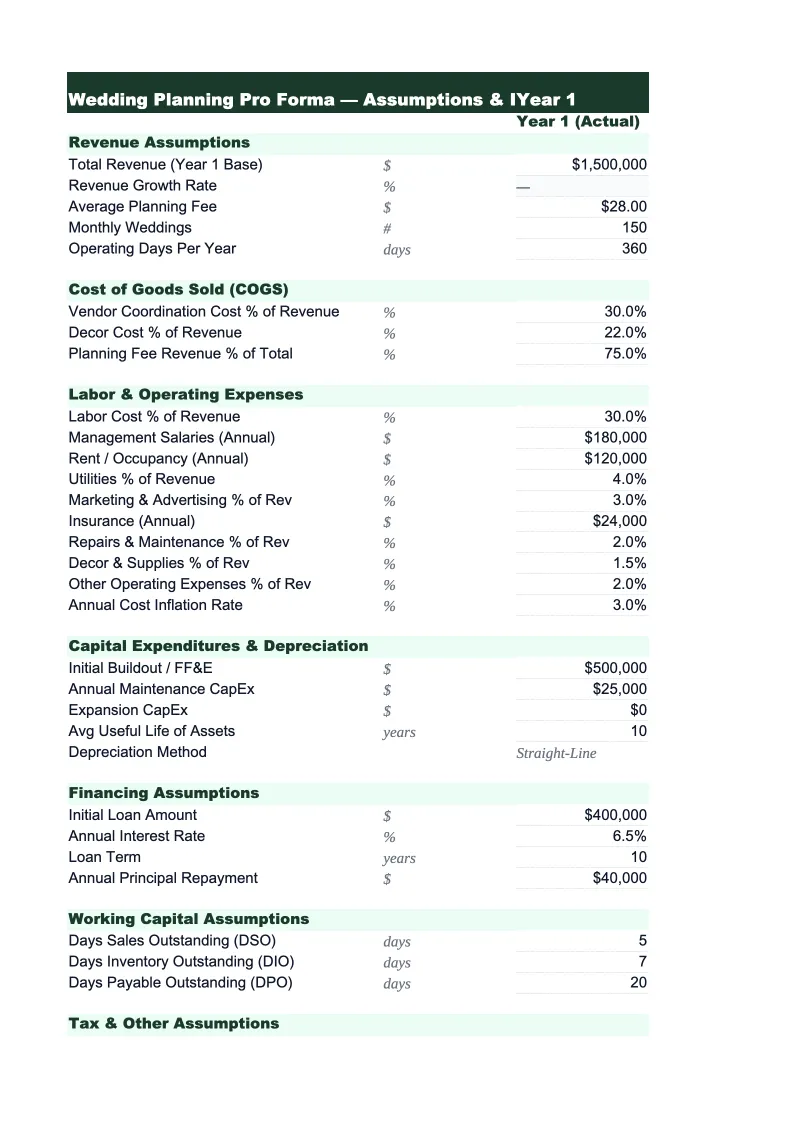
Assumptions
The control panel for the entire model.
Revenue Projections
A month-by-month and year-over-year revenue breakdown across your service mix.
Operating Expenses
A full 3-year expense projection organized by cost category: contractor and assistant coordinator fees, marketing and directory listings (The Knot, WeddingWire), planning software subscriptions, professional liability insurance, transportation and mileage, and general overhead.
Cash Flow Forecast
A monthly cash flow statement for the first 24 months, built around the realities of wedding planning cash timing.
Scenario Analysis
Three side-by-side projections — conservative, base case, and optimistic — based on different booking volume assumptions.
Summary Dashboard
A one-page financial summary with charts and key metrics for investor or lender presentations.
Wedding Planning Pro Forma Template Features
- Booking deposit schedule with milestone-based cash flow timing
- Service tier revenue split — full-service, partial, day-of, and add-ons
- Seasonal weighting table to reflect May-June and Sept-Oct peaks
- 3-year projection with conservative/base/optimistic scenario comparison
- Vendor commission and pass-through markup revenue tracking
- Investor-ready summary dashboard with printable charts
How to Use This Wedding Planning Pro Forma Spreadsheet
Start with the Assumptions sheet. Enter your expected number of events per year, your average package value for each service tier, and your target growth rate. If you're a new business, use conservative estimates — it's better to build a model that reflects realistic capacity than one that assumes you're fully booked from day one. For an established business, pull your last 12 months of bookings and use that as your baseline. The seasonality table lets you weight heavier booking months so your cash flow projections reflect the spring and fall peaks rather than spreading revenue evenly across the year.
Once your assumptions are in, review the Revenue Projections and Cash Flow sheets together. The key distinction for wedding planners is the gap between when revenue is booked and when cash is collected. A full-service engagement signed in November for an October wedding may collect a deposit immediately but not receive the final balance for 11 months. The Cash Flow sheet maps this out so you can see your actual bank balance by month — not just your accrued revenue — and identify months where you may need to draw on reserves or time your own expenses accordingly.
15 minutes from download to your first projection
Download the template, enter your booking assumptions, and see your wedding planning business's 3-year financial picture — including the cash flow timing that matters most.
Why Every Wedding Planning Business Needs a Pro Forma
Wedding planning is a low-capital but cash-flow-intensive business. Your fixed costs — insurance, software, marketing directory fees, a part-time assistant — run whether you're booked solid or waiting for leads. At the same time, revenue arrives in installments spread across months or even a year, which means your actual bank balance can look nothing like your projected revenue for any given period. A pro forma built specifically for wedding planning maps out this timing gap so you're not surprised by a slow January after a busy fall booking season.
The financial model for a wedding planning business has a few key variables that dominate everything else: average package value, events per year, and service mix. A planner running 20 events at $3,500 average earns $70,000 in fees — but one running 12 events at $5,500 earns $66,000 with 40% less workload and likely better margins. Modeling different combinations of volume and pricing helps you see which direction to optimize. Vendor commissions and pass-through markups are a secondary revenue stream that some planners track carefully and others leave off the table entirely; the pro forma includes a row for both so you can decide what applies to your business.
Wedding Planning Industry at a Glance
Financial templates built for wedding planners and coordinators — from day-of coordinators to full-service agencies. Pre-loaded with fee structures, payment milestone tracking, and vendor pass-through categories.
Revenue Drivers
- Full-service planning fees
- Day-of coordination packages
- Vendor referral commissions
- Vendor pass-through markups
- Add-on services (rehearsal dinner, elopements)
Key Cost Categories
- Assistant coordinator wages
- Contractor/sub-planner fees
- Vendor pass-through costs
- Marketing (Knot/WeddingWire listings)
- Planning software subscriptions
- Professional liability insurance
- Transportation and mileage
Typical Margins
Gross: 55-70% · Net: 15-25%
Seasonality
Peak weddings in May-June (spring) and September-October (fall). January-February slowest for events but highest for new bookings from holiday-engaged couples.
Key Performance Indicators
Wedding Planning Pro Forma Template FAQ
More Wedding Planning Templates
Wedding Planning Balance Sheet Template for Excel
$29
Wedding Planning Budget Template for Excel
$29
Wedding Planning Business Plan Template for Excel
$39
Wedding Planning Cash Flow Template for Excel
$29
Wedding Planning Expense Tracker Template for Excel
$29
Wedding Planning Financial Model Template for Excel
$29
Wedding Planning Income Statement Template for Excel
$29
Wedding Planning Invoice Template for Excel
$29
Wedding Planner KPI Dashboard Template for Excel
$29
Wedding Planner P&L Template for Excel
$29
Wedding Planning Project Budget Template for Excel
$29
Wedding Planning Sales Forecast Template for Excel
$29
Wedding Planning Business Valuation Template for Excel
$29
Wedding Planning Pro Forma Template
$29