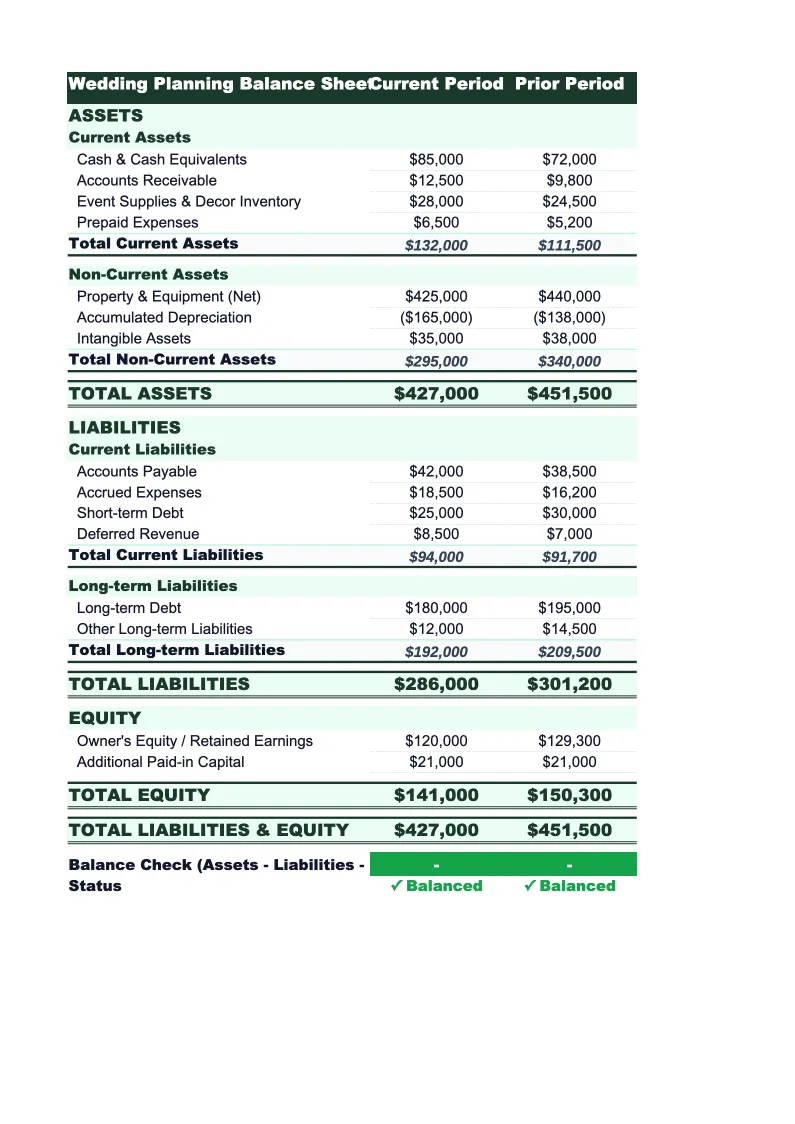
Wedding Planning Balance Sheet Template
Track what your wedding planning business owns, owes, and is worth — with built-in client deposit tracking and accounts receivable for upcoming weddings.
What's Inside This Wedding Planning Balance Sheet Template
This template includes 5 worksheets, each designed for a specific part of your wedding planning financial workflow:
Balance Sheet
The main financial statement showing your wedding planning business's assets, liabilities, and owner's equity at a specific date.
Period Comparison
A side-by-side view of two balance sheet periods — current vs.
Client Deposits
A dedicated tracker for deferred revenue — the most important liability category for a wedding planning business.
AR Schedule
An accounts receivable aging schedule that tracks outstanding client balances by days overdue.
Asset Register
A supporting schedule that itemizes your business equipment and non-current assets — laptops, tablets, cameras, décor samples, vehicle used for site visits, and any software or domain assets.
Wedding Planning Balance Sheet Template Features
- Client deposit tracker with deferred revenue auto-calculated as a balance sheet liability
- AR aging schedule with milestone payment tracking for upcoming weddings
- Equipment depreciation register with auto-calculated book values
- Side-by-side period comparison with dollar and percentage change
- Pre-built categories matching a wedding coordinator's chart of accounts
- Automatic totals, net equity calculation, and balance check across all sheets
How to Use This Wedding Planner Balance Sheet Spreadsheet
Start by opening the Asset Register sheet and entering your equipment — laptop, camera, any décor samples or display items, and a vehicle if it's used for the business. These populate your non-current assets. Then open the Client Deposits sheet and enter every current booking: client name, wedding date, total contract value, and deposit received. This step is critical because client deposits are a liability, not revenue — money you've collected but haven't yet earned. The Balance Sheet pulls from both sheets automatically, so your starting position will already be accurate.
Once your assets and deposits are in place, fill out the remaining sections of the Balance Sheet: cash on hand, any other current assets like prepaid insurance or software subscriptions, accounts payable to vendors, and any outstanding loans. Use the AR Schedule to list milestone payments due from current clients — any amounts invoiced but not yet collected show up as accounts receivable on your asset side. The Period Comparison sheet is most useful after you've completed a second balance sheet; enter your opening figures in the prior period column and it calculates the change automatically.
15 minutes from download to your first balance sheet
Download the template, enter your client deposits and assets, and see your wedding planning business's true financial position — liabilities, equity, and all.
Why Every Wedding Planning Business Needs a Balance Sheet
Wedding planning businesses carry a financial structure that looks nothing like a retail store or a consulting firm. You collect client deposits months — sometimes years — before the wedding date, which means your bank account often looks healthier than your actual financial position. Every undelivered deposit is a liability: the obligation to coordinate a wedding or refund the money. Without a balance sheet, it's easy to treat incoming deposits as profit and make spending decisions you can't sustain when the actual event costs hit.
Deferred revenue is the defining liability category for this industry, and it compounds during peak booking season (January through March, when newly engaged couples are actively contracting planners). A planner with eight weddings booked for the coming fall might be holding $80,000 in deposits, with $300,000 in total contracted services still to be coordinated and vendor payments still to be made. The balance sheet makes that picture legible — assets on one side, obligations on the other, and the difference as your true equity position.
Wedding Planning Industry at a Glance
Financial templates built for wedding planners and coordinators — from day-of coordinators to full-service agencies. Pre-loaded with fee structures, payment milestone tracking, and vendor pass-through categories.
Revenue Drivers
- Full-service planning fees
- Day-of coordination packages
- Vendor referral commissions
- Vendor pass-through markups
- Add-on services (rehearsal dinner, elopements)
Key Cost Categories
- Assistant coordinator wages
- Contractor/sub-planner fees
- Vendor pass-through costs
- Marketing (Knot/WeddingWire listings)
- Planning software subscriptions
- Professional liability insurance
- Transportation and mileage
Typical Margins
Gross: 55-70% · Net: 15-25%
Seasonality
Peak weddings in May-June (spring) and September-October (fall). January-February slowest for events but highest for new bookings from holiday-engaged couples.
Key Performance Indicators
Wedding Planning Balance Sheet Template FAQ
More Wedding Planning Templates
Wedding Planning Budget Template for Excel
$29
Wedding Planning Business Plan Template for Excel
$39
Wedding Planning Cash Flow Template for Excel
$29
Wedding Planning Expense Tracker Template for Excel
$29
Wedding Planning Financial Model Template for Excel
$29
Wedding Planning Income Statement Template for Excel
$29
Wedding Planning Invoice Template for Excel
$29
Wedding Planner KPI Dashboard Template for Excel
$29
Wedding Planner P&L Template for Excel
$29
Wedding Planning Pro Forma Template for Excel
$29
Wedding Planning Project Budget Template for Excel
$29
Wedding Planning Sales Forecast Template for Excel
$29
Wedding Planning Business Valuation Template for Excel
$29
More Balance Sheet Templates
Wedding Planning Balance Sheet Template
$29