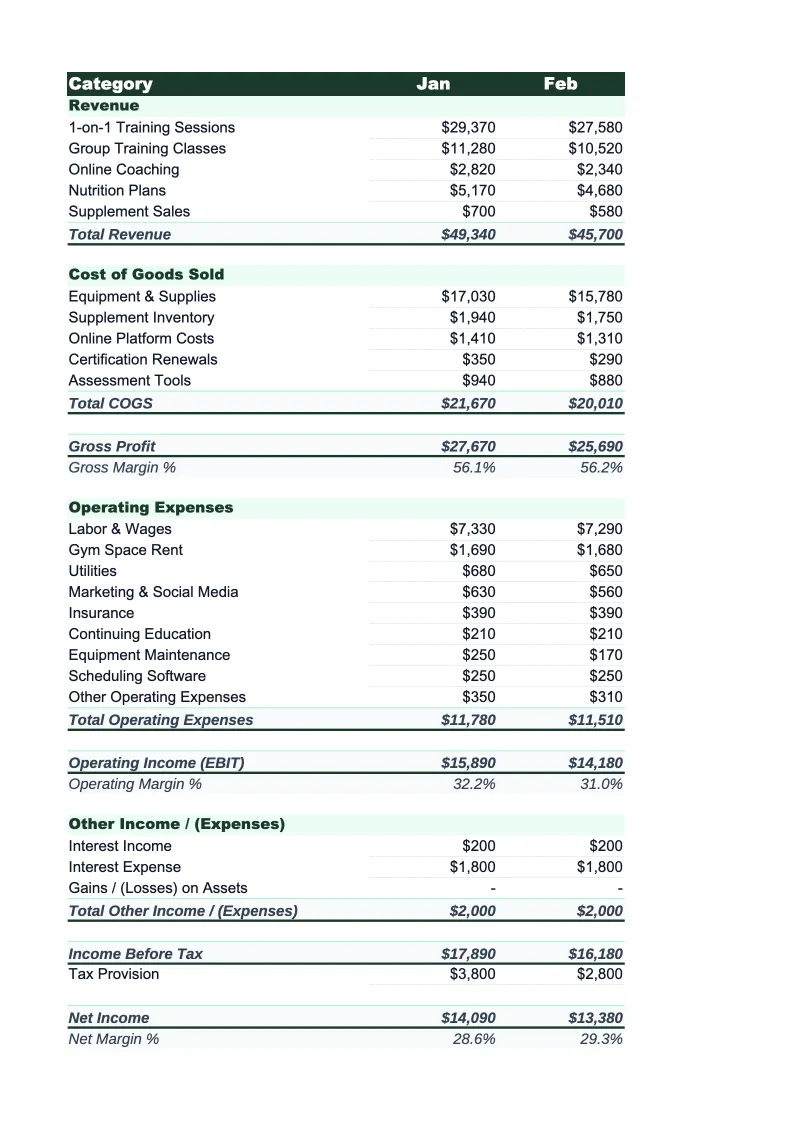
Personal Training Income Statement Template
Track revenue from sessions, packages, and online coaching alongside your facility, insurance, and equipment costs — all in one income statement built for personal trainers.
What's Inside This Personal Training Income Statement Template
This template includes 4 worksheets, each designed for a specific part of your personal training financial workflow:
Monthly Income Statement
The core worksheet where you record revenue and expenses for each month.
Annual Summary
A 12-month income statement that consolidates each monthly sheet into a single view.
Revenue Breakdown
A dedicated sheet for tracking revenue by service line — solo sessions, package sales, group classes, digital products, online coaching subscriptions, and any other income streams.
Dashboard
A visual overview with pre-built charts covering monthly revenue trends, net income by month, expense category breakdown, and gross margin percentage.
Personal Training Income Statement Template Features
- Revenue categories for sessions, packages, group classes, and online coaching
- Facility rental and contractor splits tracked separately from operating costs
- Monthly income statement with automatic gross and net income calculations
- 12-month annual summary with seasonal trend visibility
- Revenue breakdown by service line with client count and average rate inputs
- Net margin percentage and revenue-per-client ratios auto-calculated
How to Use This Personal Training Income Statement Spreadsheet
Getting started takes about 15 minutes. Download the .xlsx file and open it in Excel or Google Sheets — no macros or plugins needed. Start on the Monthly Income Statement sheet and review the pre-loaded revenue categories. Most trainers keep the structure as-is and just rename a line item or two to match their specific services. If you don't have group classes, leave that row blank; the formulas will ignore empty cells and still calculate correctly.
Once the categories match your setup, enter your revenue and expenses for the current month using your bank statements or scheduling software as a source. For revenue, enter both the number of sessions or clients and the rate — the sheet calculates the total so you can spot rate inconsistencies. For expenses, work through each category: facility fees, insurance, equipment purchases, software subscriptions, and any continuing education costs. The monthly sheet calculates gross profit and net income automatically, and those figures flow into the Annual Summary without any extra steps.
15 minutes from download to your first income statement
Download the template, enter your sessions and expenses, and see your personal training business's full financial picture — monthly view, annual summary, and revenue breakdown included.
Why Every Personal Trainer Needs an Income Statement Template
Personal training looks simple from the outside — you show up, you coach, you get paid. But the financial reality is messier: revenue is tied to session volume that shifts with client schedules and seasonal sign-up patterns, costs are split between fixed overhead and variable facility or contractor fees, and net income can swing dramatically from month to month without a clear picture of what's driving it. Most trainers who aren't tracking a formal income statement are guessing at their margins, often discovering at tax time that a busy year didn't actually translate to strong profit.
A personal training income statement works differently from a retail or restaurant P&L because the cost structure is service-based. Gross profit is high — most trainers see 70–85% gross margins because direct costs (facility rental, equipment) are relatively low compared to session revenue. But operating expenses, especially insurance, certification renewals, scheduling software, and marketing, can pull net margins down to 30–55% depending on how the business is structured. Separating these layers — revenue by service type, then cost of services, then operating expenses — gives you a clear view of where margin is being earned and where it's being spent.
Personal Training Industry at a Glance
Financial templates built for personal trainers and fitness coaches — from solo trainers billing individual clients to studio owners managing packages, group classes, and recurring memberships.
Revenue Drivers
- One-on-one sessions
- Training packages
- Group classes
- Online coaching
- Nutrition coaching add-ons
Key Cost Categories
- Gym rental or facility fees
- Equipment and supplies
- Liability insurance
- Certification and continuing education
- Software and scheduling tools
- Marketing and referral costs
Typical Margins
Gross: 70-85% · Net: 30-55%
Seasonality
January and September are peak sign-up months; summer and the holiday stretch see higher drop-off. Renewal cycles are often tied to 4-, 8-, or 12-week package structures.
Key Performance Indicators
Personal Training Income Statement Template FAQ
More Personal Training Templates
Personal Training Balance Sheet Template for Excel
$29
Personal Training Budget Template for Excel
$29
Personal Training Business Plan Template for Excel
$39
Personal Training Cash Flow Template for Excel
$29
Personal Training Expense Tracker Template for Excel
$29
Personal Training Financial Model Template for Excel
$29
Personal Training Invoice Template for Excel
$29
Personal Training KPI Dashboard Template for Excel
$29
Personal Training P&L Template for Excel
$29
Personal Training Pro Forma Template for Excel
$29
Personal Training Project Budget Template for Excel
$29
Personal Training Sales Forecast Template for Excel
$29
Personal Training Business Valuation Template for Excel
$29
More Income Statement Templates
Accounting Firm Income Statement Template for Excel
$29
Auto Repair Income Statement Template for Excel
$29
Car Wash Income Statement Template for Excel
$29
Church Income Statement Template for Excel
$29
Cleaning Service Income Statement Template for Excel
$29
Coffee Shop Income Statement Template for Excel
$29
Personal Training Income Statement Template
$29