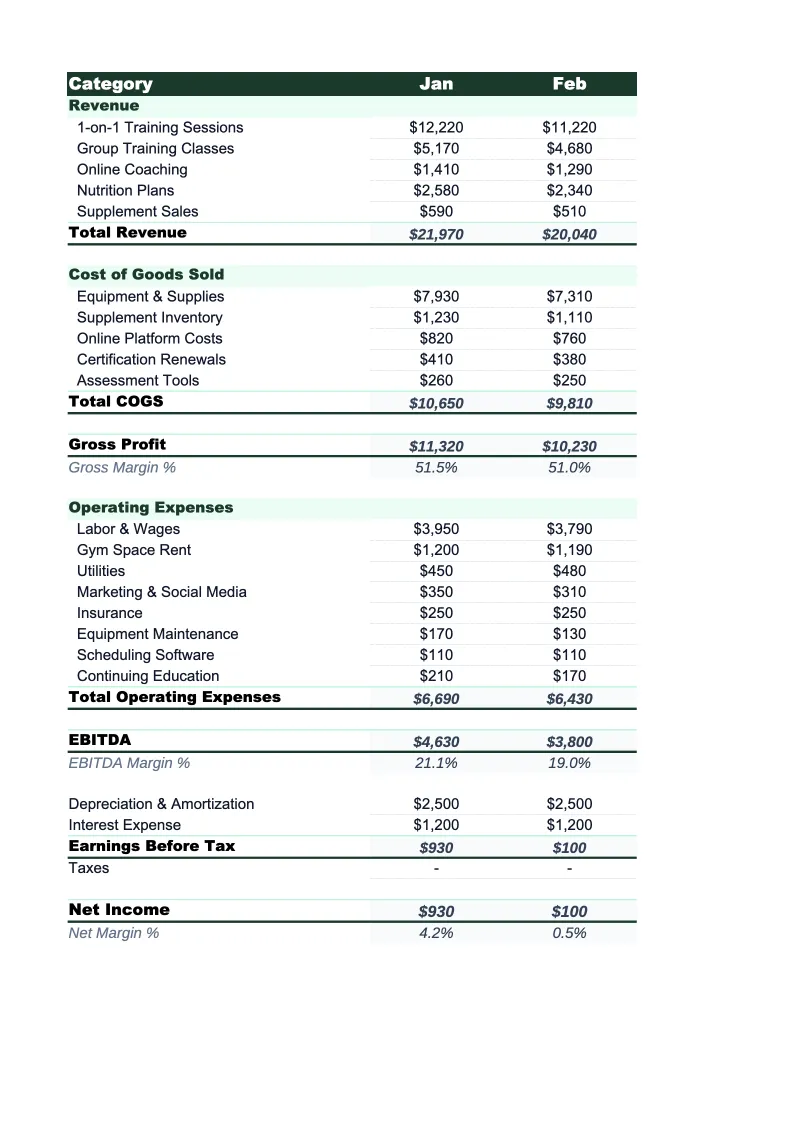
Personal Training P&L Template
Track your personal training business's revenue, session costs, and operating expenses with a P&L built for fitness coaches — not a generic spreadsheet that can't distinguish a package renewal from a drop-in session.
What's Inside This Personal Training P&L Template
This template includes 4 worksheets, each designed for a specific part of your personal training financial workflow:
Monthly P&L
The core worksheet where you record each month's revenue and expenses for your personal training business.
Annual P&L
A full 12-month view that pulls from the Monthly P&L sheet automatically, with no additional data entry.
Package Profitability
A per-package-type breakdown that tracks the revenue, direct costs, and gross margin for each training format you offer — such as 5-session packages, 10-session packages, monthly unlimited memberships, group fitness, and online coaching tiers.
Dashboard
A one-page summary with charts and key business metrics for a quick monthly review.
Personal Training P&L Template Features
- Revenue split across one-on-one sessions, training packages, group classes, online coaching, and nutrition add-ons
- Package Profitability sheet tracking gross margin per training format and package tier
- Facility rental and session-specific direct costs tracked separately from operating overhead
- Gross margin percentage calculated automatically each month
- Seasonality visibility across 12 months to plan for January peaks and summer slowdowns
- Average revenue per client and session utilization rate calculated on the Dashboard
How to Use This Personal Training P&L Spreadsheet
Download the .xlsx file and open it in Excel or Google Sheets — no macros or plugins required. Start with the Monthly P&L sheet and review the pre-loaded revenue and expense categories. Most personal trainers can use 80–90% of the categories without changes. The main customization is on the revenue side: rename the package tiers to match your actual offerings (5-session starter packs, 10-session packages, monthly memberships, online coaching plans, nutrition consults) and remove any income streams that don't apply to your business. The expense categories covering facility fees, insurance, software, and education costs typically need little adjustment. Initial setup takes about 15–20 minutes.
After each month, enter your revenue by source and actual expenses by category. For revenue, pull totals from your payment app, scheduling software, or bank statement — broken out by training format. For direct costs like facility rental, enter the hours or sessions billed against your gym access fee. For the Package Profitability sheet, enter the number of each package type sold that month, the price per package, and the direct delivery costs. Recurring operating expenses like insurance, software subscriptions, and marketing spend go in the Monthly P&L sheet. The formulas handle all the gross profit, margin, and net profit calculations.
15 minutes from download to your first P&L
Download the template, enter last month's session revenue and expenses, and see your personal training business's gross margin and net profit — with package-level profitability calculated automatically.
Why Every Personal Trainer Needs a P&L Template
Personal training businesses look simple from the outside — you charge for sessions, clients pay, you keep the difference — but the financial structure is more nuanced. One-on-one sessions, training packages, group classes, and online coaching carry fundamentally different margins and different capacity constraints. A trainer earning $80 per session at a gym that takes a percentage or charges a daily rental fee has a very different gross margin than a trainer running online coaching at $200 per month with minimal direct costs. Without separating revenue by type and matching direct costs to the format that generated them, it's impossible to know which parts of the business are actually driving profitability and which are consuming more time than they're worth. With gross margins on personal training services typically running 70–85%, the business is inherently healthy — but net margins of 30–55% leave significant room for operating expenses to erode earnings invisibly.
The cost structure in personal training divides cleanly into two buckets. Direct costs — facility rental fees, session-specific equipment wear, and any contracted trainers you bring in for large group formats — vary with session volume and should be matched to the revenue they support. Operating costs — liability insurance, certification renewals, continuing education, scheduling software, payment processing fees, marketing spend, and administrative time — run monthly regardless of how many clients you train. Treating these the same in a P&L obscures whether a slow month is a pricing problem, a volume problem, or an overhead problem. The Package Profitability sheet separates per-format costs from monthly overhead, so both are visible in context and neither hides inside an aggregate number.
Personal Training Industry at a Glance
Financial templates built for personal trainers and fitness coaches — from solo trainers billing individual clients to studio owners managing packages, group classes, and recurring memberships.
Revenue Drivers
- One-on-one sessions
- Training packages
- Group classes
- Online coaching
- Nutrition coaching add-ons
Key Cost Categories
- Gym rental or facility fees
- Equipment and supplies
- Liability insurance
- Certification and continuing education
- Software and scheduling tools
- Marketing and referral costs
Typical Margins
Gross: 70-85% · Net: 30-55%
Seasonality
January and September are peak sign-up months; summer and the holiday stretch see higher drop-off. Renewal cycles are often tied to 4-, 8-, or 12-week package structures.
Key Performance Indicators
Personal Training P&L Template FAQ
More Personal Training Templates
Personal Training Balance Sheet Template for Excel
$29
Personal Training Budget Template for Excel
$29
Personal Training Business Plan Template for Excel
$39
Personal Training Cash Flow Template for Excel
$29
Personal Training Expense Tracker Template for Excel
$29
Personal Training Financial Model Template for Excel
$29
Personal Training Income Statement Template for Excel
$29
Personal Training Invoice Template for Excel
$29
Personal Training KPI Dashboard Template for Excel
$29
Personal Training Pro Forma Template for Excel
$29
Personal Training Project Budget Template for Excel
$29
Personal Training Sales Forecast Template for Excel
$29
Personal Training Business Valuation Template for Excel
$29
Personal Training P&L Template
$29