Personal Training Valuation Template
Value your personal training business using seller's discretionary earnings multiples, a revenue approach, client retention analysis, and a trainer-dependency scorecard — built around how fitness businesses actually sell.
What's Inside This Personal Training Business Valuation Template
This template includes 6 worksheets, each designed for a specific part of your personal training financial workflow:
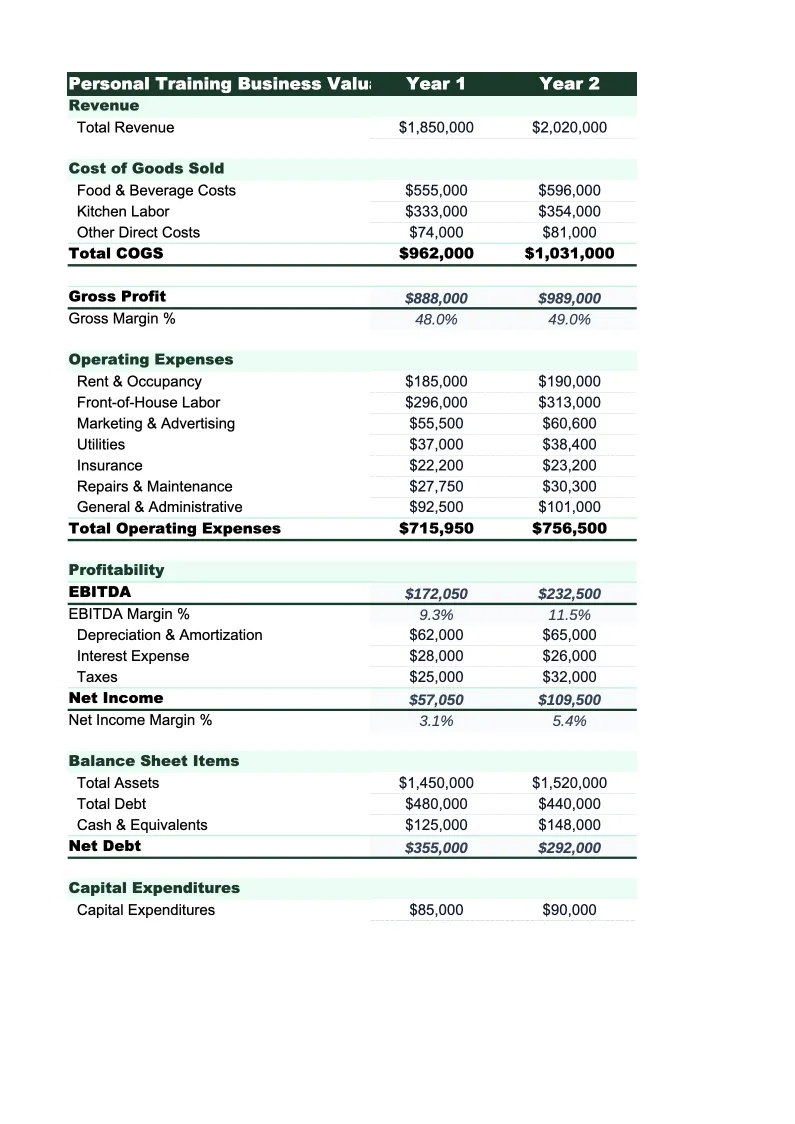
Business Inputs
The data foundation for the entire model.
Revenue Multiple Approach
A revenue-based screening method for establishing a broad value range before examining earnings in detail.
SDE Multiple Approach
Seller's Discretionary Earnings is the primary income-based valuation method for owner-operated personal training businesses and fitness studios.
Client Retention Analysis
Client retention is the most important value driver in personal training, and this sheet quantifies it rigorously.
Trainer Dependency Scorecard
A structured scoring model for the factors that most directly determine how much of a personal training business's value transfers to a new owner.
Valuation Summary
A single-page output consolidating all three valuation approaches into one view across conservative, base, and optimistic scenarios.
Personal Training Business Valuation Template Features
- Revenue multiple calculation benchmarked to personal training and fitness studio transactions with membership vs. pay-per-session adjustments
- SDE normalization with full owner-trainer compensation add-back and a multiple selection matrix for fitness business value drivers
- Client retention analysis tracking monthly churn, average client lifetime, tenure distribution, and concentration risk across your top clients
- Trainer dependency scorecard scoring eight transferability factors including client loyalty, programming documentation, and recurring revenue structure
- Transition scenario comparison showing asset sale, structured handover, and full going-concern scenarios in the Valuation Summary
- Three-scenario output with SDE sensitivity table and revenue multiple range covering the full negotiation band
How to Use This Personal Training Valuation Spreadsheet
Start with the Business Inputs sheet. Pull your trailing twelve-month revenue by type from your scheduling and payment software — most trainers use Mindbody, Trainerize, or a combination of a payment processor and a spreadsheet to track session billing, package sales, and membership fees. Break out your revenue categories precisely: individual session rates are different from package pricing, which is different from monthly membership revenue, and buyers assign different recurring revenue premiums to each. Owner compensation needs to be entered completely: your salary or draws, any personal expenses run through the business (equipment you use personally, vehicle expenses, phone), and the value of any health insurance or retirement contributions the business makes on your behalf. You'll also need operational data: total sessions delivered in the trailing twelve months, active client count, how many clients are on memberships versus pay-per-session, and headcount of any employed or contracted trainers who manage their own client portfolios.
Work through the Revenue Multiple and SDE Multiple sheets, then complete the Client Retention Analysis and Trainer Dependency Scorecard. The retention analysis often surfaces the most important insight for trainers considering a sale: whether your client base is a durable business asset or a set of personal relationships that will largely follow you when you leave. Document your monthly retention numbers honestly — the retention rate tells a buyer whether your programming, community, and facility create stickiness beyond your individual relationship with each client, or whether client continuity depends entirely on you remaining present. The Trainer Dependency Scorecard walks through the factors a business broker or buyer will evaluate during diligence, and completing it in advance lets you identify which specific changes — converting more clients to memberships, hiring a trainer who builds her own client base, creating documented programming protocols — would move your SDE multiple before you go to market.
Know what your personal training business is worth before you sell
Enter your revenue, SDE, client retention data, and operational metrics — and get a defensible valuation range with the SDE approach, client analysis, and trainer dependency scorecard that buyers will use to make their offer.
How Personal Training Businesses Are Valued When They Sell
Personal training businesses face the owner-dependency challenge in its most direct form: clients hire a specific trainer for their programming style, motivational approach, and personal connection — and when that trainer leaves, a large portion of the client base often leaves with them. This is the defining feature of personal training valuations, and it explains why most solo trainers receive relatively modest offers when they go to sell. A trainer generating $200,000 per year in revenue may have built a genuinely successful business, but if 80% of that revenue is tied to direct client relationships that will not transfer to a new owner, the actual purchase value reflects only the transferable fraction — the client list, the equipment, the brand assets, and whatever revenue a buyer can realistically expect to keep. Understanding this dynamic is the starting point for any personal training business valuation.
The factors that push a personal training valuation toward the high end of the 1.5–3.0x SDE range are the same ones that reduce client attrition risk for a buyer. Monthly membership revenue is the most valuable revenue type in the fitness space: clients who are billed automatically each month and who think of themselves as members of a studio or program rather than customers of a specific trainer are significantly more likely to remain after an ownership transition. Employed trainers who manage their own client portfolios independently — clients who book with the trainer rather than specifically requesting the owner — create a staff depth that reduces dependency. Proprietary programming documented in a way that a new owner or trainer can deliver consistently addresses the buyer's concern about whether the quality of service will hold post-transition. And a client acquisition system — a referral program, a local SEO presence, a social media following attached to the business brand rather than the owner's personal account — means a buyer inherits not just current revenue but a mechanism for growing it.
Personal Training Industry at a Glance
Financial templates built for personal trainers and fitness coaches — from solo trainers billing individual clients to studio owners managing packages, group classes, and recurring memberships.
Revenue Drivers
- One-on-one sessions
- Training packages
- Group classes
- Online coaching
- Nutrition coaching add-ons
Key Cost Categories
- Gym rental or facility fees
- Equipment and supplies
- Liability insurance
- Certification and continuing education
- Software and scheduling tools
- Marketing and referral costs
Typical Margins
Gross: 70-85% · Net: 30-55%
Seasonality
January and September are peak sign-up months; summer and the holiday stretch see higher drop-off. Renewal cycles are often tied to 4-, 8-, or 12-week package structures.
Key Performance Indicators
Personal Training Business Valuation FAQ
More Personal Training Templates
Personal Training Balance Sheet Template for Excel
$29
Personal Training Budget Template for Excel
$29
Personal Training Business Plan Template for Excel
$39
Personal Training Cash Flow Template for Excel
$29
Personal Training Expense Tracker Template for Excel
$29
Personal Training Financial Model Template for Excel
$29
Personal Training Income Statement Template for Excel
$29
Personal Training Invoice Template for Excel
$29
Personal Training KPI Dashboard Template for Excel
$29
Personal Training P&L Template for Excel
$29
Personal Training Pro Forma Template for Excel
$29
Personal Training Project Budget Template for Excel
$29
Personal Training Sales Forecast Template for Excel
$29
Personal Training Valuation Template
$29