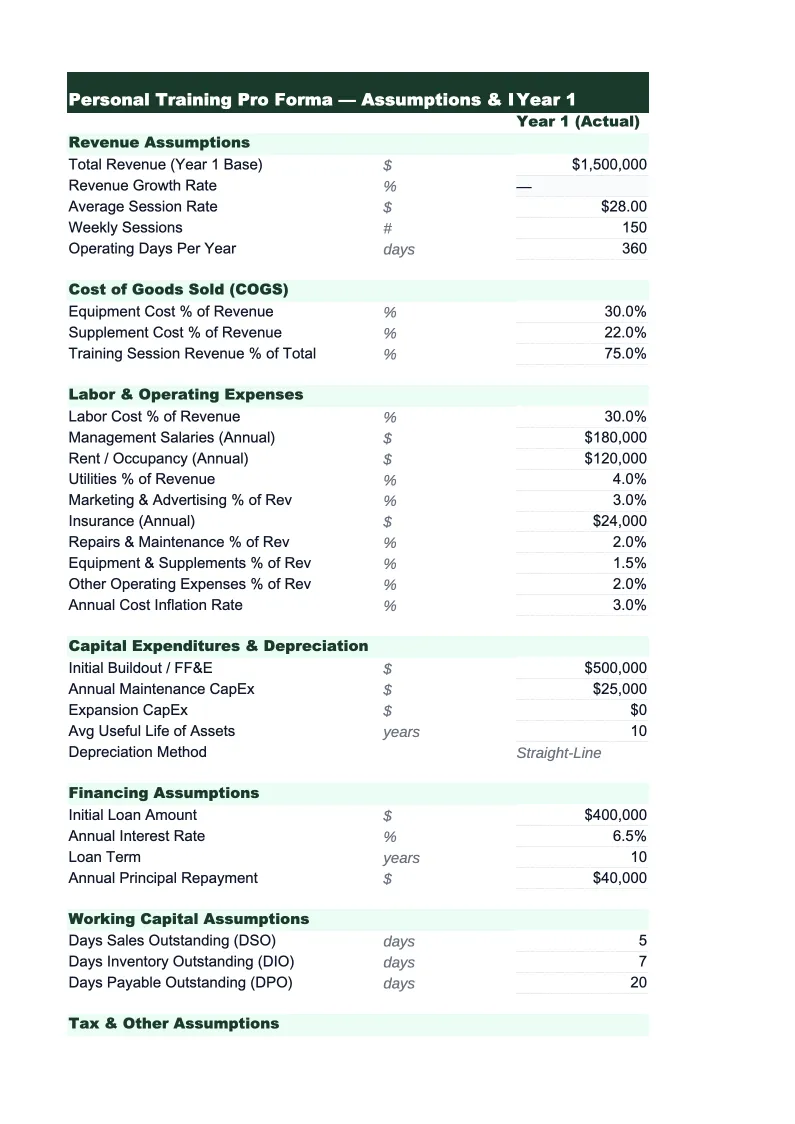
Personal Training Pro Forma Template
Project revenue, expenses, and profitability for your personal training business — built around session type mix, client capacity, package pricing, and the New Year and September demand spikes that define the fitness industry calendar.
What's Inside This Personal Training Pro Forma Template
This template includes 6 worksheets, each designed for a specific part of your personal training financial workflow:
Assumptions
The control panel for the entire model.
Revenue Projections
A month-by-month and year-over-year revenue breakdown across your service mix.
Operating Expenses
A full 3-year expense projection organized by cost category: gym floor rental or booth rental fees, liability and professional insurance, certification renewal and continuing education costs, equipment purchases and maintenance, scheduling and payment software (Mindbody, Trainerize, PT Distinction), marketing and lead generation (social media ads, referral incentives, local advertising), and general business overhead.
Cash Flow Forecast
A monthly cash flow statement for the first 24 months that reflects the cash dynamics specific to personal training.
Scenario Analysis
Three side-by-side projections — conservative, base case, and optimistic — based on different client volume and pricing assumptions.
Summary Dashboard
A one-page financial summary with charts and key metrics formatted for lender, investor, or business partner presentations.
Personal Training Pro Forma Template Features
- Session type revenue split — 1-on-1, semi-private, small group, online coaching, and add-ons
- Client capacity and churn rate modeling with monthly active roster projections
- Seasonal demand weighting for January New Year surge and September back-to-school uptick
- Pre-paid package cash flow tracking separate from earned revenue recognition
- 3-year projection with conservative/base/optimistic scenario comparison
- Investor-ready summary dashboard with break-even client count and printable charts
How to Use This Personal Training Pro Forma Spreadsheet
Start with the Assumptions sheet. Enter your current active client count and how many sessions per week each client typically books, your session pricing (or package pricing if you sell blocks of sessions), and the service types you offer — 1-on-1, semi-private, group, or online coaching. If you're starting from scratch, use a realistic target: most solo trainers working full-time have capacity for 20-30 clients with consistent weekly sessions, and building to that from zero typically takes 6-12 months. Set your seasonality weights to reflect the January bump and summer dip that affect most fitness businesses. The churn rate input is important — enter a realistic monthly attrition figure (5-8% is typical) and pair it with your projected new client acquisition to see how your roster evolves over time.
Once your assumptions are set, review the Revenue Projections and Cash Flow sheets together. If you sell pre-paid packages, pay close attention to the distinction between cash collected and sessions delivered — a client who buys a 20-session package in January generates a large cash inflow immediately, but the revenue is earned over the next 2-3 months as you deliver sessions. The Cash Flow sheet tracks your actual bank balance versus your delivered-session revenue so you can see how much of your January cash surge you should set aside for slower months rather than treat as available profit. For trainers who bill per-session, the model simplifies — cash and revenue align by month.
15 minutes from download to your first projection
Download the template, enter your client and session assumptions, and see your personal training business's 3-year financial picture — including the break-even client count you need to hit.
Why Every Personal Training Business Needs a Pro Forma
Personal training is a capacity-constrained business: your time is the product, there are only so many hours in a day, and your income ceiling is set by how many sessions you can deliver and what you charge for each one. Most trainers hit a revenue plateau when they reach 25-30 weekly sessions — any more and quality slips or the trainer burns out — which means growth beyond that ceiling requires either raising prices, adding semi-private or group formats that generate more revenue per hour, or hiring other trainers to expand capacity. A pro forma forces you to think through that math before you're in the middle of it: what does your income look like at 20 clients versus 30? What does the ceiling look like, and what would it take to break through it?
The financial model for a personal training business has a handful of variables that drive most of the outcome: active client count, average sessions per client per month, price per session, and the cost of your gym floor rental or studio space. Gym floor rent — typically 30-50% of session revenue paid to the facility — is the largest single cost for most trainers working inside a commercial gym. Trainers who rent their own studio space swap percentage-of-revenue rent for a fixed monthly lease, which raises the break-even threshold but increases upside once capacity is reached. Online coaching changes the math again: no facility cost, scalable client count beyond your in-person capacity ceiling, but typically lower prices and higher churn. The model in this template lets you run any combination of these structures to see which one produces the best margin for your situation.
Personal Training Industry at a Glance
Financial templates built for personal trainers and fitness coaches — from solo trainers billing individual clients to studio owners managing packages, group classes, and recurring memberships.
Revenue Drivers
- One-on-one sessions
- Training packages
- Group classes
- Online coaching
- Nutrition coaching add-ons
Key Cost Categories
- Gym rental or facility fees
- Equipment and supplies
- Liability insurance
- Certification and continuing education
- Software and scheduling tools
- Marketing and referral costs
Typical Margins
Gross: 70-85% · Net: 30-55%
Seasonality
January and September are peak sign-up months; summer and the holiday stretch see higher drop-off. Renewal cycles are often tied to 4-, 8-, or 12-week package structures.
Key Performance Indicators
Personal Training Pro Forma Template FAQ
More Personal Training Templates
Personal Training Balance Sheet Template for Excel
$29
Personal Training Budget Template for Excel
$29
Personal Training Business Plan Template for Excel
$39
Personal Training Cash Flow Template for Excel
$29
Personal Training Expense Tracker Template for Excel
$29
Personal Training Financial Model Template for Excel
$29
Personal Training Income Statement Template for Excel
$29
Personal Training Invoice Template for Excel
$29
Personal Training KPI Dashboard Template for Excel
$29
Personal Training P&L Template for Excel
$29
Personal Training Project Budget Template for Excel
$29
Personal Training Sales Forecast Template for Excel
$29
Personal Training Business Valuation Template for Excel
$29
Personal Training Pro Forma Template
$29