Personal Training Financial Model Template
Model session revenue, package renewals, and recurring memberships — then see your personal training business's cash position month by month, built for solo trainers and small studios planning their next year.
What's Inside This Personal Training Financial Model Template
This template includes 6 worksheets, each designed for a specific part of your personal training financial workflow:
Assumptions
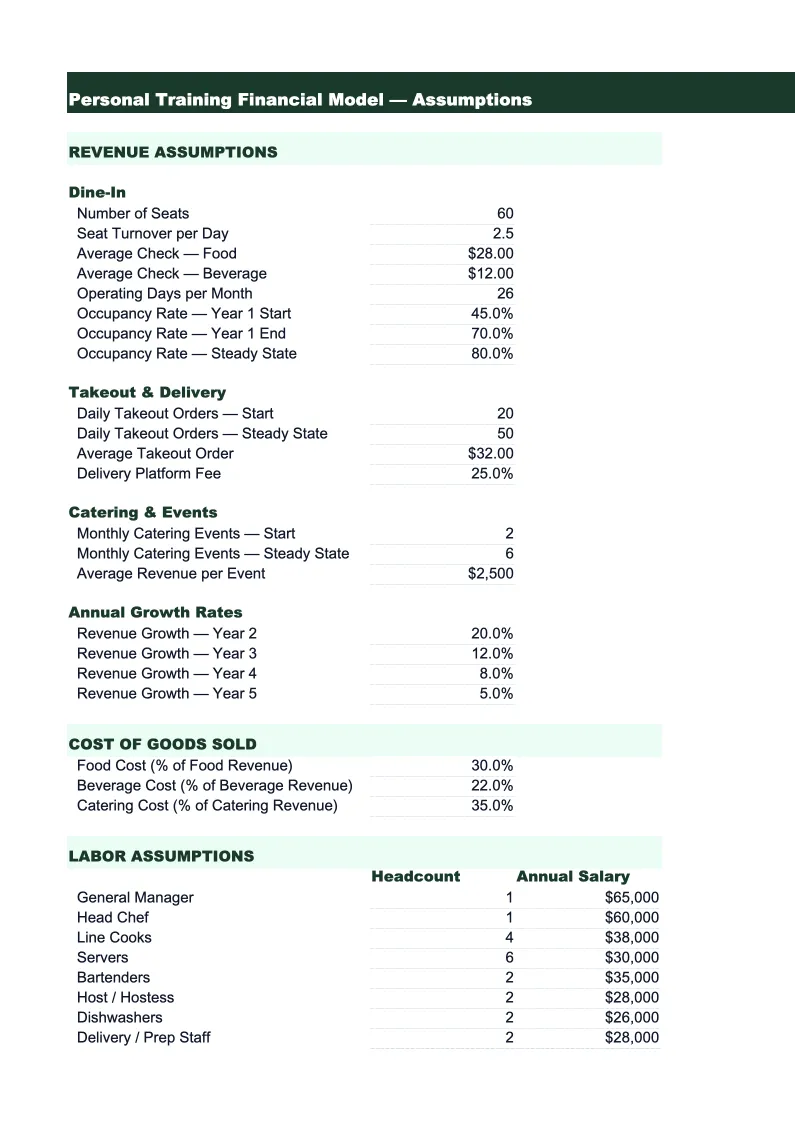
The single input sheet that drives every calculation in the model.
Revenue Projections
A 24-month revenue build organized by revenue stream: individual sessions (active clients × sessions per month × session rate), training packages (packages sold × package price, with a renewal rate assumption driving repeat purchases), group classes (class capacity × fill rate × class price), online coaching retainers (subscribers × monthly fee), and nutrition coaching add-ons.
Client & Retention Model
A month-by-month view of your client base — new clients acquired, clients who churn, and the total active count at the end of each month.
P&L
A 24-month profit and loss statement that pulls revenue from the Revenue Projections sheet and expenses from your Assumptions inputs.
Cash Flow
A monthly cash flow statement that models the timing differences between when training revenue is earned and when cash is actually collected.
Dashboard
A one-page visual summary designed for annual planning, loan applications, or presenting to a landlord or studio partner.
Personal Training Financial Model Template Features
- Revenue model split by stream: individual sessions, packages, group classes, and online coaching projected separately
- Client and retention model — new client acquisitions, churn rate, and package renewal rate drive the revenue build
- Average revenue per client and revenue per training hour calculated automatically
- Upfront package payment timing modeled in cash flow separately from session-based billing
- Seasonal multipliers pre-set for January and September intake surges and summer/holiday slowdowns
- 24-month P&L with gross and net margin benchmarks displayed alongside your projections
How to Use This Personal Training Financial Model Spreadsheet
Start in the Assumptions sheet. Enter your current active client count, average sessions each client books per month, and your rates for each revenue type — individual sessions, packages, group classes, online coaching, and any nutrition add-on services. If you're an existing trainer, use last year's invoices or your scheduling software's revenue report as a baseline. Calculate what percentage of your revenue came from each stream, your actual renewal rate for packages (how many clients rebuy after finishing one), and your average monthly churn rate. If you're modeling a new business, start with conservative numbers — 10–15 clients in month one, 60–70% package renewal rate, and utilization that builds gradually over the first six months. Then enter your costs: gym rental, insurance, software, marketing. The Client & Retention Model sheet will immediately show whether your client growth plan is achievable.
Once your assumptions look right, review the Revenue Projections and P&L sheets. Check whether your projected gross margin is in the 70–85% range typical for personal training businesses. If it's lower, look at whether gym rental fees are taking a large percentage of session revenue, or whether your rates are below market for your service type and location. The Cash Flow sheet is especially useful if you sell packages — it shows that package buyers give you cash upfront, which can mask later slowdowns if you're not tracking active client count separately. Trainers who look profitable on accrual-basis P&L but run low on cash are often burning through prepaid package cash without tracking whether they have the client base to sustain it.
15 minutes from download to your first personal training business projection
Download the template, plug in your client count and session rates, and see your personal training business's full financial picture — revenue by stream, client retention tracking, cash flow, and 24-month P&L included.
Why Every Personal Trainer Needs a Financial Model
Personal training businesses run on two numbers that most trainers don't track formally: client retention rate and revenue per active client. Retention matters because acquiring a new client costs 5–10 times more than keeping an existing one, and the compounding effect of high retention on annual revenue is significant. A trainer with 30 clients and 90% monthly retention has a stable, growing business. A trainer with 40 clients and 75% monthly retention is on a treadmill — replacing churn fast enough to stay even, but unable to build momentum. Without a model, it's hard to see that distinction because both businesses look busy. A financial model makes the retention math visible.
Revenue stream mix matters more in personal training than many trainers realize. Individual sessions provide flexibility but are vulnerable to cancellations and no-shows that directly cut revenue. Training packages provide upfront cash and reduce cancellation risk — clients who've already paid are more likely to show up. Group classes and online coaching scale revenue without proportional time investment, which is how solo trainers increase their earnings ceiling without adding 1:1 hours. A model that separates these streams lets you see whether you're building toward a scalable revenue base or staying fully dependent on trading time for money. Most financial advisors recommend personal trainers move at least 30–40% of revenue toward recurring or package-based formats.
Personal Training Industry at a Glance
Financial templates built for personal trainers and fitness coaches — from solo trainers billing individual clients to studio owners managing packages, group classes, and recurring memberships.
Revenue Drivers
- One-on-one sessions
- Training packages
- Group classes
- Online coaching
- Nutrition coaching add-ons
Key Cost Categories
- Gym rental or facility fees
- Equipment and supplies
- Liability insurance
- Certification and continuing education
- Software and scheduling tools
- Marketing and referral costs
Typical Margins
Gross: 70-85% · Net: 30-55%
Seasonality
January and September are peak sign-up months; summer and the holiday stretch see higher drop-off. Renewal cycles are often tied to 4-, 8-, or 12-week package structures.
Key Performance Indicators
Personal Training Financial Model Template FAQ
More Personal Training Templates
Personal Training Balance Sheet Template for Excel
$29
Personal Training Budget Template for Excel
$29
Personal Training Business Plan Template for Excel
$39
Personal Training Cash Flow Template for Excel
$29
Personal Training Expense Tracker Template for Excel
$29
Personal Training Income Statement Template for Excel
$29
Personal Training Invoice Template for Excel
$29
Personal Training KPI Dashboard Template for Excel
$29
Personal Training P&L Template for Excel
$29
Personal Training Pro Forma Template for Excel
$29
Personal Training Project Budget Template for Excel
$29
Personal Training Sales Forecast Template for Excel
$29
Personal Training Business Valuation Template for Excel
$29
More Financial Model Templates
Personal Training Financial Model Template
$29