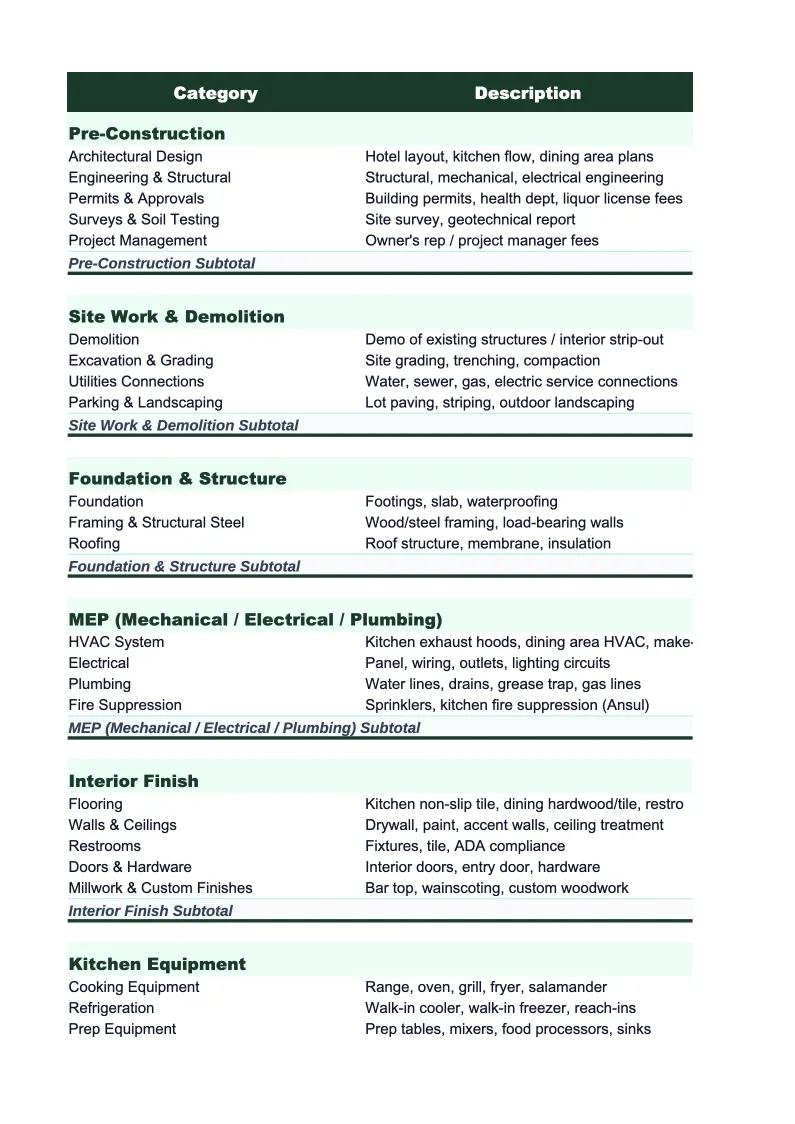
Hotel Project Budget Template
Track hotel renovation and capital project costs from initial estimate through closeout — with pre-built categories for construction, FF&E, OS&E, and soft costs.
What's Inside This Hotel Project Budget Template
This template includes 6 worksheets, each designed for a specific part of your hotel financial workflow:
Project Setup
Enter your project details here before populating the other sheets: property name, project type (room renovation, lobby refresh, F&B outlet buildout, FF&E replacement, etc.), total approved budget, project manager, owner's representative, general contractor, and scheduled start and completion dates.
Cost Estimate
The baseline budget broken down by hotel project cost category.
Actual Costs
Log project costs as invoices are received and approved: contractor draw requests, design fees, FF&E purchase orders, OS&E procurement, permit fees, and soft costs.
Change Orders
A log for scope changes, unforeseen conditions, and owner-directed modifications.
Budget vs Actual
Side-by-side comparison of your approved project budget against actual costs incurred to date, organized by cost category.
Dashboard
A one-page project financial summary designed for owner or asset manager reporting.
Hotel Project Budget Template Features
- Pre-built hotel project cost categories: construction, FF&E, OS&E, technology, soft costs, and contingency
- Change order log that updates the revised project budget automatically
- Budget vs actual variance by category with cost-to-complete projection
- Quantity × unit cost estimating structure for FF&E and construction line items
- Monthly draw cycle workflow with running cost-to-date accumulation
- Owner/asset manager dashboard formatted for reporting and PDF export
How to Use This Hotel Project Budget Spreadsheet
Start with the Project Setup sheet before anything else. Enter the property name, project type, approved budget, and key personnel — this information flows through to the headers on all other sheets. Then open the Cost Estimate sheet and review the pre-loaded categories. Hotel renovation projects typically use the full set of divisions, though the relative weight varies by project type: a room renovation is heavy on FF&E and construction but light on pre-opening costs, while a new F&B outlet will have significant OS&E and pre-opening expenses. Adjust the line items to match your approved project scope and enter your budgeted amounts. If you're setting up the template before final contractor pricing is locked, use your owner's budget or feasibility estimate and update once bids are received.
As the project progresses, log costs in the Actual Costs sheet each time invoices are reviewed and approved — most hotel projects run on monthly draw cycles, so entering costs once per cycle is practical. Assign each entry to its cost category and the running totals update automatically. Track change orders in the Change Orders sheet as they arise: enter them as pending when submitted, update to approved when the owner signs off. Approved change orders will adjust your revised budget total on the Project Setup sheet, so the budget vs actual comparison always reflects current scope. Hotels tend to accumulate change orders from concealed conditions and brand standard modifications, so keeping this log current is more important than it might seem on a straightforward renovation.
15 minutes from download to your first hotel project budget
Download the template, enter your approved project scope and budget, and you have a complete capital cost tracker — with FF&E, change orders, budget vs actual, and owner reporting built in.
Why Hotel Capital Projects Need a Dedicated Budget Template
Hotel capital projects are expensive, slow, and full of variables that are hard to see in advance. A guestroom renovation that looks straightforward in the scope document regularly encounters outdated mechanical systems, failing substrates, or brand-mandated design changes mid-project. Meanwhile, FF&E lead times push schedules out by months, and owner-directed additions accumulate faster than anyone expected. With renovation costs running $15,000–$80,000+ per room depending on property class and scope, even a 10% cost overrun on a 100-room project is a six-figure problem. A structured project budget doesn't prevent any of this — but it tells you when it's happening while you still have options.
Hotel project budgets need to track five distinct cost components that behave very differently from each other. Hard construction costs — the actual renovation work performed by your general contractor and subs — move through monthly draw requests tied to percent complete and are the easiest to monitor. FF&E procurement runs on purchase orders with long lead times, meaning you can be fully committed before a single piece of furniture arrives on property; the budget needs to reflect PO value, not just received goods. OS&E tends to accumulate in the final months of a project and is chronically underestimated. Soft costs (design, legal, permits, brand application fees) are often fixed at the start of the project but can change with scope creep. And contingency — typically 5–15% of hard costs on hotel renovations — exists to absorb the inevitable, but tracking how it's being drawn down is essential to knowing whether you have enough runway to close the project.
Hotel Industry at a Glance
Financial templates built for hotels and hospitality businesses — from independent properties to branded franchises. Pre-loaded with room revenue, F&B, and event billing categories.
Revenue Drivers
- Room revenue (ADR × occupancy)
- Food & beverage
- Meeting & event space
- Spa & wellness
- Parking & ancillary fees
Key Cost Categories
- Labor (rooms, F&B, front office)
- Cost of F&B sold
- OTA & marketing commissions
- Utilities & property maintenance
- Franchise & management fees
- Administrative overhead
Typical Margins
Gross: 65-80% · Net: 10-20%
Seasonality
Business hotels peak weekdays and Q1/Q3; leisure properties peak summer and holidays. January is typically slowest for both segments.
Key Performance Indicators
Hotel Project Budget Template FAQ
More Hotel Templates
Hotel Balance Sheet Template for Excel
$29
Hotel Budget Template for Excel
$29
Hotel Business Plan Template for Excel
$39
Hotel Cash Flow Template for Excel
$29
Hotel Expense Tracker Template for Excel
$29
Hotel Financial Model Template for Excel
$29
Hotel Income Statement Template for Excel
$29
Hotel Invoice Template for Excel
$29
Hotel KPI Dashboard Template for Excel
$29
Hotel P&L Template for Excel
$29
Hotel Pro Forma Template for Excel
$29
Hotel Sales Forecast Template for Excel
$29
Hotel Valuation Template for Excel
$29
More Project Budget Templates
Hotel Project Budget Template
$29