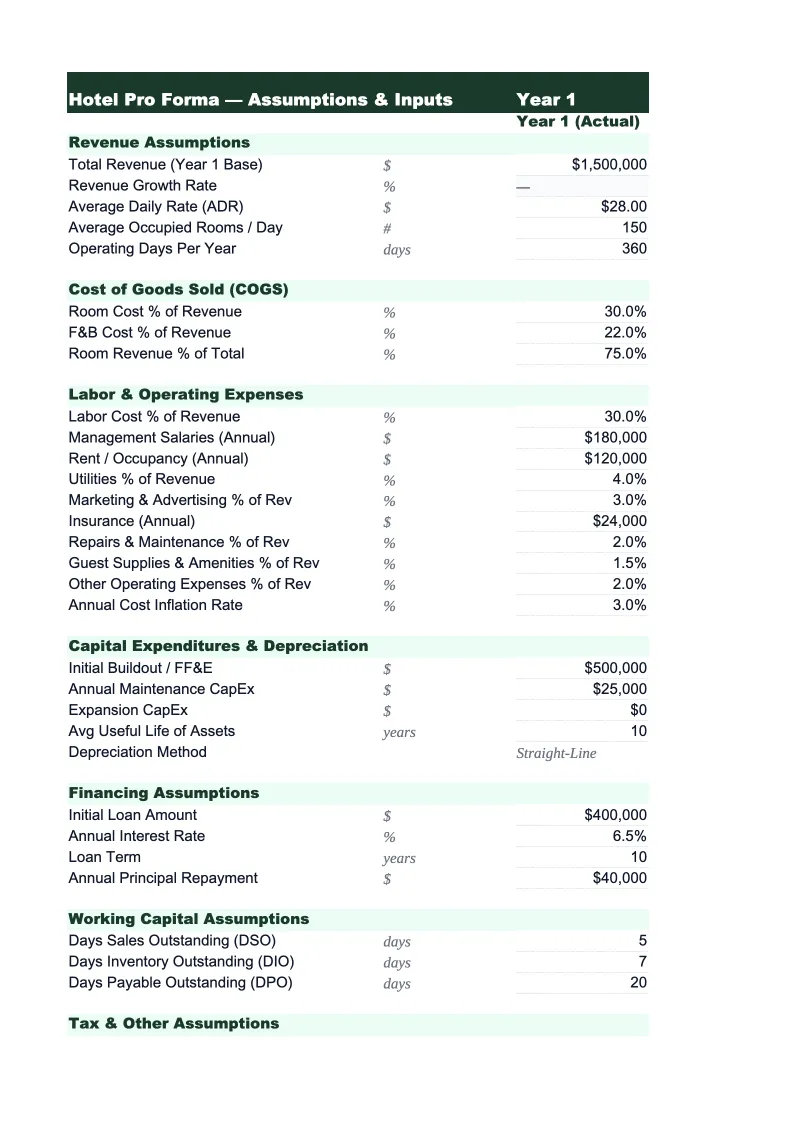
Hotel Pro Forma Template
Project a hotel's revenue, operating costs, and investor returns across a 5–10 year hold period — with hospitality-specific formulas for ADR, RevPAR, occupancy ramp, and NOI.
What's Inside This Hotel Pro Forma Template
This template includes 6 worksheets, each designed for a specific part of your hotel financial workflow:
Assumptions
The control panel for the entire model.
Revenue Projections
Projects total revenue across all hotel departments by year.
Operating Expenses
Breaks out hotel operating costs following the Uniform System of Accounts for the Lodging Industry (USALI) structure, which is the standard that lenders and investors expect.
NOI Summary
A 10-year waterfall view of the property's financial performance, showing total revenue, total operating expenses, GOP, and NOI for each year side by side.
Investor Returns
Calculates the full return profile of the investment — equity multiple, internal rate of return (IRR), and cash-on-cash return for each year of the hold period.
Sensitivity Analysis
A two-variable sensitivity table that shows how IRR and exit value change across a range of ADR and occupancy scenarios.
Hotel Pro Forma Template Features
- USALI-structured operating expense model (rooms, F&B, undistributed, fixed charges)
- ADR and occupancy ramp schedule for lease-up and repositioning scenarios
- RevPAR auto-calculation from ADR and occupancy inputs
- Levered and unlevered IRR with equity multiple and cash-on-cash returns
- 10-year NOI projection with GOP margin benchmarks
- Two-variable sensitivity table for ADR, occupancy, and exit cap rate scenarios
How to Use This Hotel Pro Forma Spreadsheet
Start with the Assumptions sheet. Enter the property basics — room count, property type (full-service, select-service, extended stay), acquisition price or total development cost, and hold period. Then set your ADR and occupancy inputs, including the ramp schedule if you're projecting lease-up or post-renovation stabilization. Most users spend 20–30 minutes here getting the inputs right before looking at any output sheets. The closer these assumptions are to reality, the more useful the rest of the model becomes.
Once assumptions are in, review the Revenue Projections and Operating Expenses sheets to make sure the categories match your property. Toggle off revenue lines that don't apply (a limited-service hotel won't have spa revenue), and adjust the expense percentages under each department to reflect actual operator benchmarks or LOIs you've already negotiated. The NOI Summary sheet will start showing a 10-year picture as soon as the revenue and expense lines are populated.
From download to deal model in under an hour
Enter your property assumptions, review the NOI waterfall, and run sensitivity scenarios before your next investor call.
Why Every Hotel Deal Needs a Pro Forma
Hotels are operationally complex investments, and a pro forma built on generic spreadsheet logic usually falls apart in due diligence. The reason is that hotel revenue isn't just one number — it's the product of ADR, occupancy, and rooms available, each of which behaves differently across market cycles, competitive sets, and property types. A select-service hotel in a suburban market ramps to stabilization in 12–18 months. A full-service urban property with a new F&B concept can take three years to reach underwritten occupancy. Any pro forma that doesn't model the ramp explicitly is hiding the hardest part of the deal.
Lenders and institutional equity partners expect hotel financials to follow the Uniform System of Accounts for the Lodging Industry (USALI). This means departmental P&Ls, undistributed operating expenses broken out line by line, and GOP stated before management fees and franchise royalties. If your model collapses everything into a single expense column, it signals to investors that you're working from a residential or retail template rather than hospitality-specific underwriting. The structure in this template matches what a hotel asset manager or hotel-specialized lender expects to see.
Hotel Industry at a Glance
Financial templates built for hotels and hospitality businesses — from independent properties to branded franchises. Pre-loaded with room revenue, F&B, and event billing categories.
Revenue Drivers
- Room revenue (ADR × occupancy)
- Food & beverage
- Meeting & event space
- Spa & wellness
- Parking & ancillary fees
Key Cost Categories
- Labor (rooms, F&B, front office)
- Cost of F&B sold
- OTA & marketing commissions
- Utilities & property maintenance
- Franchise & management fees
- Administrative overhead
Typical Margins
Gross: 65-80% · Net: 10-20%
Seasonality
Business hotels peak weekdays and Q1/Q3; leisure properties peak summer and holidays. January is typically slowest for both segments.
Key Performance Indicators
Hotel Pro Forma Template FAQ
More Hotel Templates
Hotel Balance Sheet Template for Excel
$29
Hotel Budget Template for Excel
$29
Hotel Business Plan Template for Excel
$39
Hotel Cash Flow Template for Excel
$29
Hotel Expense Tracker Template for Excel
$29
Hotel Financial Model Template for Excel
$29
Hotel Income Statement Template for Excel
$29
Hotel Invoice Template for Excel
$29
Hotel KPI Dashboard Template for Excel
$29
Hotel P&L Template for Excel
$29
Hotel Project Budget Template for Excel
$29
Hotel Sales Forecast Template for Excel
$29
Hotel Valuation Template for Excel
$29
Hotel Pro Forma Template
$29