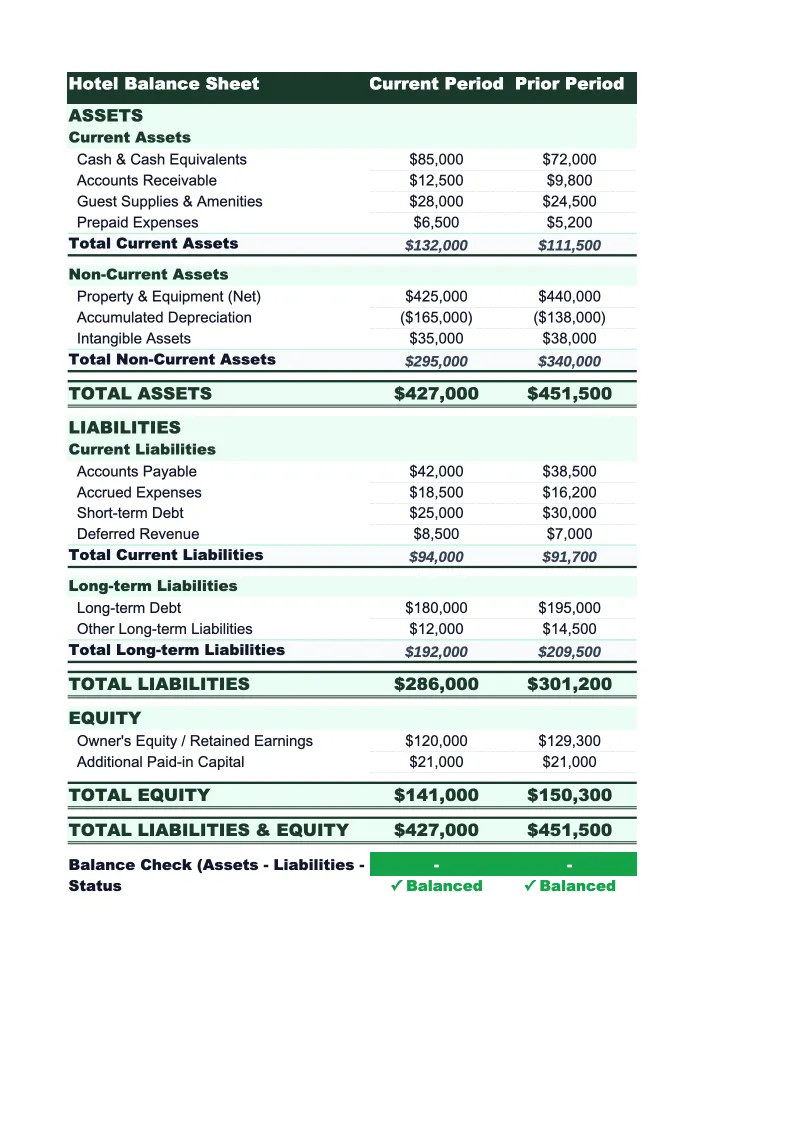
Hotel Balance Sheet Template
Track what your hotel property owns, owes, and is worth — a balance sheet built for hospitality with FF&E schedules, advance deposit tracking, and property-level equity.
What's Inside This Hotel Balance Sheet Template
This template includes 4 worksheets, each designed for a specific part of your hotel financial workflow:
Balance Sheet
The core statement organized around the hospitality chart of accounts.
FF&E Schedule
A fixed-asset register for your furniture, fixtures, and equipment — the largest and most complex asset category for most hotel properties.
Advance Deposits
A liability schedule tracking all guest deposits and advance payments received for future arrivals.
Period Comparison
A side-by-side comparison of two balance sheet dates — typically year-end vs.
Hotel Balance Sheet Template Features
- Guest ledger and city ledger receivables tracked separately
- FF&E fixed-asset register with depreciation schedules by asset
- Advance deposits liability schedule that feeds into current liabilities
- Land, building, and FF&E asset classification with accumulated depreciation
- Accounting equation check — flags any imbalance automatically
- Period-over-period comparison for lender and investor reporting
How to Use This Hotel Balance Sheet Spreadsheet
Download the file and open it in Excel or Google Sheets. Start with the FF&E Schedule: list every major fixed asset the property owns — room furniture, lobby fixtures, kitchen equipment, fitness equipment, signage, and vehicles — along with each asset's original cost, purchase date, and useful life. Most hotel owners pull this from their depreciation schedule in their tax return or accounting software. The sheet calculates accumulated depreciation and net book value automatically, and the total feeds into the main balance sheet. Getting this right first is worth the time — FF&E is often the single largest asset on a hotel balance sheet.
Next, complete the Advance Deposits sheet using your PMS (property management system) folio and reservation reports. List every deposit received for future arrivals, including group blocks and event deposits. This becomes your deferred revenue balance on the main balance sheet. Then work through the Balance Sheet sheet itself: enter cash balances from your bank statements, pull outstanding guest and city ledger balances from your PMS aging report, and enter vendor payables from your accounts payable aging. Accrued wages, franchise fees payable, and current mortgage payment go in current liabilities. Long-term mortgage principal balance goes in non-current liabilities.
15 minutes from download to your first hotel balance sheet
Download the template, enter your accounts, and see your property's full financial position — assets, liabilities, equity, and period-over-period trends.
Why Every Hotel Needs a Balance Sheet Template
Hotel balance sheets are more complex than most small-business balance sheets because of two features specific to the industry. First, fixed assets are substantial and require their own tracking: a single mid-scale property might carry $5–15 million in building and FF&E value, and that value erodes through depreciation faster than most business owners realize. Rooms-division FF&E typically deprecates over 7–10 years, which means a property that hasn't invested in renovations for a decade may be carrying net book values that no longer reflect what guests experience — a signal that lenders and buyers look at carefully. Second, advance deposits create a liability that cash-flow-focused operators often overlook. A sold-out holiday weekend with $50,000 in deposits on the books is not $50,000 in revenue until those guests check in.
The standard hotel balance sheet separates receivables into two buckets for a reason. The guest ledger tracks in-house guests with open folios — amounts owed by currently checked-in guests that will settle at checkout. These are typically liquid within days. The city ledger is everything else: corporate direct-bill accounts, OTA settlements, group master folios, and any post-departure disputes. City ledger aging matters — accounts over 60 days are at meaningful risk of becoming bad debt, and hotels with heavy corporate business need to monitor this closely. A clean balance sheet tracks both separately so you can spot collection problems before they compound.
Hotel Industry at a Glance
Financial templates built for hotels and hospitality businesses — from independent properties to branded franchises. Pre-loaded with room revenue, F&B, and event billing categories.
Revenue Drivers
- Room revenue (ADR × occupancy)
- Food & beverage
- Meeting & event space
- Spa & wellness
- Parking & ancillary fees
Key Cost Categories
- Labor (rooms, F&B, front office)
- Cost of F&B sold
- OTA & marketing commissions
- Utilities & property maintenance
- Franchise & management fees
- Administrative overhead
Typical Margins
Gross: 65-80% · Net: 10-20%
Seasonality
Business hotels peak weekdays and Q1/Q3; leisure properties peak summer and holidays. January is typically slowest for both segments.
Key Performance Indicators
Hotel Balance Sheet Template FAQ
More Hotel Templates
Hotel Budget Template for Excel
$29
Hotel Business Plan Template for Excel
$39
Hotel Cash Flow Template for Excel
$29
Hotel Expense Tracker Template for Excel
$29
Hotel Financial Model Template for Excel
$29
Hotel Income Statement Template for Excel
$29
Hotel Invoice Template for Excel
$29
Hotel KPI Dashboard Template for Excel
$29
Hotel P&L Template for Excel
$29
Hotel Pro Forma Template for Excel
$29
Hotel Project Budget Template for Excel
$29
Hotel Sales Forecast Template for Excel
$29
Hotel Valuation Template for Excel
$29
More Balance Sheet Templates
Hotel Balance Sheet Template
$29