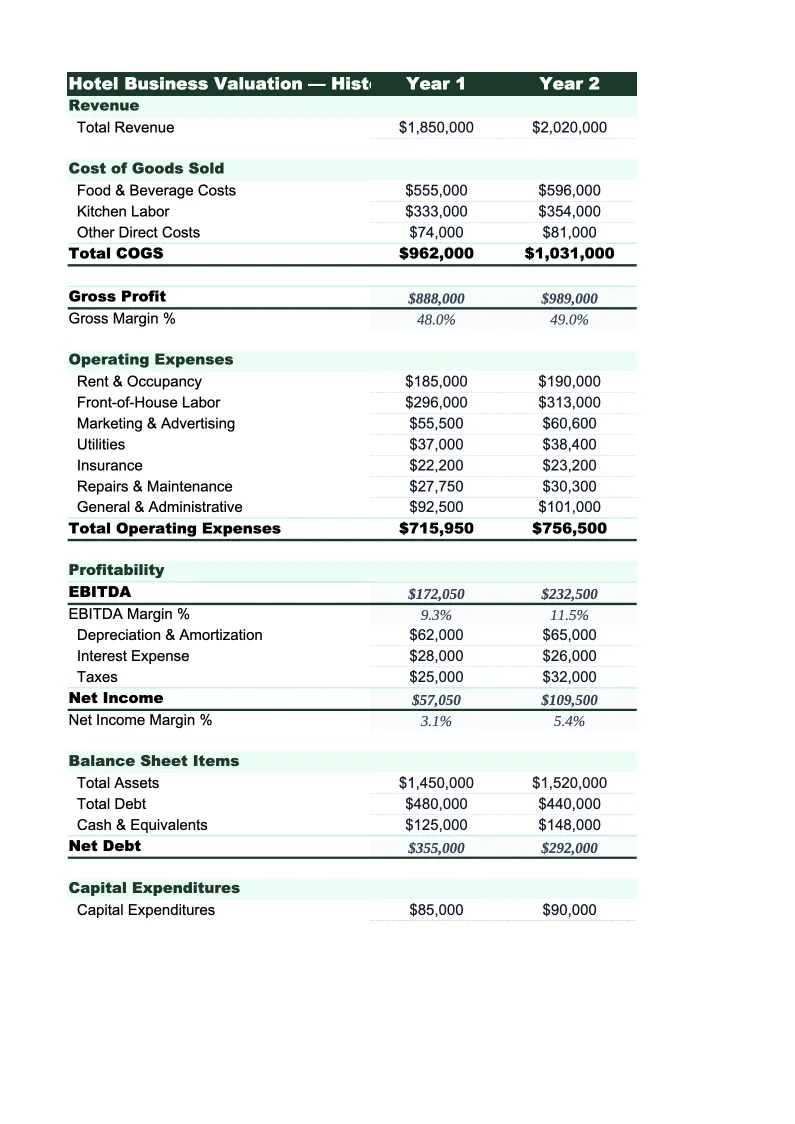
Hotel Valuation Template
Value a hotel or hospitality property using the income approach, comparable sales multiples, and asset-based methods — all in one Excel spreadsheet built for lodging businesses.
What's Inside This Hotel Valuation Template
This template includes 5 worksheets, each designed for a specific part of your hotel financial workflow:
Assumptions
The central input sheet where you enter the operating data that drives all three valuation approaches.
Income Approach
Calculates value based on the hotel's ability to generate income using two sub-methods.
Market Approach
Values the property by reference to comparable hotel sales using two industry-standard metrics: price per room and RevPAR multiple.
Asset-Based Approach
Estimates value based on the underlying assets — the real property, FF&E, and any associated brand or franchise value — minus liabilities.
Valuation Summary
Consolidates the results from all three approaches into a weighted average valuation.
Hotel Valuation Template Features
- Income approach with direct capitalization and DCF methods
- Market approach using price per room and RevPAR multiples
- Asset-based approach with replacement cost and depreciation
- Weighted average summary with adjustable method weights
- Cap rate sensitivity table across ±200 basis points
- Comparable sales tracker for up to 8 hotel transactions
How to Use This Hotel Valuation Spreadsheet
Start with the Assumptions sheet. Enter your hotel's current ADR, occupancy rate, number of available rooms, and revenue split by department. If you're valuing a property you own, pull these figures from your most recent full year of operations. If you're valuing an acquisition target, use the trailing 12-month (T-12) financials from the offering memorandum, or build a stabilized projection if the property is underperforming. Set your cap rate based on current market data for your property class and market — the sheet includes a reference table of typical cap rate ranges by hotel category as a starting point.
Once the assumptions are in place, move through each valuation tab. The Income Approach sheet will auto-populate from your inputs — review the NOI figure and make sure it reflects normalized operations (strip out one-time items, owner expenses, and non-recurring revenue). On the Market Approach sheet, enter your comparable sales data. Even three or four solid comps give you a defensible range. The Asset-Based sheet requires a few additional inputs around construction cost estimates and FF&E value — check with a local contractor or appraiser if you don't have current replacement cost data.
15 minutes from download to your first hotel valuation
Download the template, enter your operating data, and get a cross-checked valuation using income, market, and asset-based approaches — all in one spreadsheet.
Why Hotel Valuation Requires an Industry-Specific Approach
Valuing a hotel is more complicated than valuing most commercial real estate because the business component is inseparable from the physical asset. A vacant office building has a clear replacement cost; a hotel with a strong management team, a loyal corporate account base, and optimized RevPAR is worth significantly more than the same building with poor operations. That's why hotel appraisals always use at least two — and usually three — valuation approaches, and why the income approach typically carries the most weight: the property's value is fundamentally a function of what it earns, not just what it's built from.
The income approach for hotels centers on Net Operating Income (NOI), which differs from EBITDA in that it includes a reserve for FF&E replacement — typically 3–5% of total revenue — and is calculated after management fees. Stabilized NOI is what a competently managed property would generate in a normal year, stripped of one-time disruptions. Cap rates for hotels vary widely: luxury full-service properties in major markets trade at 7–8%, upper-midscale select-service assets in secondary markets at 9–10%, and budget or economy properties at 10–12% or higher. RevPAR multiples — where price is expressed as a multiple of annual RevPAR times the number of rooms — typically range from 6–10x depending on market and property quality. These benchmarks shift with interest rates and the broader transaction market, so always verify against recent comp sales.
Hotel Industry at a Glance
Financial templates built for hotels and hospitality businesses — from independent properties to branded franchises. Pre-loaded with room revenue, F&B, and event billing categories.
Revenue Drivers
- Room revenue (ADR × occupancy)
- Food & beverage
- Meeting & event space
- Spa & wellness
- Parking & ancillary fees
Key Cost Categories
- Labor (rooms, F&B, front office)
- Cost of F&B sold
- OTA & marketing commissions
- Utilities & property maintenance
- Franchise & management fees
- Administrative overhead
Typical Margins
Gross: 65-80% · Net: 10-20%
Seasonality
Business hotels peak weekdays and Q1/Q3; leisure properties peak summer and holidays. January is typically slowest for both segments.
Key Performance Indicators
Hotel Valuation Template FAQ
More Hotel Templates
Hotel Balance Sheet Template for Excel
$29
Hotel Budget Template for Excel
$29
Hotel Business Plan Template for Excel
$39
Hotel Cash Flow Template for Excel
$29
Hotel Expense Tracker Template for Excel
$29
Hotel Financial Model Template for Excel
$29
Hotel Income Statement Template for Excel
$29
Hotel Invoice Template for Excel
$29
Hotel KPI Dashboard Template for Excel
$29
Hotel P&L Template for Excel
$29
Hotel Pro Forma Template for Excel
$29
Hotel Project Budget Template for Excel
$29
Hotel Sales Forecast Template for Excel
$29
Hotel Valuation Template
$29