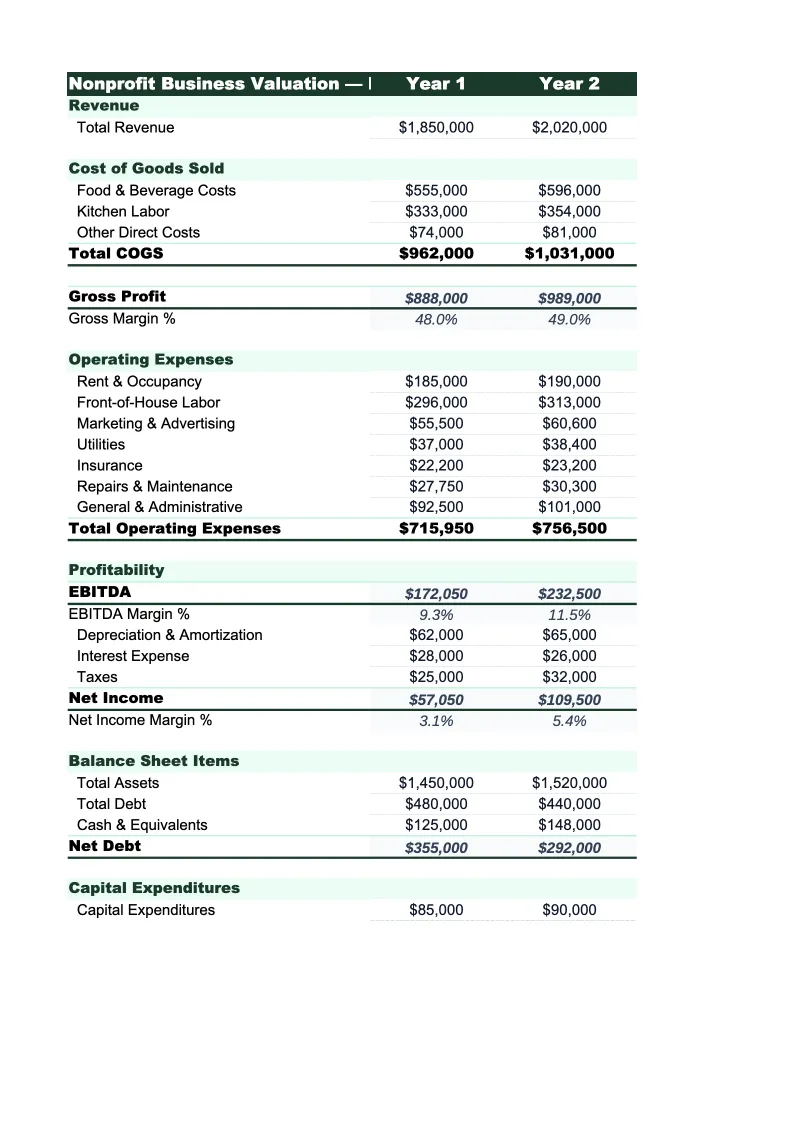
Nonprofit Valuation Template
Assess a nonprofit's financial health, sustainability, and organizational value using reserve analysis, donor concentration scoring, program efficiency ratios, and a structured framework for merger and acquisition conversations — built for how nonprofits actually change hands.
What's Inside This Nonprofit Valuation Template
This template includes 5 worksheets, each designed for a specific part of your nonprofit financial workflow:
Organization Inputs
The data entry foundation for the entire assessment. Enter trailing twelve-month total revenue broken out by source: government grants and contracts (federal, state, local), foundation grants (restricted and unrestricted), corporate sponsorships, individual donations (major gifts, annual fund, online giving), special events (gross revenue less direct event costs), earned revenue from program fees and services, membership dues, and investment income. The expense section captures program expenses broken down by each major program area, management and general (administrative) expenses, fundraising expenses, and depreciation. Balance sheet inputs include unrestricted net assets, temporarily restricted net assets, permanently restricted net assets (endowment), total current assets, and total current liabilities. Operational metrics include total number of active donors (gave in the past 12 months), number of recurring monthly donors, number of individual donors representing 5% or more of total contributions, headcount of development staff, total number of FTE employees and full-time volunteers, and total number of program beneficiaries served in the trailing twelve months. These inputs flow into all downstream analysis sheets automatically.
Financial Health Scorecard
A structured assessment of the organization's financial condition across six dimensions that charity evaluators, foundation program officers, and merger partners use to assess organizational capacity. The first dimension is the operating reserve ratio: unrestricted net assets divided by monthly operating expenses, benchmarked against the sector standard of 3–6 months. Organizations below 2 months face significant financial vulnerability; those above 6 months are generally considered well-capitalized for a nonprofit. The second dimension is the program expense ratio: program expenses as a percentage of total expenses, with sector benchmarks ranging from 65–80% for well-run organizations — Charity Navigator and GuideStar both use 65% as a minimum threshold for favorable ratings. The third is fundraising efficiency: cost to raise one dollar in charitable contributions, calculated as total fundraising expenses divided by total charitable revenue (excluding government contracts and earned revenue). An efficient fundraising operation typically costs $0.10–$0.25 per dollar raised; costs above $0.35 indicate structural fundraising challenges. The fourth dimension is government contract dependency: government grants and contracts as a percentage of total revenue — above 40–50% creates meaningful vulnerability to policy changes, appropriations gaps, and contract non-renewals. The fifth is donor concentration: contributions from the top five individual donors as a percentage of total individual giving, with concentration above 30% flagging high dependency on a small number of relationships. The sixth is revenue diversification across the full source mix, scored against the principle that no single revenue source should exceed 40% of total organizational revenue for a resilient nonprofit. Each dimension is scored 1–5, and the composite score drives the overall financial health rating used in the merger valuation summary.
Donor Concentration Analysis
A detailed look at the dependency and transferability of the organization's donor and funder base — the primary risk factor in any nonprofit merger, leadership transition, or sustainability assessment. Enter your top 20 funders and donors by trailing twelve-month contribution amount, and the sheet calculates each relationship's percentage of total contributed revenue, cumulative concentration across top 1, 3, 5, and 10 funders, and a transferability risk score based on relationship type. Government grants and foundation grants with written agreements are classified as institutional — they are typically more transferable through a merger or leadership change because they are governed by a contract with the organization entity, not a personal relationship with the executive director. Individual major gifts and corporate sponsorships driven by personal relationships with board members or the executive director are classified as relationship-dependent and carry higher post-transition attrition risk. The sheet also captures grant renewal history for the top 10 funders: multi-year commitments and track records of renewal are weighted as transferability assets; first-time grants with no renewal history are flagged as uncertain. A funder type breakdown shows the percentage of contributed revenue from each source category — diversified funders with no single source above 20–25% of total revenue score well on sustainability; organizations dependent on one government contract or one foundation relationship for 40%+ of their budget are structurally fragile. This analysis directly informs the merger due diligence section and the overall organizational value summary.
Asset-Based Approach
An estimation of the organization's tangible asset value, used primarily in merger and acquisition contexts where one nonprofit is acquiring another's programs, client base, or physical infrastructure. Total assets entered in the Organization Inputs sheet are categorized here by liquidity and transferability: unrestricted liquid assets (cash, money market, short-term investments) represent immediately available resources a successor organization could deploy; restricted assets (temporarily restricted net assets tied to specific grants or programs) are valued at face amount but flagged as encumbered — the restrictions travel with the funds and the successor organization inherits both the assets and the programmatic obligations. Permanently restricted endowment assets are valued at fair market value, though endowment transfers in nonprofit mergers require legal review and sometimes court approval depending on the endowment terms. Property and equipment are entered at book value (net of accumulated depreciation) with a separate field for current appraised or replacement value if the organization owns significant real property. Intangible assets — the program model, established service relationships, brand recognition, licensing agreements, staff capacity, and client or beneficiary databases — are qualitatively assessed rather than formulaically calculated, with a structured scoring section that captures whether the program model is documented and replicable, whether the client and beneficiary relationships are recorded in a CRM or case management system, and whether the organization holds any government contracts or licensed program models that transfer with the entity. The net asset value output provides the floor for merger transaction discussions.
Merger Valuation Summary
A single-page output consolidating the financial health score, donor concentration analysis, asset-based assessment, and program impact metrics into a structured merger or partnership discussion framework. Nonprofit mergers are not transacted like for-profit acquisitions — there is no purchase price paid to shareholders because no one owns a 501(c)(3). What changes hands is a combination of: unrestricted and transferable net assets (the financial value), established programs and their beneficiary relationships (the mission value), human capital and staff capacity (the operational value), and funder and donor relationships (the revenue-generation value). The summary separates these four components and presents each with a qualitative risk rating so both parties in a merger conversation — the acquirer and the organization being absorbed — can identify where value lies and where integration risks are concentrated. A sustainability trajectory assessment shows whether the organization's financial health metrics are improving, stable, or declining based on the last three years of audited financial data entered in the Organization Inputs section. A program integration complexity score estimates how difficult it would be for a successor organization to absorb and continue the programs, based on client complexity, government contract terms, staff specialization, and geographic footprint. The output also includes a reserve transfer analysis showing what portion of unrestricted net assets would remain available to the acquiring organization post-merger after satisfying all restricted fund obligations and wind-down costs.
Nonprofit Valuation Template Features
- Financial health scorecard across six dimensions — operating reserve, program expense ratio, fundraising efficiency, government dependency, donor concentration, and revenue diversification — benchmarked to Charity Navigator and GuideStar standards
- Donor and funder concentration analysis tracking top-20 relationships by revenue share, grant renewal history, and transferability classification
- Asset-based valuation separating unrestricted liquid assets, restricted funds, endowment, real property, and intangible program assets
- Merger valuation summary comparing financial value, mission value, operational value, and funder relationship value as distinct components
- Sustainability trajectory assessment using three years of financial data to identify improving, stable, or declining organizational health
- Program integration complexity scoring based on client complexity, government contract terms, staff specialization, and geographic scope
How to Use This Nonprofit Valuation Spreadsheet
Start with the Organization Inputs sheet. Pull trailing twelve-month revenue data from your most recent audited financial statements or your accounting system — most nonprofits track revenue across government grants, foundation grants, individual donations, events, and earned income in separate general ledger accounts, and keeping them separated here matters because each source type carries a different risk profile. Enter balance sheet figures for net assets in all three categories: unrestricted, temporarily restricted, and permanently restricted. Operational metrics including active donor count, recurring donor count, and development staff headcount flow into the Financial Health Scorecard and Donor Concentration Analysis, so gather those from your CRM or donor database. If your organization has multiple program areas, enter program expenses by program so the program expense ratio reflects the true mission-delivery percentage.
Work through the Financial Health Scorecard, then complete the Donor Concentration Analysis. The scorecard will surface your organization's strengths and vulnerabilities across the six dimensions that foundation program officers, merger partners, and major donors use to assess organizational capacity. Pay particular attention to operating reserve — many nonprofits that feel financially stable are actually running with fewer than two months of reserve, which creates significant fragility in the event of a delayed grant payment or an unexpected expense. The Donor Concentration Analysis is where most organizations encounter uncomfortable clarity about dependency: if your top three funders represent 50% or more of contributed revenue, the organization's sustainability is highly sensitive to those specific relationships, and that risk needs to be understood and managed.
Review the Merger Valuation Summary before any conversation with a potential merger partner, foundation considering a capacity-building grant, or board strategic planning process. The summary separates the four components of organizational value — financial assets, program capacity, staff and operational systems, and funder relationships — because nonprofit merger conversations often break down when parties conflate them. An organization with strong mission value (established programs, beneficiary relationships, specialized staff) but weak financial value (depleted reserves, government contract dependency) is a very different merger candidate than one with strong financial value and weak program integration complexity. The sustainability trajectory assessment is particularly useful for boards evaluating whether organizational challenges are structural or situational — and for funders deciding whether a capacity-building investment is likely to produce a different outcome.
Know your organization's financial health before your next board meeting
Enter your revenue mix, net assets, donor concentration, and program expenses — and get a complete picture of operating reserve depth, fundraising efficiency, and organizational sustainability.
How Nonprofits Are Valued for Mergers and Sustainability Planning
Valuing a nonprofit organization is fundamentally different from valuing a for-profit business — there are no shareholders, no equity, and no purchase price changes hands. But nonprofits are valued all the time, in contexts that matter: foundation program officers assess organizational capacity before making multi-year grants; potential merger partners evaluate whether absorbing a smaller nonprofit would strengthen or strain the acquirer's finances; boards considering leadership transitions need to understand whether the organization's revenue base is transferable to a new executive director or is deeply dependent on the outgoing leader's personal relationships; and planned giving advisors need to assess whether the organization has the financial health to responsibly steward a bequest. In all of these contexts, what's being assessed is sustainability and mission-delivery capacity — not shareholder return. The key metrics that matter are operating reserve depth, program expense efficiency, fundraising cost structure, and how distributed or concentrated the revenue base is.
The characteristics that make a nonprofit financially healthy, and therefore valuable to funders and merger partners, cluster around a few core ratios. A program expense ratio above 70% signals that the organization is efficiently converting resources into mission delivery rather than consuming them in overhead — though ratios above 90% can indicate underinvestment in the administration and fundraising infrastructure needed to sustain operations. An operating reserve of 3–6 months of operating expenses is the most commonly cited benchmark for organizational resilience; it provides a buffer against delayed grant payments, unexpected legal or facility costs, or the loss of a major funder relationship. Fundraising efficiency below $0.20 per dollar raised indicates a healthy balance between development investment and return; costs above $0.35 per dollar raised suggest either significant infrastructure challenges or overreliance on expensive event-based fundraising. Revenue diversification — no single source above 35–40% of total revenue — is the structural characteristic that most clearly distinguishes sustainably funded nonprofits from those that are one government contract or one foundation relationship away from a financial crisis.
Nonprofit mergers are driven more by mission alignment and organizational sustainability than by financial engineering, but the financial analysis matters because it determines whether a merger strengthens or burdens the surviving organization. The practical framework for evaluating a merger candidate is: what are the unrestricted net assets that would transfer (the financial runway a successor organization gets), what are the restricted funds and the programmatic obligations that come with them, what is the complexity and transferability of the programs being absorbed, and what happens to the funder and donor base when the organizational name and leadership change. The last question is often the most uncertain: individual major donors with strong personal relationships to an executive director may not transfer. Foundation relationships are more portable, particularly multi-year commitments with written agreements. Government contracts typically transfer if the successor organization meets the contract qualifications. The template's merger valuation summary is designed around these specific questions so that both parties in a merger conversation can move past surface-level financial statements and have a structured discussion about where value actually lies and where the integration risks are concentrated.
Nonprofit Industry at a Glance
Financial templates built for nonprofit organizations — from community foundations to service-delivery charities. Pre-loaded with fund accounting categories, grant tracking, and program expense ratios.
Revenue Drivers
- Grants (government & foundation)
- Individual donations
- Program fees
- Membership dues
- Special events
- Corporate sponsorships
Key Cost Categories
- Personnel & benefits
- Program expenses
- Administrative overhead
- Fundraising costs
- Occupancy
- Equipment & technology
Typical Margins
Gross: N/A · Net: 2-5% operating surplus
Seasonality
Grant cycles create Q1 and Q4 revenue spikes; year-end giving peaks in December. Fiscal years often run July–June rather than calendar year.
Key Performance Indicators
Nonprofit Valuation Template FAQ
More Nonprofit Templates
Nonprofit Balance Sheet Template for Excel
$29
Nonprofit Budget Template for Excel
$29
Nonprofit Cash Flow Template for Excel
$29
Nonprofit Financial Model Template for Excel
$29
Nonprofit Income Statement Template for Excel
$29
Nonprofit Invoice Template for Excel
$29
Nonprofit KPI Dashboard Template for Excel
$29
Nonprofit P&L Template for Excel
$29
Nonprofit Pro Forma Template for Excel
$29
Nonprofit Project Budget Template for Excel
$29
Nonprofit Sales Forecast Template for Excel
$29
Nonprofit Valuation Template
$29