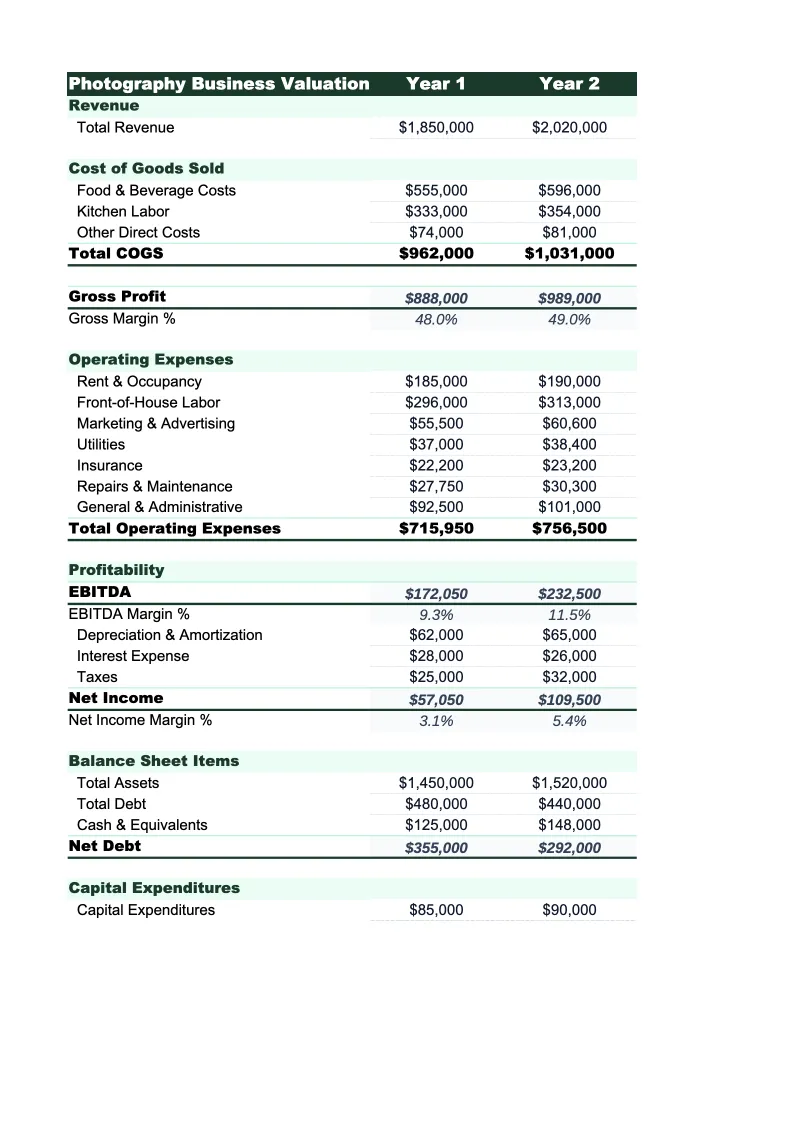
Photography Valuation Template
Value your photography business using seller's discretionary earnings multiples, a revenue approach, and an owner-dependency scorecard — built around how photography studios and portrait businesses actually sell.
What's Inside This Photography Business Valuation Template
This template includes 6 worksheets, each designed for a specific part of your photography financial workflow:
Business Inputs
The data foundation for the entire model. Enter your trailing twelve-month gross revenue split by category: wedding photography, portrait sessions (family, senior, newborn/maternity, headshots), commercial and editorial work, image licensing fees, print and product sales, digital download packages, and second shooter or associate photographer revenue. The expense section captures cost of goods sold (lab and printing costs, album products, packaging), editing software subscriptions (Adobe Creative Cloud, Lightroom, Capture One), gallery delivery platform fees (Pixieset, Shootproof, Pic-Time), equipment purchase and depreciation, studio rent and utilities, insurance (equipment and liability), marketing and advertising, travel and location expenses, and professional services. Owner compensation — salary, any distributions, and personal expenses run through the business — is entered separately for SDE normalization. On the operational side, enter total sessions completed in the trailing twelve months, average revenue per session or client, number of repeat clients versus new clients, number of photographers on staff (including associates and second shooters), and whether the business generates passive income through image licensing or stock photography. All downstream sheets pull from these inputs.
Revenue Multiple Approach
A revenue-based screening method for establishing a broad value range before digging into earnings. Photography businesses selling as going concerns typically trade at 0.5–1.5x trailing twelve-month gross revenue in private transactions, with the range driven by how transferable the business is. A studio where clients book the brand, location, or team — rather than specifically the owner-photographer — commands the upper end of this range. A solo photographer whose entire booking volume is tied to personal reputation and client relationships typically lands at 0.5–0.75x revenue, because a buyer inheriting the equipment and business name faces a high risk that existing clients won't rebook under new ownership. The sheet adjusts the multiple based on three factors: revenue mix (recurring portrait clients, commercial contracts, and licensing income command a premium over one-time wedding bookings), staff capacity (associate photographers who can carry client relationships post-sale meaningfully reduce owner dependency risk), and passive revenue (licensing and stock photography income that continues without active effort from any photographer). A per-session implied value is calculated alongside the revenue multiple as a cross-check, helping you benchmark against comparable transactions where studio sale prices have been disclosed.
SDE Multiple Approach
Seller's Discretionary Earnings is the primary income-based valuation method for photography businesses and other owner-operated service businesses. SDE starts from net income and adds back the owner-photographer's total compensation — salary, draws, and any personal expenses run through the business — plus depreciation and amortization on equipment, interest on business debt, and one-time or non-recurring expenses such as a major equipment purchase or significant marketing investment. Unlike EBITDA normalization for larger businesses, SDE normalization for photography businesses adds back all owner compensation because a buyer is replacing the owner entirely, including the labor of shooting and editing, not just a management layer. The resulting SDE figure represents the total cash the business generates for one full-time owner-operator. Photography businesses typically sell at 2.0–3.5x trailing twelve-month SDE in private transactions. The sheet includes a multiple selection matrix that maps specific practice attributes — owner dependency, revenue transferability, staff depth, lease or studio situation, brand equity, and passive income — to the appropriate SDE multiple range, so you can see where your business falls and what would move it higher before initiating a sale.
Asset Inventory
Calculates the tangible asset value of the photography business, which establishes the floor for any transaction and is the primary basis of value for businesses where goodwill is low or non-transferable. Photography businesses carry meaningful equipment bases: professional camera bodies and backup bodies, lens inventories (typically $5,000–$25,000 for a working wedding or portrait studio), lighting systems (strobes, monolights, modifiers, and stands), grip equipment, video capability if offered, and a studio facility with props, backgrounds, and client-facing furniture and decor if operating a physical studio. Each asset is entered at estimated fair market value — used professional photography equipment typically retains 30–60% of new value depending on age, model, and condition, with high-end camera bodies and prime lenses holding value best. The goodwill section captures intangible business value: established brand and reputation (Google reviews, wedding directory presence, social media following), active client relationships (repeat portrait clients who have booked more than once), commercial contracts or licensing agreements with recurring revenue, website domain authority and SEO traffic, and the business's booking calendar and leads pipeline. For photography businesses with high owner dependency, goodwill may represent a small fraction of total value — or may be discounted to near zero in a pure equipment sale scenario — which is why the SDE multiple approach and the asset floor need to be assessed together.
Owner Dependency Scorecard
A structured scoring model for the factors that most directly determine how much of a photography business's value is transferable to a new owner. Owner dependency is the central risk factor in photography valuations: a business where clients book because of the specific photographer's style, personality, or reputation creates a meaningful risk that bookings decline after a sale, and buyers price that risk directly into the offer. The scorecard evaluates eight dimensions: client loyalty to the brand versus the photographer (are repeat clients booking the studio or specifically requesting the owner?); staff depth and associate capability (can associate photographers handle sessions independently and maintain client satisfaction without the owner present?); documented systems and processes (is the workflow — booking, communication, shooting, editing, delivery — documented so a new owner can run it?); digital and brand assets (is the website, Instagram, and Google Business profile tied to the business brand or to the owner's personal name and face?); recurring and passive revenue (what portion of annual revenue comes from repeat portrait clients, licensing, or commercial contracts that would continue regardless of ownership?); booking lead time and pipeline health (how full is the calendar, and are bookings driven by inbound inquiries to the business or by personal referrals to the owner?); geographic market and competition (is the studio in a market with limited competition and strong demand, or a saturated market where clients have many alternatives?); and commercial versus consumer revenue mix (commercial clients contracting with the business entity are more transferable than individual consumers with a personal relationship to the photographer). Each factor is scored 1–5, and the composite score maps to a specific SDE multiple adjustment within the 2.0–3.5x range.
Valuation Summary
A single-page output consolidating all three valuation approaches into one view across conservative, base, and optimistic scenarios. The summary shows the revenue multiple range, the SDE multiple range, and the tangible asset floor side by side, with goodwill isolated so buyers and sellers can see what fraction of the total price represents transferable business value versus tangible equipment and physical assets. A transferability comparison section shows how the same revenue and SDE figures produce different valuations depending on the ownership transition scenario: an asset sale (equipment and business name only), a partial transition (owner stays on for 6–12 months), and a full going-concern sale (documented systems, trained staff, and client relationships transfer intact). The sensitivity table shows how the SDE valuation shifts as the multiple moves in 0.25x increments from 1.75x to 3.75x, and how the revenue multiple result moves across the 0.5x–1.5x range, giving both parties a clear view of the full negotiation band. Most solo photography businesses sell in the $30,000–$150,000 range; established studios with associate photographers, strong recurring revenue, and transferable client relationships often reach $150,000–$400,000; commercial photography businesses with contracts and licensing income can trade at the high end of the range or above it.
Photography Business Valuation Template Features
- Revenue multiple calculation with per-session implied value benchmarked to photography business transactions
- SDE normalization with full owner compensation add-back for owner-operator photography businesses
- Tangible asset inventory covering camera bodies, lenses, lighting, studio equipment, and goodwill components
- Owner dependency scorecard scoring eight transferability factors including client loyalty, staff depth, and passive revenue
- Transferability comparison showing asset sale, partial transition, and full going-concern scenarios in the Valuation Summary
- Three-scenario output with SDE sensitivity table and revenue multiple range showing full negotiation band
How to Use This Photography Business Valuation Spreadsheet
Start with the Business Inputs sheet. Pull your trailing twelve-month revenue by category from your booking and accounting software — most photographers use HoneyBook, Studio Ninja, or 17hats for session revenue tracking, and QuickBooks or a basic spreadsheet for expenses. Break down revenue by session type: weddings, portrait sessions by category (families, seniors, newborns, headshots), commercial work, licensing, and product sales. You'll need the full expense structure from your P&L, total owner compensation including any draws or personal expenses through the business, and operational data: total sessions completed, average revenue per session, number of repeat clients who have booked more than once, and headcount of any associate photographers or staff. If your books combine COGS (labs, albums, packaging) with general overhead, separate them — buyers look at product margin as a proxy for how efficiently the business is priced and managed.
Work through the Revenue Multiple and SDE Multiple sheets together, then score the Owner Dependency Scorecard. The SDE normalization step requires an honest accounting of all owner compensation — base pay, profit distributions, and any business expenses that are genuinely personal (vehicle, travel, CE). This number is often larger than photographers expect, because many owner-operators mix personal and business spending in ways that are clean for tax purposes but need to be separated for a valuation. The Owner Dependency Scorecard is where the real analytical work happens: score each factor honestly, because this scorecard is ultimately what a buyer will walk through with you during diligence, and understanding your score before that conversation gives you the opportunity to improve specific factors before going to market.
Review the Valuation Summary before any conversation with a business broker or prospective buyer. The transferability comparison section is particularly valuable if you're planning a transition over time — a phased sale where you stay on as an employed photographer for 12–24 months can meaningfully increase the multiple a buyer is willing to pay, because it reduces the client relationship transfer risk that compresses valuations for solo operators. The sensitivity table shows the full range from a pessimistic to an optimistic scenario, so you understand what improving one factor — adding a trained associate, building out documented booking systems, or growing your repeat portrait client base — would actually do to the final number before you invest the time.
Know what your photography business is worth before you sell
Enter your revenue, SDE, client data, and operational metrics — and get a defensible valuation range with the revenue multiple, SDE approach, and owner dependency scorecard that buyers will use to make their offer.
How Photography Businesses Are Valued When They Sell
Photography business valuations hinge almost entirely on one question: how much of the business goes with the owner when they leave? A photography studio where clients book because of the brand, the associate team, or the location can sell as a going concern with a meaningful goodwill premium. A solo photographer whose clients book specifically because of their personal style, their portfolio, and their social media presence — which describes the majority of high-earning photographers — faces a fundamentally different valuation problem. The work is valuable. The revenue is real. But the question is whether any of it follows a new owner, and buyers price that uncertainty directly into the offer. Most solo photography businesses that sell do so as asset sales or partial transitions, not full going-concern acquisitions, because the goodwill is tied to a person rather than a business.
The operational factors that drive premium valuations in photography are the same ones that reduce owner dependency. Associate photographers who can handle client sessions independently and maintain client satisfaction — not just assist during busy periods — demonstrate that the business can operate without the owner and are the single most important value driver. Repeat portrait clients who have booked more than once (and specifically re-booked the studio rather than the owner-photographer personally) represent recurring revenue that transfers with a sale, and buyers assign meaningfully higher multiples to studios with documented repeat booking rates above 30–40%. Commercial contracts — brands, publications, or agencies contracting with the studio for ongoing work — are the most transferable revenue in the industry because they are tied to the business entity, not to an individual's portfolio. Passive licensing income from stock photography or existing image archives is similarly transferable and is valued at a premium.
The practical workflow for a photography business sale involves three scenarios that deserve separate analysis before engaging any buyer. An asset sale transfers equipment, the business name, and any digital assets but does not assume client goodwill — buyers pay near tangible asset value and expect to rebuild the client base themselves. A partial transition involves the selling photographer staying on as an employed shooter for 6–24 months to hand off client relationships gradually — this scenario can achieve 2.5–3x SDE if well-structured. A full going-concern sale requires documented systems, trained associates, a transferable brand, and demonstrated repeat client relationships — the conditions that support the top of the 2.5–3.5x SDE range. This template is designed to show you all three scenarios alongside the asset floor so you can assess which path makes the most sense for your specific business before committing to a process.
Photography Industry at a Glance
Financial templates built for photographers and photography studios — from solo portrait photographers to commercial studios. Pre-loaded with session fees, licensing line items, print product categories, and industry-standard KPIs.
Revenue Drivers
- Session bookings
- Print & product sales
- Image licensing fees
- Digital download packages
- Second shooter add-ons
Key Cost Categories
- Equipment purchase & depreciation
- Editing software subscriptions
- Gallery delivery platform fees
- Studio rent
- Lab & printing costs (COGS)
- Equipment & liability insurance
- Marketing & advertising
- Travel & location expenses
Typical Margins
Gross: 50-70% · Net: 15-35%
Seasonality
Peak seasons: spring (April–June) and fall (September–November) for portraits and weddings. December busy for holiday portraits. January–February typically slowest.
Key Performance Indicators
Photography Business Valuation FAQ
More Photography Templates
Photography Balance Sheet Template for Excel
$29
Photography Budget Template for Excel
$29
Photography Cash Flow Template for Excel
$29
Photography Financial Model Template for Excel
$29
Photography Income Statement Template for Excel
$29
Photography Invoice Template for Excel
$29
Photography KPI Dashboard Template for Excel
$29
Photography P&L Template for Excel
$29
Photography Business Pro Forma Template for Excel
$29
Photography Project Budget Template for Excel
$29
Photography Sales Forecast Template for Excel
$29
Photography Valuation Template
$29