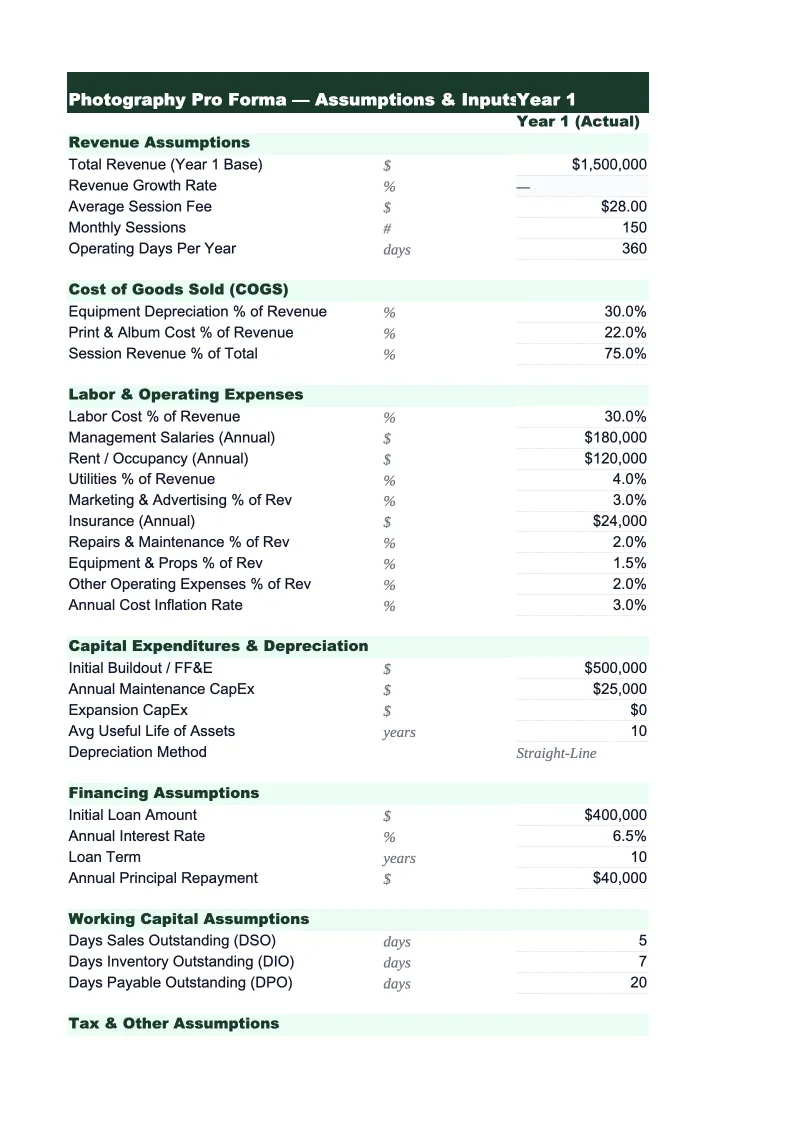
Photography Pro Forma Template
Project revenue, costs, and returns for a new photography studio, solo practice expansion, or specialty pivot — with pre-built formulas for weddings, portraits, commercial, and product sessions.
What's Inside This Photography Pro Forma Template
This template includes 7 worksheets, each designed for a specific part of your photography financial workflow:
Assumptions
The control panel for your entire photography pro forma.
Revenue Projections
A 5-year monthly and annual revenue forecast broken out by income category: session fees by type (wedding, portrait, commercial, event, newborn), print and physical product sales, digital download packages, image licensing fees, and second shooter or associate photographer revenue.
Expense Projections
A detailed 5-year expense forecast organized into cost of goods sold (lab and printing costs, album costs, physical product fulfillment), equipment costs (new gear purchases, annual depreciation, maintenance and repair), software and platform fees (editing subscriptions like Lightroom and Capture One, gallery delivery platforms like Pixieset or Pic-Time, booking and CRM tools), operating overhead (studio rent, utilities, insurance, travel and location expenses, marketing and advertising, outsourced editing), and labor costs if you hire second shooters, associates, or office support.
Capital Requirements
Itemizes the upfront investment needed to launch or significantly expand a photography business.
P&L Projection
A full projected income statement covering 5 years annually and year 1 monthly.
Cash Flow Projection
Projects monthly cash flow for year 1 and annual cash flow for years 2–5.
Dashboard
A one-page summary designed for a bank, investor, business partner, or your own annual planning review.
Photography Business Pro Forma Template Features
- Session-type revenue modeling: weddings, portraits, commercial, events, newborn, and licensing
- Print and product COGS tracking separate from session fee revenue
- CODB (Cost of Doing Business) per session hour calculated automatically from your expense inputs
- Seasonal cash flow modeling with peak spring/fall and slow winter months
- Capital requirements calculator for new studio buildouts and equipment purchases
- 5-year P&L with gross and net margins benchmarked against photography industry ranges
How to Use This Photography Business Pro Forma
Start with the Assumptions sheet — this is where the full model is built. Enter your planned session types and monthly booking targets, your average fees per session type, and your expected print sales attach rate (the percentage of portrait clients who purchase prints or albums). If you're already shooting, use your last 12 months of bookings as your baseline. If you're projecting a new business, use industry benchmarks as your starting point: portrait session fees typically run $300–$800, wedding packages $2,000–$5,000, and commercial day rates $1,500–$3,500 depending on market. Enter your overhead costs — studio rent, software, insurance — and your planned equipment investment. Most users spend 20–30 minutes getting inputs right, and the rest of the model fills in automatically.
Once your assumptions are in, review the Revenue Projections and Expense Projections sheets to check that the outputs look realistic. The most important ratio to verify is your CODB (Cost of Doing Business) per session hour, which the Dashboard calculates automatically. If your CODB is higher than your average session fee, your pricing isn't covering your overhead — a problem that shows up clearly in this model but would otherwise stay hidden in a basic income tracker. Also check your gross margin: photographers with strong digital delivery programs should see 60–70% gross margins, while those with album and print programs will run 50–60% after lab costs.
Know your numbers before you sign a lease or buy a camera
Download the template, enter your session types and overhead, and see whether your pricing and booking volume actually add up to a profitable photography business.
Why Photographers Need a Pro Forma Before Opening a Studio
Photography is one of the few creative businesses where pricing is almost entirely self-determined — there's no market rate that clients know in advance. That's both an opportunity and a trap. Photographers routinely underprice their work because they haven't modeled their Cost of Doing Business (CODB): the total annual cost to operate the business divided by billable hours. A photographer with $40,000 in annual overhead shooting 40 weddings a year needs to earn $1,000 per wedding just to break even before paying themselves. Without a pro forma, that math stays invisible until tax season reveals that a year of hard work produced a $12,000 net income.
The financial structure of a photography business depends heavily on the specialty. Wedding photographers have high average revenue per client ($3,000–$8,000 for a full package) but low booking volume (most solo photographers shoot 20–50 weddings per year) and lumpy cash flow driven by deposit timing. Portrait photographers have lower per-session revenue but more frequent bookings and more predictable month-to-month income. Commercial photographers have the highest day rates but the most variable booking cycles — one large corporate client can represent 30% of annual revenue. A pro forma forces you to model your specific mix and see whether the math works before you invest in studio space or equipment.
Photography Industry at a Glance
Financial templates built for photographers and photography studios — from solo portrait photographers to commercial studios. Pre-loaded with session fees, licensing line items, print product categories, and industry-standard KPIs.
Revenue Drivers
- Session bookings
- Print & product sales
- Image licensing fees
- Digital download packages
- Second shooter add-ons
Key Cost Categories
- Equipment purchase & depreciation
- Editing software subscriptions
- Gallery delivery platform fees
- Studio rent
- Lab & printing costs (COGS)
- Equipment & liability insurance
- Marketing & advertising
- Travel & location expenses
Typical Margins
Gross: 50-70% · Net: 15-35%
Seasonality
Peak seasons: spring (April–June) and fall (September–November) for portraits and weddings. December busy for holiday portraits. January–February typically slowest.
Key Performance Indicators
Photography Pro Forma Template FAQ
More Photography Templates
Photography Balance Sheet Template for Excel
$29
Photography Budget Template for Excel
$29
Photography Business Plan Template for Excel
$39
Photography Cash Flow Template for Excel
$29
Photography Expense Tracker Template for Excel
$29
Photography Financial Model Template for Excel
$29
Photography Income Statement Template for Excel
$29
Photography Invoice Template for Excel
$29
Photography KPI Dashboard Template for Excel
$29
Photography P&L Template for Excel
$29
Photography Project Budget Template for Excel
$29
Photography Sales Forecast Template for Excel
$29
Photography Business Valuation Template for Excel
$29
Photography Pro Forma Template
$29