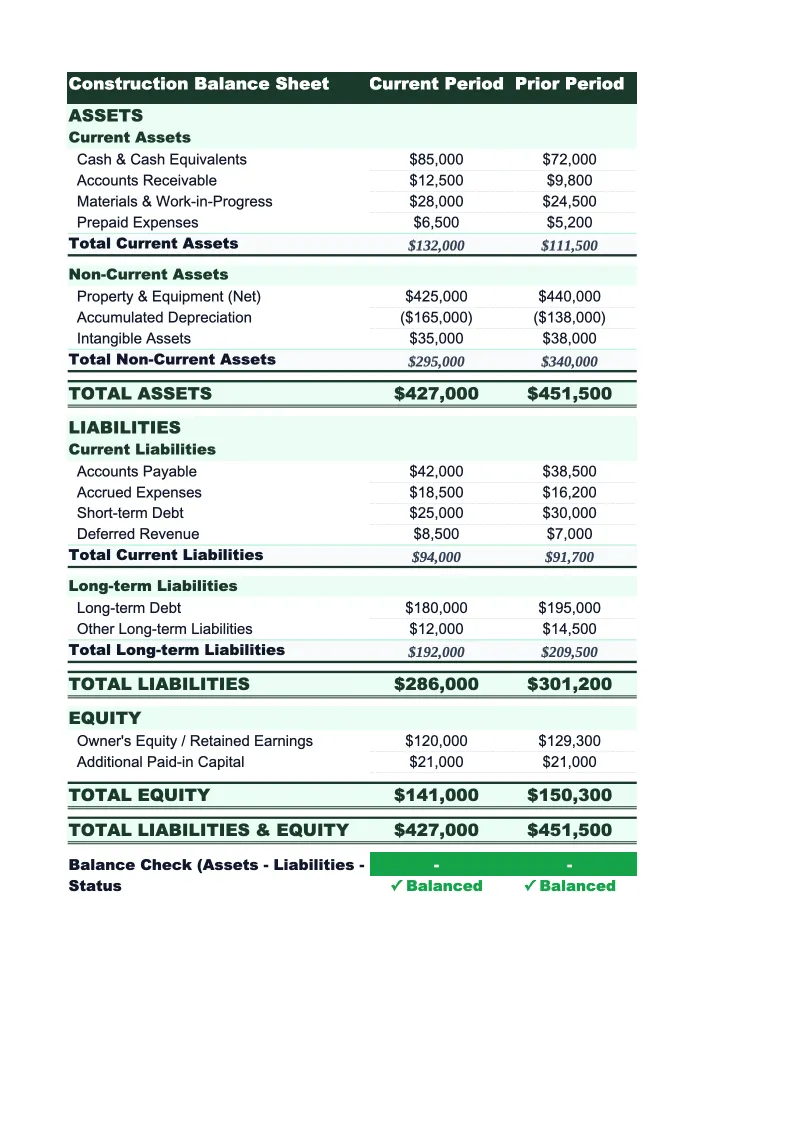
Construction Balance Sheet Template
Track what your construction company owns, owes, and is worth — a balance sheet built for contractors with retainage receivables, WIP billing schedules, and equipment depreciation.
What's Inside This Construction Balance Sheet Template
This template includes 4 worksheets, each designed for a specific part of your construction financial workflow:
Balance Sheet
The core financial statement organized around the construction chart of accounts.
WIP Schedule
The work-in-progress schedule is the most construction-specific component of a contractor balance sheet — and the one that most separates construction accounting from generic small-business accounting.
Equipment Register
A fixed-asset register tracking every major piece of equipment, vehicle, and tool the company owns.
Period Comparison
A side-by-side view of two balance sheet dates — typically year-end vs.
Construction Balance Sheet Template Features
- Retainage receivable and retainage payable tracked as separate line items
- WIP schedule calculates overbillings and underbillings and feeds them into the balance sheet
- Equipment register with depreciation schedules by asset class
- Accounts payable split between trade suppliers and subcontractors
- Accounting equation check — flags any imbalance automatically
- Period-over-period comparison for bonding agent and lender reporting
How to Use This Construction Balance Sheet Spreadsheet
Start with the Equipment Register before anything else. Pull your depreciation schedule from last year's tax return or your accounting software and enter each major asset: equipment description, purchase date, original cost, and useful life. The sheet handles depreciation calculations and produces category totals that flow into the balance sheet automatically. For most contractors, this is the most time-intensive step — but it only needs to be done once. After the initial setup, you're just adding new assets and updating loan balances.
Next, work through the WIP Schedule using your job cost reports. List every open project with its contract value, total estimated costs, actual costs incurred to date, and billings to date. The sheet calculates percent complete and flags which projects are underbilled (you've earned more than you've invoiced) and which are overbilled (you've invoiced more than you've earned). These figures flow directly into the current assets and current liabilities sections of the main balance sheet — so getting this right is essential. Then fill in the Balance Sheet itself: pull cash from your bank statement, trade receivables and retainage from your AR aging report, and payables from your AP aging. Match equipment loan balances to the individual assets in your register.
15 minutes from download to your first construction balance sheet
Download the template, enter your accounts and open projects, and see your company's full financial position — assets, WIP positions, equipment equity, and retainage included.
Why Every Construction Company Needs a Balance Sheet Template
Construction balance sheets are unlike most small-business balance sheets because of two items that don't exist in most industries: retainage and work-in-progress billing positions. Retainage — typically 5–10% of each progress payment withheld by the project owner until final completion — can represent a substantial portion of a contractor's assets. A general contractor running $5 million in annual revenue might carry $250,000–$500,000 in retainage receivable at any given time. That's real money tied up in completed work that won't hit your bank account until punchlist items are closed, final lien waivers are exchanged, and the owner is satisfied. Contractors who don't track retainage separately from regular receivables routinely underestimate how much cash is locked up in their balance sheet.
The WIP schedule is what makes construction accounting genuinely complex. On a percentage-of-completion basis, the revenue you've earned on a project is not the same as what you've billed. If a project is 60% complete and you've only billed 40% of the contract value, you have an underbilling — a current asset representing earned revenue you haven't invoiced yet. If you've billed 70% of a project that's only 50% complete, you have an overbilling — a current liability representing cash you've collected for work not yet done. These positions are real and meaningful. Growing underbillings can signal that project managers are billing behind schedule, which strains cash flow. Growing overbillings can mask profitability problems that only surface at project closeout. Bonding companies look at these numbers closely because they reveal operational discipline.
Construction Industry at a Glance
Financial templates built for construction companies — from general contractors to specialty trades. Pre-loaded with job costing categories, bid tracking, and project-based financials.
Revenue Drivers
- Project contracts
- Change orders
- Service & maintenance
- Material markups
Key Cost Categories
- Materials
- Labor (direct)
- Subcontractors
- Equipment rental
- Permits & insurance
- Overhead
Typical Margins
Gross: 20-35% · Net: 2-7%
Seasonality
Peak activity spring through fall; winter slowdown in northern climates. Year-end push to close projects.
Key Performance Indicators
Construction Balance Sheet Template FAQ
More Construction Templates
Construction Budget Template for Excel
$29
Construction Business Plan Template for Excel
$39
Construction Cash Flow Template for Excel
$29
Construction Expense Tracker Template for Excel
$29
Construction Financial Model Template for Excel
$29
Construction Income Statement Template for Excel
$29
Construction Invoice Template for Excel
$29
Construction KPI Dashboard Template for Excel
$29
Construction P&L Template for Excel
$29
Construction Pro Forma Template for Excel
$29
Construction Project Budget Template for Excel
$29
Construction Sales Forecast Template for Excel
$29
Construction Business Valuation Template for Excel
$29
More Balance Sheet Templates
Construction Balance Sheet Template
$29