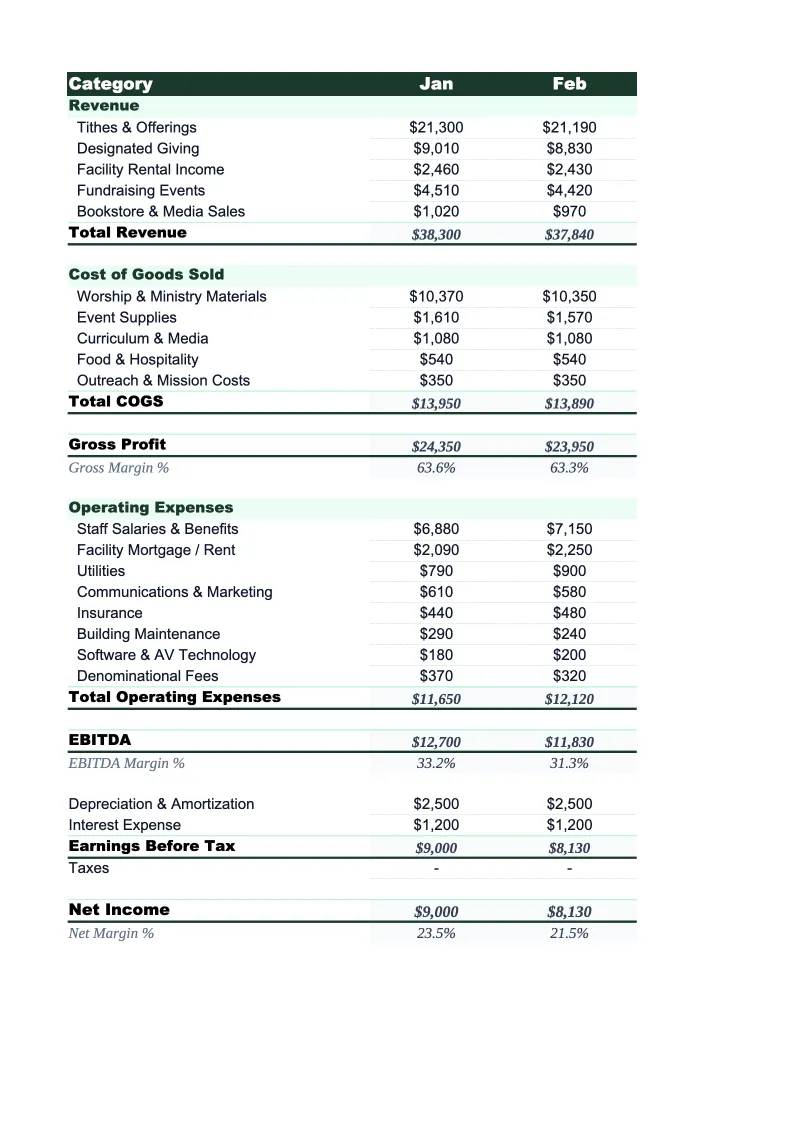
Church P&L Template
Track your church's giving income, ministry expenses, and operating surplus with a P&L template built for religious organizations — not a generic spreadsheet that doesn't account for tithes, offerings, or housing allowances.
What's Inside This Church P&L Template
This template includes 4 worksheets, each designed for a specific part of your church financial workflow:
Monthly P&L
The main worksheet where you record each month's income and expenses for the church.
Annual P&L
A full 12-month view that pulls data from the Monthly P&L sheet automatically.
Ministry Budget vs Actual
A worksheet that compares your approved ministry budget to actual spending for each month and year-to-date.
Dashboard
A one-page summary with charts and key financial metrics for leadership and board presentations.
Church P&L Template Features
- Giving income split by type: tithes, special offerings, facility rental, and school tuition
- Expense categories follow standard church chart of accounts including housing allowance
- Ministry Budget vs Actual tracker with monthly and YTD variance calculations
- Personnel cost as % of budget calculated automatically each month
- Operating reserve months calculated from current balance and monthly expense run rate
- Visual dashboard formatted for board packets and congregational reports
How to Use This Church P&L Spreadsheet
Download the .xlsx file and open it in Excel or Google Sheets — no macros, no plugins. Start with the Monthly P&L sheet and review the pre-loaded income and expense categories. Most churches can work with 80–90% of them as-is; rename or remove any that don't fit your structure. If your church doesn't operate a school or cemetery, remove those income lines and add categories that do apply — like building fund contributions or memorial gifts. The initial setup typically takes 15–20 minutes.
At the end of each month, pull your giving report from your church management software (Planning Center, Breeze, Church Community Builder, or similar) and enter the giving totals by category. For expenses, pull from your accounting software or bank statements. Fill in the Ministry Budget vs Actual sheet by entering your board-approved budget for the year — the sheet will divide it into monthly targets and compare against what you've actually spent. This is the most useful view for your finance committee between board meetings.
15 minutes from download to your first P&L
Download the template, enter last month's giving and expenses, and see your church's operating surplus and ministry spending — with personnel and facilities percentages calculated automatically.
Why Every Church Needs a P&L Template
Churches operate on a fundamentally different financial model than businesses — there's no product margin to optimize, no revenue growth target, and the goal isn't profit but faithful stewardship of donated resources. Yet the need for clear, accurate financial reporting is just as real. Congregational trust depends on financial transparency, and most church governing documents require regular financial reports to leadership boards and often to the congregation itself. A structured P&L is how churches demonstrate that stewardship clearly — and catch problems before they become crises.
A church P&L has specific structural requirements that generic templates miss. Income needs to distinguish between regular giving (tithes and plate offerings), designated funds (building campaign, missions, memorial gifts), and earned income (facility rental, school tuition, event fees) — because these behave differently, hit cash at different times, and carry different spending restrictions. Expenses should be organized by ministry function, not just account type, so the board can see what each area of ministry actually costs. Personnel expenses — often 45–55% of a church budget — should include not just salaries but also housing allowances, which are a tax-exempt benefit unique to clergy and often the largest single compensation item.
Church Industry at a Glance
Financial templates built for churches and religious organizations — facility rentals, ceremony fees, staff payroll, and ministry budgets.
Revenue Drivers
- Tithes and weekly offerings
- Facility rental income
- Special offerings (Christmas, Easter)
- School and childcare tuition
- Cemetery and memorial service fees
Key Cost Categories
- Personnel and housing allowance
- Facilities and occupancy
- Worship and ministry programs
- Missions and benevolence
- Administration and software
- Debt service
Typical Margins
Gross: N/A · Net: 0-5% operating surplus
Seasonality
Giving peaks at Christmas and Easter; summer typically sees 10-20% attendance and giving decline. Year-end giving surge in December is common for tax purposes.
Key Performance Indicators
Church P&L Template FAQ
More Church Templates
Church Balance Sheet Template for Excel
$29
Church Budget Template for Excel
$29
Church Budget & Financial Plan Template for Excel
$39
Church Cash Flow Template for Excel
$29
Church Expense Tracker Template for Excel
$29
Church Financial Model Template for Excel
$29
Church Income Statement Template for Excel
$29
Church Invoice Template for Excel
$29
Church KPI Dashboard Template for Excel
$29
Church Pro Forma Template for Excel
$29
Church Project Budget Template for Excel
$29
Church Revenue Forecast Template for Excel
$29
Church Valuation Template for Excel
$29
Church P&L Template
$29