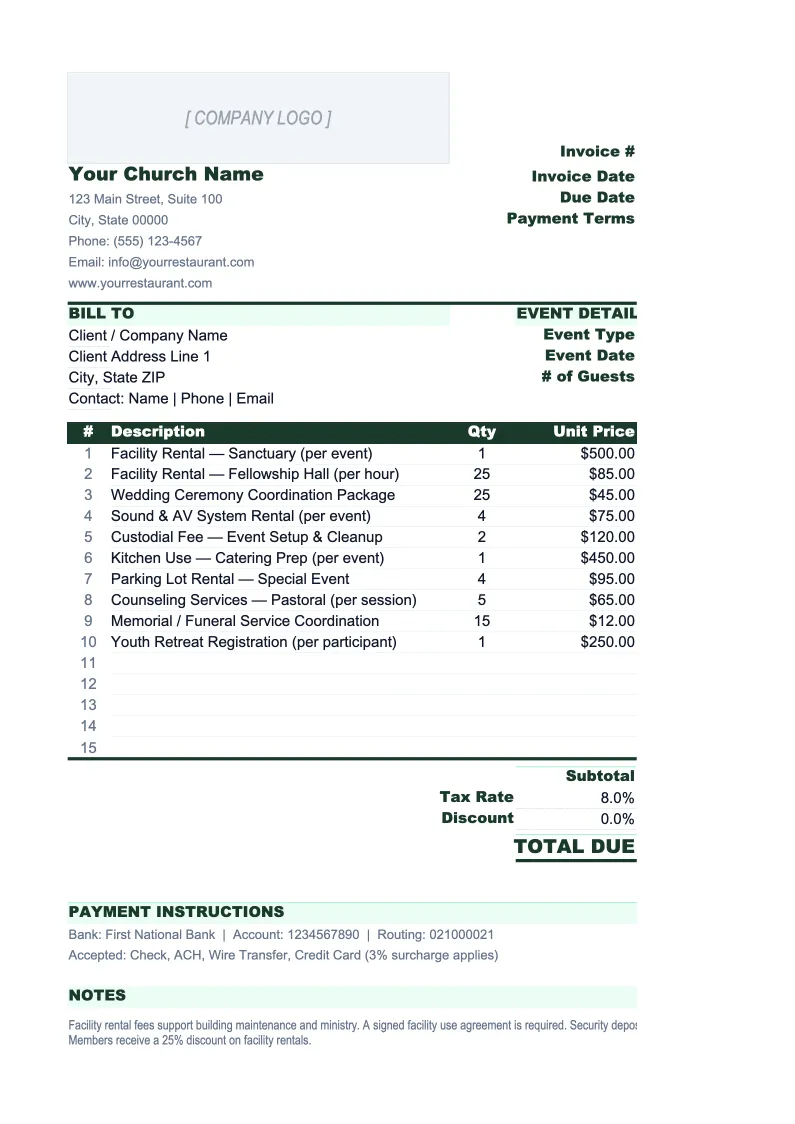
Church Invoice Template
Invoice facility renters, wedding clients, and outside groups with a template built for churches — member and non-member pricing tiers, ceremony line items, and a log for tracking every outstanding payment.
What's Inside This Church Invoice Template
This template includes 4 worksheets, each designed for a specific part of your church financial workflow:
Invoice
The print-ready invoice document for a single transaction.
Fee Schedule
A reference table that stores your church's standard rates so you never have to remember or look them up during a booking conversation.
Client Directory
A contact register for every renter or regular client so you stop re-entering information for repeat bookings.
Invoice Log
A running register of every invoice issued, with payment status tracking and overdue flagging.
Church Invoice Template Features
- Member vs. non-member pricing tiers — one dropdown applies the correct rate to every line item on the invoice
- Pre-loaded ceremony line items: officiant, music director, sound technician, premarital counseling, custodial fee
- Facility rental fields: venue name, event date, time block, and hourly or flat-rate billing
- Client Directory for repeat renters with certificate of insurance tracking and pricing tier on file
- Fee Schedule lookup — enter a service code and the rate pulls automatically, no manual price lookup
- Invoice Log with overdue flagging and year-to-date earned income totals by event type
How to Use This Church Invoice Spreadsheet
Setup takes about 20 minutes the first time. Download the .xlsx file and open it in Excel or Google Sheets. Start with the Fee Schedule sheet: enter the services your church bills for — facility rental rates, ceremony fees, AV packages, counseling session rates — with separate columns for member rate and non-member rate. Most churches have 10-20 billable services; entering them here once means you never manually type a price on an invoice again. Then add your recurring clients to the Client Directory: wedding venue renters, community organizations using your fellowship hall, and any outside groups with regular bookings. Note the certificate of insurance status for each — most liability policies require it for outside renters.
When a booking comes in, open a blank Invoice sheet. Select the client from your directory (their contact information fills automatically), enter the event details, and add line items from the Fee Schedule. Choose the pricing tier — member, non-member, or nonprofit partner — from the dropdown and the correct rate applies across the invoice. Add any event-specific items not in the Fee Schedule as manual line items. Review the total, confirm payment terms (most churches require payment before the event date for rentals), and export to PDF to send or print. Log the invoice immediately in the Invoice Log as Outstanding before filing.
Invoice your next facility rental in under 10 minutes
Set up your Fee Schedule once, add recurring renters to the directory, and generate clean invoices for every wedding, community group, and outside event — with member and non-member rates built in.
Why Churches Need a Proper Invoice Template
Most churches think of themselves as nonprofit organizations that don't really invoice anyone. But a church that rents its fellowship hall to outside groups, hosts weddings for non-members, provides pastoral counseling, or operates a preschool is billing real money to real clients — and that billing deserves the same rigor as any other small business. Without a formal invoicing system, churches routinely underbill (forgetting add-on services), fail to collect (no overdue tracking), and apply inconsistent rates (charging one wedding $800 and the next $1,200 for the same sanctuary booking with no documented reason). None of that is a theological problem, but it is a financial management problem that a simple invoice template solves.
The member vs. non-member rate structure is where church invoicing gets specific. Most religious organizations maintain two (or three) pricing tiers: a subsidized rate for active members or affiliated ministries, a standard commercial rate for outside groups and non-members, and sometimes a reduced nonprofit rate for community organizations like AA groups or food banks using the space. Generic invoice templates have no mechanism for this — you have to manually calculate and enter different rates each time. A church-specific Fee Schedule with both columns and a tier dropdown on the invoice sheet means the right rate applies every time without manual lookup or calculation.
Church Industry at a Glance
Financial templates built for churches and religious organizations — facility rentals, ceremony fees, staff payroll, and ministry budgets.
Revenue Drivers
- Tithes and weekly offerings
- Facility rental income
- Special offerings (Christmas, Easter)
- School and childcare tuition
- Cemetery and memorial service fees
Key Cost Categories
- Personnel and housing allowance
- Facilities and occupancy
- Worship and ministry programs
- Missions and benevolence
- Administration and software
- Debt service
Typical Margins
Gross: N/A · Net: 0-5% operating surplus
Seasonality
Giving peaks at Christmas and Easter; summer typically sees 10-20% attendance and giving decline. Year-end giving surge in December is common for tax purposes.
Key Performance Indicators
Church Invoice Template FAQ
More Church Templates
Church Balance Sheet Template for Excel
$29
Church Budget Template for Excel
$29
Church Budget & Financial Plan Template for Excel
$39
Church Cash Flow Template for Excel
$29
Church Expense Tracker Template for Excel
$29
Church Financial Model Template for Excel
$29
Church Income Statement Template for Excel
$29
Church KPI Dashboard Template for Excel
$29
Church P&L Template for Excel
$29
Church Pro Forma Template for Excel
$29
Church Project Budget Template for Excel
$29
Church Revenue Forecast Template for Excel
$29
Church Valuation Template for Excel
$29
Church Invoice Template
$29