Church Financial Model Template
Project giving income, plan ministry expenses, and track operating reserves with a financial model built for the way churches actually operate.
What's Inside This Church Financial Model Template
This template includes 8 worksheets, each designed for a specific part of your church financial workflow:
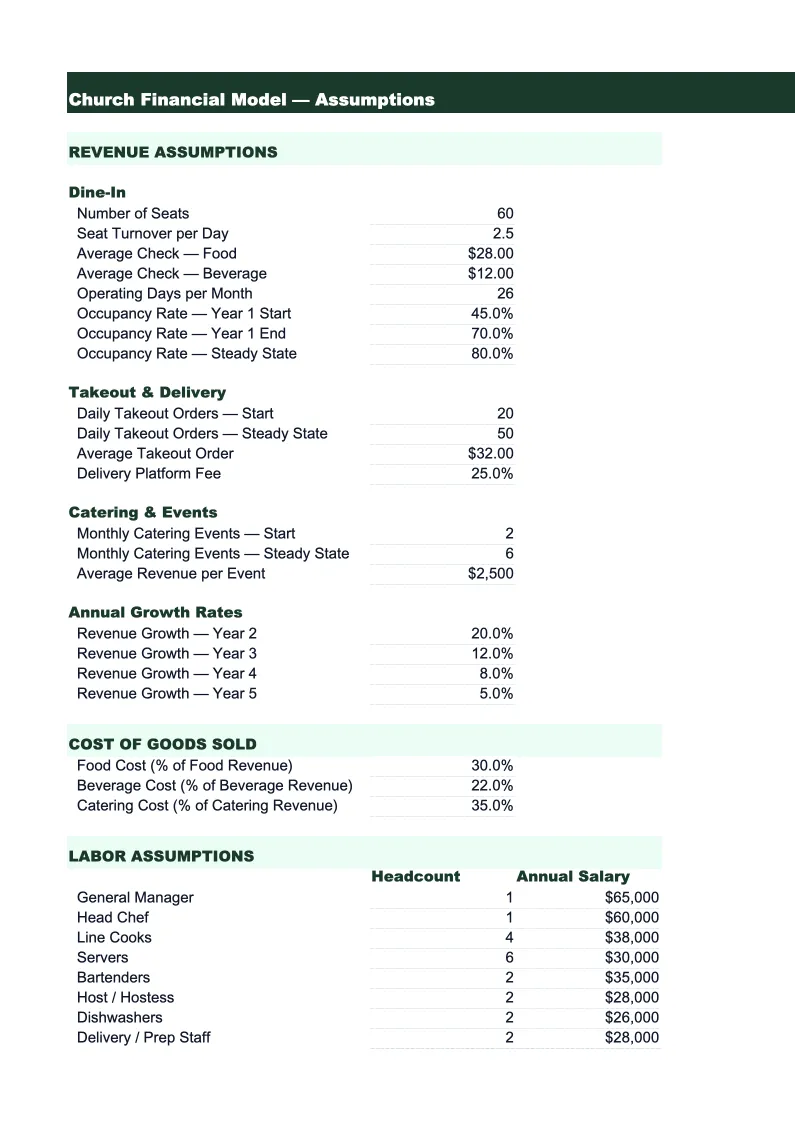
Assumptions
The central inputs sheet where you define the key drivers for your entire model.
Giving Projections
A 12-month giving forecast that accounts for the patterns unique to church income.
Non-Giving Revenue
Tracks all income sources outside of tithes and offerings: facility rentals to community groups and outside organizations, school or childcare tuition if the church operates those programs, cemetery and memorial service fees, bookstore or media sales, event ticket income, and interest on reserve funds.
Expense Budget
A detailed expense plan organized around the categories that matter most for church operations.
P&L Summary
A monthly income statement that consolidates giving revenue, non-giving income, and all expense categories into a clear surplus or deficit for each month and for the full year.
Cash Flow
A month-by-month cash flow projection that shows opening cash balance, cash inflows from all revenue sources, cash outflows for operating expenses and debt service, capital expenditures (building repairs, equipment, renovations), and closing cash balance.
Reserve Tracking
Churches are expected to hold operating reserves, and this sheet models what your reserve fund looks like over time under different scenarios.
Dashboard
A one-page summary designed for elder board, deacon board, or congregation presentation.
Church Financial Model Template Features
- Seasonal giving projections with summer dip and Christmas/Easter multipliers
- Personnel budget with housing allowance tracked separately by staff role
- Reserve fund tracking with months-of-coverage calculation
- Cash flow forecast that surfaces summer giving gap before it hits
- Ministry department expense budget: worship, children's, youth, adult, missions
- Elder/deacon board dashboard with giving trends and reserve coverage charts
How to Use This Church Financial Spreadsheet
Start with the Assumptions sheet — it controls everything else. Enter your current average weekly attendance, your average giving per attender, and your full-time and part-time staff headcount with their compensation packages. If you track housing allowance separately (which you should for pastoral staff), enter it in the designated column. Don't try to get it perfect on day one — reasonable estimates get you a working model in 30 minutes, and you can refine the inputs as you go.
Move to the Giving Projections sheet and review the seasonal multipliers that are pre-configured. The default assumptions model a 15% summer giving dip from June through August and a 20% December surge — adjust these percentages to match your own congregation's historical pattern if you have prior-year data. Add any planned special offering campaigns or capital campaign pledges as line items with their expected timing. Then fill in the Non-Giving Revenue sheet with any rental income, school tuition, or other predictable revenue streams.
30 minutes from download to your first full-year church projection
Download the template, enter your giving assumptions and staff compensation, and see your church's full financial picture — cash flow, reserve coverage, and ministry budgets included.
Why Every Church Needs a Financial Model
Churches have a revenue problem that most for-profit businesses don't: the people who decide how much to give are also the people the church serves. Giving is behavioral and seasonal, not contractual. A church's income can drop 15–20% over summer with no change in expenses — staff still get paid, utilities still run, debt service still comes due. Most small churches manage this by watching the bank account week to week, which works until it doesn't. A financial model lets leadership see that gap three or four months out and make a deliberate decision: draw from reserves, hold a special campaign, or adjust discretionary spending. That's a much better position than discovering the shortfall in July.
The two expense categories that define church financial health are personnel and facilities. Personnel cost as a percentage of total income should generally stay under 45–50% — above that, you're structurally constrained from growing programs or handling any revenue shortfall. Facilities cost (mortgage or rent, utilities, maintenance) ideally stays under 30%. Together, those two categories often consume 65–75% of a church's budget before a single ministry program dollar is spent. The financial model makes these percentages visible in real time so that staffing decisions and building commitments are made with full awareness of what they do to the overall budget balance.
Church Industry at a Glance
Financial templates built for churches and religious organizations — facility rentals, ceremony fees, staff payroll, and ministry budgets.
Revenue Drivers
- Tithes and weekly offerings
- Facility rental income
- Special offerings (Christmas, Easter)
- School and childcare tuition
- Cemetery and memorial service fees
Key Cost Categories
- Personnel and housing allowance
- Facilities and occupancy
- Worship and ministry programs
- Missions and benevolence
- Administration and software
- Debt service
Typical Margins
Gross: N/A · Net: 0-5% operating surplus
Seasonality
Giving peaks at Christmas and Easter; summer typically sees 10-20% attendance and giving decline. Year-end giving surge in December is common for tax purposes.
Key Performance Indicators
Church Financial Model Template FAQ
More Church Templates
Church Balance Sheet Template for Excel
$29
Church Budget Template for Excel
$29
Church Budget & Financial Plan Template for Excel
$39
Church Cash Flow Template for Excel
$29
Church Expense Tracker Template for Excel
$29
Church Income Statement Template for Excel
$29
Church Invoice Template for Excel
$29
Church KPI Dashboard Template for Excel
$29
Church P&L Template for Excel
$29
Church Pro Forma Template for Excel
$29
Church Project Budget Template for Excel
$29
Church Revenue Forecast Template for Excel
$29
Church Valuation Template for Excel
$29
More Financial Model Templates
Accounting Firm Financial Model Template for Excel
$29
Auto Repair Financial Model Template for Excel
$29
Car Wash Financial Model Template for Excel
$29
Cleaning Service Financial Model Template for Excel
$29
Coffee Shop Financial Model Template for Excel
$29
Construction Financial Model Template for Excel
$29
Church Financial Model Template
$29