Moving Company Budget Template
Plan and track your moving company's finances with a budget template built for the industry — pre-loaded with job revenue categories, crew labor, fuel, insurance, and the seasonal structure movers actually need.
What's Inside This Moving Company Budget Template
This template includes 5 worksheets, each designed for a specific part of your moving company financial workflow:
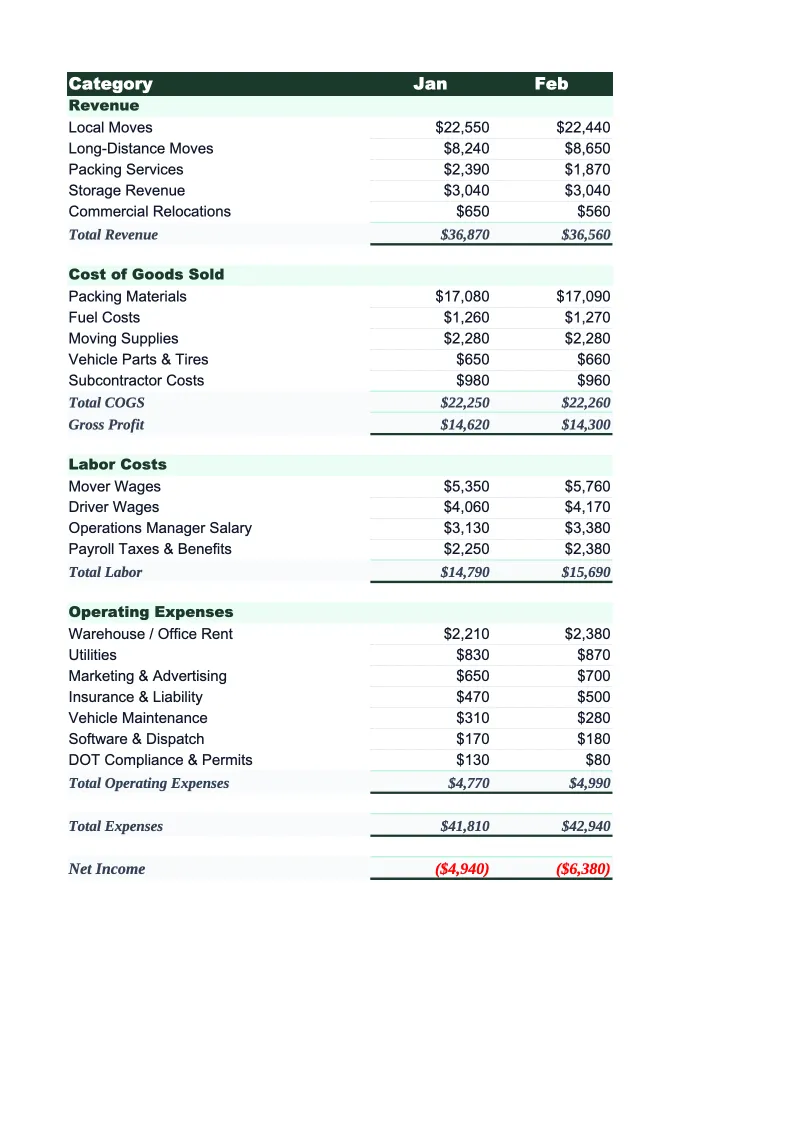
Monthly Budget
The core planning worksheet where you set your monthly revenue and expense targets.
Annual Summary
A 12-month rollup that pulls automatically from each month's data.
Budget vs Actual
Track your projections against what actually happened.
Job Cost Tracker
A per-job profitability worksheet where you can log individual moves and see contribution margin at the job level.
Dashboard
A single-page visual summary with pre-built charts and KPI tiles covering the metrics that matter most for a moving business: average job value by type, crew labor percentage, revenue by month (highlighting the seasonal curve), marketing cost per booked job, and net margin trend.
Moving Company Budget Template Features
- Revenue split by job type: local, long-distance, packing, storage, valuation
- Crew labor tracking by field and office/admin headcount
- Fuel and truck cost categories with per-mile or flat-rate structure
- Seasonal annual view built for peak May–August revenue concentration
- Per-job profitability tracking with labor efficiency calculations
- Dashboard with crew labor %, average job value, and marketing cost per booking
How to Use This Moving Company Budget Spreadsheet
Getting started takes about 15 minutes. Download the .xlsx file and open it in Excel or Google Sheets — no macros or plugins needed. Start with the Monthly Budget sheet: review the pre-loaded revenue and expense categories and adjust them to match your operation. Most moving companies keep the structure as-is and rename a line item or two — for example, swapping 'specialty item handling' to 'piano and safe moves' or adding a 'franchise fee' line if you run a branded franchise location.
Once the categories are set, enter your projected revenue and expenses for the first month. If you're not starting from scratch, pull your last three months of bank statements and use those actuals as your baseline. Copy the monthly structure forward through the year, then adjust for seasonality: moving companies typically see 55–65% of revenue fall in May through August, so your summer months should look very different from January or February. Use the Job Cost Tracker in parallel to log individual moves as they're completed — it feeds the performance picture that your monthly budget captures at the aggregate level.
15 minutes from download to your first budget
Download the template, plug in your numbers, and see your moving company's full financial picture — monthly budget, seasonal annual view, variance tracking, and job-level cost data included.
Why Every Moving Company Needs a Budget Template
Moving companies run on thin net margins — typically 7–10% — while managing the most unpredictable cost structure in service businesses. Fuel prices swing. Crew overtime spikes in June. A single large cargo claim can erase a month's profit. Most operators know their numbers are tight, but without a structured budget, cost problems only become visible after the damage is done. The issue isn't that moving companies are poorly run — it's that the business model makes it easy to be fully booked and still lose money on individual jobs if labor hours and fuel aren't tracked at the job level.
A proper moving company budget breaks revenue and costs into categories that actually reflect how the business works. On the revenue side, local hourly moves and long-distance flat-rate moves behave differently — one scales with time, the other with distance and weight — so they need separate tracking. Packing services and storage add meaningful margin when sold consistently, but they rarely get the visibility they deserve in a generic spreadsheet. On the cost side, crew labor as a percentage of revenue is the single most important number: most well-run movers target 30–40%, and anything above 45% signals either underpricing, excessive overtime, or inefficient job routing. Fuel and equipment maintenance are the next two categories operators most consistently underestimate in their planning.
Moving Company Industry at a Glance
Financial templates built for moving companies — from local movers to long-distance carriers. Pre-loaded with job-based billing, labor tracking, and the KPIs that matter for seasonal service businesses.
Revenue Drivers
- Local moves (hourly billing)
- Long-distance moves (flat-rate/weight-based)
- Packing services
- Storage and SIT fees
- Specialty item handling (pianos, safes)
- Valuation and liability coverage
Key Cost Categories
- Crew labor (field)
- Truck costs and fuel
- Insurance (cargo, liability, workers comp)
- Packing materials
- Marketing and lead generation
- Administrative labor
- Equipment maintenance
Typical Margins
Gross: 25-45% · Net: 7-10%
Seasonality
Peak season May–August accounts for ~60% of annual moves. June is the single busiest month. November–February is slowest; cash reserves built in summer cover winter operations.
Key Performance Indicators
Moving Company Budget Template FAQ
More Moving Company Templates
Moving Company Balance Sheet Template for Excel
$29
Moving Company Business Plan Template for Excel
$39
Moving Company Cash Flow Template for Excel
$29
Moving Company Expense Tracker Template for Excel
$29
Moving Company Financial Model Template for Excel
$29
Moving Company Income Statement Template for Excel
$29
Moving Company Invoice Template for Excel
$29
Moving Company KPI Dashboard Template for Excel
$29
Moving Company P&L Template for Excel
$29
Moving Company Pro Forma Template for Excel
$29
Moving Company Project Budget Template for Excel
$29
Moving Company Sales Forecast Template for Excel
$29
Moving Company Valuation Template for Excel
$29
Moving Company Budget Template
$29