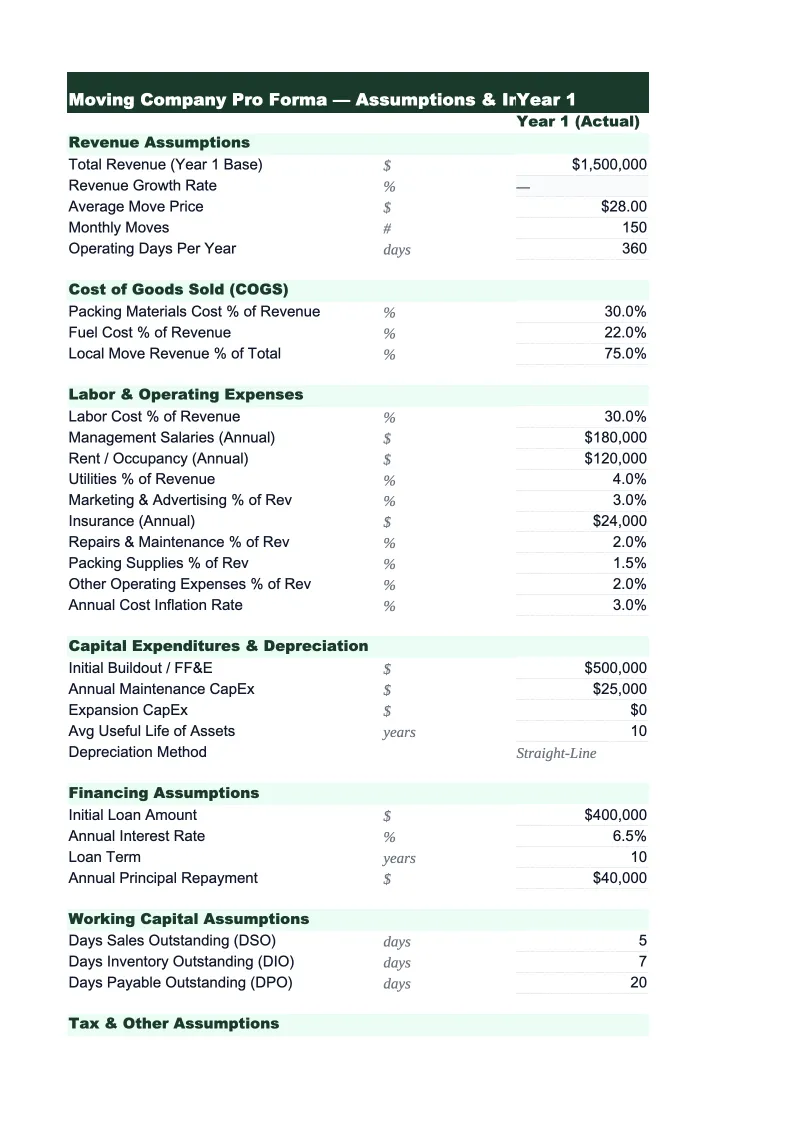
Moving Company Pro Forma Template
Project three years of job volume, revenue by service type, and crew labor costs — built around local hourly moves, long-distance flat-rate jobs, packing services, and the seasonal cash flow swings that define moving company operations.
What's Inside This Moving Company Pro Forma Template
This template includes 6 worksheets, each designed for a specific part of your moving company financial workflow:
Assumptions
The central input sheet that drives every projection in the model.
Revenue Projections
Projects monthly revenue across all moving company service lines over a 36-month horizon.
Operating Costs
Projects the variable and semi-fixed costs that move with job volume.
Projected P&L
A complete three-year projected income statement organized the way a moving company owner or lender actually reads it.
Cash Flow Projection
Maps your projected cash position month by month from startup through 36 months of operations, with particular attention to the seasonal cash flow pattern that is one of the defining challenges of running a moving company.
Dashboard
A one-page visual summary pulling the key moving company metrics from the underlying model.
Moving Company Pro Forma Template Features
- Bottom-up revenue model built from monthly job volume, service mix, and hourly or flat-rate pricing
- Seasonal cash flow modeling with distinct peak season (May–August) and off-peak assumptions
- Crew labor cost modeled per job from crew size, average move hours, and hourly wage
- Startup costs section covering truck purchase, equipment, DOT licensing, insurance, and working capital
- 36-month projected P&L with crew labor %, gross margin, and net margin benchmarks displayed per period
- Cash flow trough identification to size winter working capital reserve before slow season arrives
How to Use This Moving Company Financial Projections Spreadsheet
Start on the Assumptions sheet and set your service volume inputs first. The most important numbers are your projected monthly local move count by season, average move duration in hours, and crew billing rate. If you're an existing operator, pull 12 months of job history from your dispatch software or invoices and calculate your actual average — most local moves run 3–6 hours with a 2–3 person crew. If you're starting fresh, research local competitor pricing and use industry benchmarks as your baseline: local moves typically bill at $100–$180 per hour for a 2-person crew, and a new operation in a mid-size market should realistically target 15–30 jobs per month in year one before ramping. Set your long-distance move count conservatively — long-haul jobs require DOT authority, FMCSA compliance, and a different sales motion than local moves, and most new operators focus on local before adding interstate.
After setting volume and pricing assumptions, fill in the startup costs section of the Cash Flow sheet. The two largest items are usually truck acquisition and working capital. A used 26-foot box truck in good mechanical condition runs $30,000–$60,000; a new truck runs $90,000–$130,000. Blankets, dollies, straps, and floor runners add $5,000–$12,000 depending on truck count. DOT registration, FMCSA authority (required for interstate moves), and state permits typically run $2,000–$5,000 including the costs of a process agent and UCR registration. Your first-year insurance premium — covering cargo, general liability, and workers comp — is often the biggest surprise for new operators; a single-truck operation can expect $8,000–$18,000 per year depending on coverage levels and driving history. Set your working capital reserve at a minimum of 3 months of projected operating expenses, because moving companies can run 8–10 weeks with minimal revenue during the winter slow period.
15 minutes from download to your first moving company projection
Download the template, enter your job volume, service mix, and startup costs, and get a complete 3-year financial projection for your moving business.
Why Moving Companies Need a Pro Forma Template
Moving company financials are harder to project than most service businesses because revenue doesn't just vary by month — it concentrates in a narrow summer window while overhead runs year-round. May through August typically accounts for 55–65% of annual move volume, with June as the peak month in most markets. That means a moving company earning $600,000 per year might generate $80,000 in revenue in June and $20,000 in January. Without a pro forma that models this pattern explicitly, operators either underestimate how much cash they need to build in summer or get caught short in winter when revenue drops but truck payments, insurance, and admin labor keep running. A pro forma built around the actual seasonal curve — rather than a flat monthly revenue assumption — changes the entire conversation about working capital.
The capital structure of a moving company is dominated by two things: trucks and insurance. A single used 26-foot box truck represents $30,000–$60,000 in capital, and insurance on that truck plus cargo coverage and workers comp for crew runs $8,000–$18,000 per year for a basic operation. These costs exist before the first job is booked, which means break-even analysis at startup is a critical planning exercise. For a one-truck operation with $4,000–$6,000 in monthly fixed costs (truck payment, insurance, base admin labor, and marketing), break-even requires roughly 20–30 jobs per month depending on average job value. Reaching that job volume takes most new operators 6–12 months, which is why working capital sizing matters — you need enough reserves to cover the gap between fixed costs and actual revenue during the ramp period, plus the winter slow season that follows.
Moving Company Industry at a Glance
Financial templates built for moving companies — from local movers to long-distance carriers. Pre-loaded with job-based billing, labor tracking, and the KPIs that matter for seasonal service businesses.
Revenue Drivers
- Local moves (hourly billing)
- Long-distance moves (flat-rate/weight-based)
- Packing services
- Storage and SIT fees
- Specialty item handling (pianos, safes)
- Valuation and liability coverage
Key Cost Categories
- Crew labor (field)
- Truck costs and fuel
- Insurance (cargo, liability, workers comp)
- Packing materials
- Marketing and lead generation
- Administrative labor
- Equipment maintenance
Typical Margins
Gross: 25-45% · Net: 7-10%
Seasonality
Peak season May–August accounts for ~60% of annual moves. June is the single busiest month. November–February is slowest; cash reserves built in summer cover winter operations.
Key Performance Indicators
Moving Company Pro Forma Template FAQ
More Moving Company Templates
Moving Company Balance Sheet Template for Excel
$29
Moving Company Budget Template for Excel
$29
Moving Company Business Plan Template for Excel
$39
Moving Company Cash Flow Template for Excel
$29
Moving Company Expense Tracker Template for Excel
$29
Moving Company Financial Model Template for Excel
$29
Moving Company Income Statement Template for Excel
$29
Moving Company Invoice Template for Excel
$29
Moving Company KPI Dashboard Template for Excel
$29
Moving Company P&L Template for Excel
$29
Moving Company Project Budget Template for Excel
$29
Moving Company Sales Forecast Template for Excel
$29
Moving Company Valuation Template for Excel
$29
Moving Company Pro Forma Template
$29