Moving Company Cash Flow Template
Track your moving company's cash position with a spreadsheet built around job deposits, seasonal volume swings, and the truck financing payments that define the business.
What's Inside This Moving Company Cash Flow Template
This template includes 5 worksheets, each designed for a specific part of your moving company financial workflow:
13-Week Cash Flow
A rolling 13-week view of cash inflows and outflows organized around how moving companies actually collect and spend money.
Annual Cash Flow
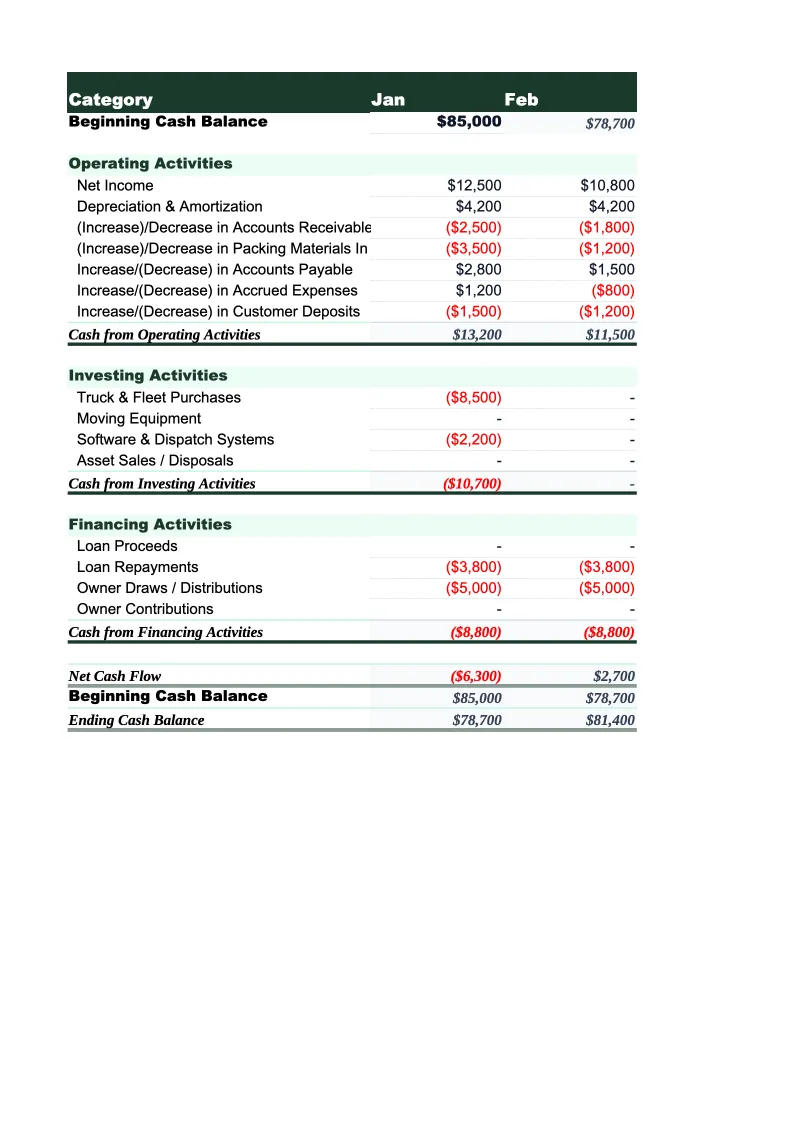
A full 12-month cash flow statement built on the indirect method with operating, investing, and financing sections structured for moving company operations.
Job Deposit Tracker
A dedicated sheet for tracking deposits collected against jobs not yet completed, which is one of the most important cash flow management tasks for moving companies.
Fleet & Truck Schedule
A capital expenditure and financing tracker for the trucks and trailers that are the largest balance sheet items in any moving company.
Seasonal Crew & Cash Planner
A monthly planning tool for managing the crew scaling and cash reserve strategy that defines moving company operations.
Moving Company Cash Flow Template Features
- 13-week rolling cash flow with local move, long-distance, storage, and packing revenue rows
- Annual cash flow statement with operating, investing, and financing sections
- Job deposit tracker showing deposits on hand vs. jobs still outstanding
- Fleet and truck financing schedule that feeds into the annual statement automatically
- Seasonal crew and cash reserve planner for peak-to-off-season cash management
- Ending cash balance and weeks-of-runway calculation updated automatically
How to Use This Moving Company Cash Flow Spreadsheet
Start with the 13-Week Cash Flow sheet. Enter your current cash balance, then fill in expected weekly inflows — scheduled local move completions with their balance-due amounts, any long-distance job final payments coming in, storage fees billed this week, and packing service revenue. For outflows, enter next payroll by crew, upcoming fuel and maintenance costs, packing material orders, and any insurance installments or truck payments due. The sheet calculates your ending cash position week by week and shows you clearly whether you can cover payroll without drawing on a line of credit.
Set up the Fleet & Truck Schedule once with all your current vehicles — enter each truck's loan balance, monthly payment, and remaining term. Those payments will populate the Annual Cash Flow sheet automatically so your statement stays accurate. Then use the Job Deposit Tracker to log every booked job as it comes in. Keeping this sheet current gives you a real-time view of how much of your cash balance is actually yours versus deposits you still owe service on — a distinction that matters most during the booking rush before peak season.
15 minutes from download to your first cash flow projection
Download the template, enter your current cash balance and booked jobs, and see your moving company's 13-week cash position in one view.
Why Moving Companies Need a Cash Flow Template
Moving company cash flow is seasonal in a way that catches a lot of operators off guard. June alone can account for 15–20% of a full year's revenue, and the summer surge creates a cash position that feels comfortable — until November arrives and volume drops by half while truck payments, insurance, and warehouse rent stay exactly the same. The net margins in moving (7–10% for well-run operations) leave little buffer for a slow winter, and companies that don't plan the seasonal cycle often find themselves drawing on personal funds or maxing credit lines just to get to March.
The other cash flow complexity unique to moving companies is the deposit structure. Most movers collect a deposit at booking — often 10–25% of the estimated job value — which shows up as cash inflow weeks before the job is actually performed. During a busy booking season, this creates a flattering cash picture: you might have $40,000 in deposits on hand that represents future labor, fuel, and materials you haven't spent yet. Understanding the difference between cash on hand and free cash — after accounting for the cost to deliver those booked jobs — is what separates operators who feel comfortable from ones who genuinely are. The job deposit tracker addresses this directly.
Moving Company Industry at a Glance
Financial templates built for moving companies — from local movers to long-distance carriers. Pre-loaded with job-based billing, labor tracking, and the KPIs that matter for seasonal service businesses.
Revenue Drivers
- Local moves (hourly billing)
- Long-distance moves (flat-rate/weight-based)
- Packing services
- Storage and SIT fees
- Specialty item handling (pianos, safes)
- Valuation and liability coverage
Key Cost Categories
- Crew labor (field)
- Truck costs and fuel
- Insurance (cargo, liability, workers comp)
- Packing materials
- Marketing and lead generation
- Administrative labor
- Equipment maintenance
Typical Margins
Gross: 25-45% · Net: 7-10%
Seasonality
Peak season May–August accounts for ~60% of annual moves. June is the single busiest month. November–February is slowest; cash reserves built in summer cover winter operations.
Key Performance Indicators
Moving Company Cash Flow Template FAQ
More Moving Company Templates
Moving Company Balance Sheet Template for Excel
$29
Moving Company Budget Template for Excel
$29
Moving Company Business Plan Template for Excel
$39
Moving Company Expense Tracker Template for Excel
$29
Moving Company Financial Model Template for Excel
$29
Moving Company Income Statement Template for Excel
$29
Moving Company Invoice Template for Excel
$29
Moving Company KPI Dashboard Template for Excel
$29
Moving Company P&L Template for Excel
$29
Moving Company Pro Forma Template for Excel
$29
Moving Company Project Budget Template for Excel
$29
Moving Company Sales Forecast Template for Excel
$29
Moving Company Valuation Template for Excel
$29
Moving Company Cash Flow Template
$29