Stackrows
Moving Company Valuation Template
A
B
C
D
E
F
G
1
Category
Budget
Actual
2
3
4
5
6
7
8
Business Inputs
Earnings Multiple Approach
Asset-Based Approach
Operations Profile
Valuation Summary

Moving Company Valuation Template

Value your moving company using SDE or EBITDA multiples, a fleet and equipment asset approach, DOT authority and license valuation, and an operations profile covering crew utilization, claims ratio, and customer concentration — built around the factors buyers and brokers actually use when pricing residential and commercial moving businesses.

$29Save 4+ hours vs. building a moving company business valuation model from scratch
Instant download after purchase
Works in Excel & Google Sheets
30-day money-back guarantee
.xlsx215 KB5 sheetsUpdated 2026-03-23

What's Inside This Moving Company Valuation Template

This template includes 5 worksheets, each designed for a specific part of your moving company financial workflow:

1

Business Inputs

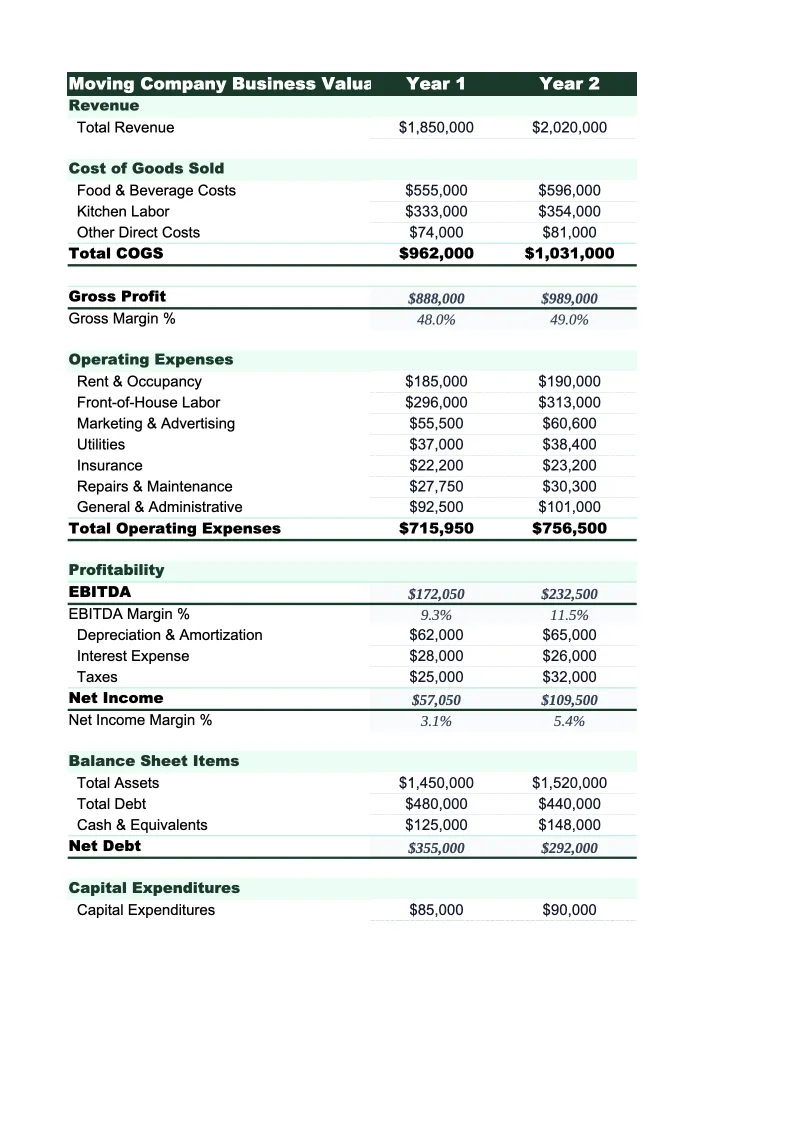
The data entry foundation for the entire valuation model. Revenue is entered by move type and service category: local residential moves (entered as total annual revenue or as job count multiplied by average job value), long-distance and interstate residential moves (which carry higher average revenue per job and are weighted separately in the earnings multiple analysis because of their different risk profile), commercial and office relocations, corporate relocation contract revenue if any, and storage and SIT (storage-in-transit) fee revenue entered separately because it represents a recurring income stream that buyers value differently from episodic move revenue. The expense section captures the full operating cost structure: crew labor by type (hourly movers, drivers, packing specialists), truck costs including lease or depreciation payments per vehicle, fuel and maintenance, cargo and liability insurance (entered separately because claims ratios directly affect this cost), workers' compensation insurance, packing materials cost, marketing and lead generation spend, dispatch and administrative labor, and any warehouse or storage facility rent. Owner compensation is entered completely — salary, health insurance, vehicle expenses run through the business, and any personal expenses — because the SDE normalization that applies to smaller operations depends on accurate figures here. The fleet section captures each vehicle's current market value, age, mileage, and condition rating so the asset-based approach calculates a realistic fleet book. All downstream sheets pull from these inputs.

2

Earnings Multiple Approach

Moving company valuations operate on two different earnings frameworks depending on the size and complexity of the business, and this sheet handles both. For owner-operated local moving companies — typically those generating under $1 million in annual revenue with the owner involved in daily operations including dispatch, estimating, or physical moves — the sheet calculates Seller's Discretionary Earnings by starting from net income and adding back owner compensation, depreciation, amortization, interest, and documented one-time expenses. Local residential movers typically sell at 1.5–3.0x SDE; the wide range reflects the degree to which the business runs independently of the owner, the strength of referral and repeat business channels, and fleet condition. For larger operations — companies with interstate DOT authority and commercial relocation accounts, or those generating over $1.5 million in revenue — the sheet applies an EBITDA-based framework because buyers at this scale are typically operators looking to acquire routes, DOT authority, and established commercial relationships rather than purchasing a job for themselves. Mid-size moving companies with diversified revenue and managed operations typically sell at 2.5–4.5x EBITDA. A multiple scoring matrix on this sheet evaluates five value drivers: revenue diversification across move types and customer categories, owner dependency in daily operations (dispatch, estimating, and crew management), claims ratio relative to industry norms, fleet age and condition, and the strength and transferability of referral and commercial account relationships. Each driver is scored and mapped to a specific position within the applicable multiple range.

3

Asset-Based Approach

A floor-value calculation based on the tangible and intangible assets a buyer would be acquiring — particularly relevant for moving company transactions because the fleet is the primary tangible asset, DOT authority has real value, and the replacement cost of building a licensed and insured moving operation from scratch is significant. Enter the current market resale value for each major asset category: moving trucks by vehicle (box trucks and 26-foot straight trucks are entered individually with make, model, year, mileage, and current auction or dealer resale value — well-maintained trucks in the five-to-eight-year range typically hold 40–65% of purchase price), cargo vans and smaller vehicles, moving equipment (dollies, furniture pads, straps, ramps, and appliance hand trucks are listed by quantity and estimated resale value as a category), warehouse or storage facility value if owned rather than leased, and any owned real estate at current appraised market value. The intangible asset section captures DOT authority and MC number value — an active interstate DOT operating authority with a clean safety record and satisfactory carrier rating has real market value because acquiring it transfers the ability to operate legally on interstate moves without the multi-year process of establishing a new authority from scratch. Customer database and CRM records, commercial account contracts with remaining term, and any non-compete agreements from key personnel are also captured here. For operations where the fleet is older or the earnings are modest, the asset floor provides a meaningful valuation anchor. For profitable operations with strong commercial accounts, the earnings approach will typically exceed the asset floor substantially.

4

Operations Profile

Moving company valuations are heavily influenced by operational metrics that don't appear directly on the income statement but that experienced buyers and business brokers scrutinize because they determine whether the revenue and earnings are reliable and transferable. This sheet captures and analyzes the key metrics. Job count is entered by move type (local residential, long-distance, commercial) with average revenue per job and contribution margin by category — this disaggregation matters because long-distance moves and commercial relocations typically carry different margins than local residential work and attract different buyer risk assessments. Crew utilization rate is calculated as billable crew hours divided by available crew hours across the year, which reveals whether the operation is running efficiently or carrying significant idle labor cost during slow periods. Claims ratio — cargo damage and liability claims as a percentage of revenue — is a critical metric in moving company due diligence because a high claims ratio signals operational problems that affect insurance costs, customer satisfaction, and crew training quality; industry benchmarks for well-run moving companies typically fall between 0.5% and 2.0% of revenue. Customer concentration analysis shows what percentage of annual revenue comes from the top five accounts and from a single largest account, which directly affects the multiple a buyer is willing to pay — heavy dependence on one corporate relocation contract is a significant risk flag. Referral and repeat business percentage quantifies how much new revenue comes from past customers and referrals versus paid lead generation, because referral-heavy businesses have lower customer acquisition costs and more stable demand. The owner dependency section evaluates whether daily dispatch, job estimating, crew oversight, and commercial account management require the owner's personal involvement or whether trained staff handle these functions independently.

5

Valuation Summary

A single-page output consolidating the earnings multiple approach and the asset-based floor into one view across conservative, base, and optimistic scenarios. The summary presents the earnings-based value (SDE or EBITDA multiple as applicable) alongside the asset floor and shows how the two cross-check each other — for a moving company where the fleet represents a substantial portion of total asset value, the asset floor can be a meaningful negotiating reference even when the earnings approach produces a higher number. A DOT authority and intangible value section quantifies the estimated contribution of the operating authority, carrier safety rating, commercial account relationships, and customer database to the total valuation, because buyers acquiring an established moving operation are paying explicitly for these intangibles and sophisticated acquirers will identify them separately in their purchase price allocation. A sensitivity table shows how the total valuation changes as the earnings multiple moves in 0.5x increments across the relevant range, giving both parties a clear view of the negotiating band. A revenue concentration adjustment section discounts the base valuation if a significant share of revenue comes from a single corporate account or commercial client, because that concentration represents transferability risk that buyers will price into their offer. The deal structure section compares a cash purchase against a seller-financed arrangement and an earnout structure tied to revenue retention over twelve months post-close, which is common in commercial moving company transactions where key account relationships are a primary driver of value and buyers want protection against account attrition following the ownership change.

Moving Company Valuation Template Features

  • Dual earnings multiple framework covering SDE multiples for owner-operated local movers (1.5–3.0x) and EBITDA multiples for larger operations with commercial accounts (2.5–4.5x), with a scoring matrix for five value drivers including owner dependency and claims ratio
  • Fleet asset valuation entering each vehicle individually by make, model, year, mileage, and current market resale value — plus moving equipment, warehouse, and any owned real estate
  • DOT authority and intangible asset section capturing the value of operating authority, carrier safety rating, commercial account contracts, and customer database as distinct line items in the asset-based approach
  • Operations Profile sheet analyzing job count by move type, crew utilization rate, cargo claims ratio, customer concentration by account, and referral versus paid-lead revenue split
  • Revenue concentration adjustment that discounts the base valuation for over-dependence on a single corporate relocation client — quantifying the risk that buyers will price in
  • Three-scenario Valuation Summary with earnings multiple sensitivity table, DOT authority premium section, and deal structure comparison covering cash, seller financing, and twelve-month earnout arrangements

How to Use This Moving Company Business Valuation Spreadsheet

Start with the Business Inputs sheet. Pull your trailing twelve-month revenue broken down by move type — local residential, long-distance, commercial, and storage fees — from your job management system or accounting software. Separate these categories rather than entering a single revenue total, because they carry different margins and buyers value them differently. For the fleet section, gather each vehicle's year, make, model, and current mileage, then estimate current auction or dealer resale value for each unit — NADA or trade dealer quotes work well here, and being accurate matters more than being optimistic because buyers will verify fleet values during due diligence. Enter owner compensation fully: salary, any health insurance paid through the business, personal vehicles expensed through the company, and any other personal expenses running through the P&L.

Work through the Operations Profile sheet carefully before applying any multiple. Crew utilization, claims ratio, and customer concentration are the three metrics that will most directly affect where your operation falls in the multiple range — a claims ratio above 3% of revenue or a single corporate account representing more than 25% of total annual revenue will trigger hard questions from any experienced buyer and will compress the multiple they're willing to pay. Calculate your referral and repeat business percentage by reviewing the last two to three years of new customer sources: a business where 40–50% of new jobs come from past customer referrals and repeat relocations is significantly more defensible than one where most new business comes from paid lead generation, because the referral channel transfers with the business and the paid leads require ongoing marketing spend to sustain.

Review the Valuation Summary before talking to a business broker or beginning any sale process. The DOT authority section is often underappreciated by owners selling a moving company for the first time — an active interstate operating authority with a clean safety record has real value to a buyer who would otherwise need to apply for and establish their own authority, and quantifying it explicitly in your valuation strengthens your negotiating position. Run the sensitivity table and review the revenue concentration adjustment to understand the realistic range before the first conversation with a prospective buyer. If a single commercial account represents a large share of revenue, consider whether you can document a strong relationship with a contact other than yourself, or whether getting a letter of intent from that client to continue service post-sale is feasible — both materially affect the multiple.

Know what your moving company is worth before you sell

Enter your revenue by move type, fleet values, earnings, and operations profile — and get a defensible valuation range with the earnings multiple approach, fleet asset floor, DOT authority premium, and customer concentration adjustment that buyers will use to structure their offer.

How Moving Companies Are Valued When They Sell

Moving company valuations differ from most service businesses in two important ways. First, the business has a significant asset base — the fleet — that buyers must finance or assume, and the age and condition of that fleet is a direct input into the offer price rather than just a due diligence concern. A moving company running ten-year-old trucks with deferred maintenance is a fundamentally different acquisition from one running a fleet purchased in the last three years, and buyers separate these clearly in their underwriting. Second, the business operates under federal and state regulatory frameworks — DOT operating authority, MC numbers for interstate carriers, state-level permits — that have real transfer value and that create meaningful barriers to entry for anyone trying to build a competing operation from scratch in the same market. This regulatory intangibility, while invisible on the balance sheet, is something experienced buyers assign value to explicitly.

The factors that move a moving company to the top of its multiple range are consistent across company sizes. Owner independence is the primary driver: a moving company where the owner handles daily dispatch, writes every estimate, and maintains all key commercial relationships personally is worth meaningfully less than one where trained office staff and a lead dispatcher handle daily operations under documented procedures. Buyers are acquiring a business, not hiring themselves into a job, and the cost of the owner's absence — whether from retirement, relocation, or simply stepping back — is the central risk they're pricing. Claims ratio is the second major driver: a clean safety and claims record reflects crew training quality, equipment maintenance discipline, and job selection practices, and it translates directly into lower insurance costs that a buyer will benefit from going forward. Revenue diversification matters at every scale — a company generating revenue across local residential, long-distance, and commercial moves with no single customer exceeding 15% of annual revenue is a substantially safer acquisition than one heavily dependent on a single corporate relocation contract.

The practical steps to maximize a moving company's value before selling center on documentation and operational systematization. Create written dispatch procedures, standard estimating practices, and crew training materials — not because buyers will audit these documents during due diligence, but because the existence of documented systems signals that operations are not dependent on the owner's judgment and institutional knowledge alone. Address deferred fleet maintenance honestly: deferred repairs will show up during a buyer's inspection and will be used to negotiate a dollar-for-dollar reduction in the offer price, so fixing known issues before listing generally returns more than it costs. Clean up the commercial account documentation — compile contract copies, renewal dates, and contact information for key accounts so a buyer can see clearly what they're acquiring and assess the relationship's transferability. If your claims ratio has been elevated in the past two to three years, document what operational changes you've made to address it; buyers can accept that problems existed if you can show they've been resolved.

Moving Company Industry at a Glance

Financial templates built for moving companies — from local movers to long-distance carriers. Pre-loaded with job-based billing, labor tracking, and the KPIs that matter for seasonal service businesses.

Revenue Drivers

  • Local moves (hourly billing)
  • Long-distance moves (flat-rate/weight-based)
  • Packing services
  • Storage and SIT fees
  • Specialty item handling (pianos, safes)
  • Valuation and liability coverage

Key Cost Categories

  • Crew labor (field)
  • Truck costs and fuel
  • Insurance (cargo, liability, workers comp)
  • Packing materials
  • Marketing and lead generation
  • Administrative labor
  • Equipment maintenance

Typical Margins

Gross: 25-45% · Net: 7-10%

Seasonality

Peak season May–August accounts for ~60% of annual moves. June is the single busiest month. November–February is slowest; cash reserves built in summer cover winter operations.

Key Performance Indicators

Average job valueCrew labor % of revenueClaims ratioCrew utilization rateBooking/close rateValuation coverage sold rate

Moving Company Valuation FAQ

Moving Company Valuation Template

$29