Moving Company Invoice Template
Invoice residential and commercial customers for moves with labor charges, truck fees, access surcharges, packing materials, and storage — built for local movers and small fleets.
What's Inside This Moving Company Invoice Template
This template includes 4 worksheets, each designed for a specific part of your moving company financial workflow:
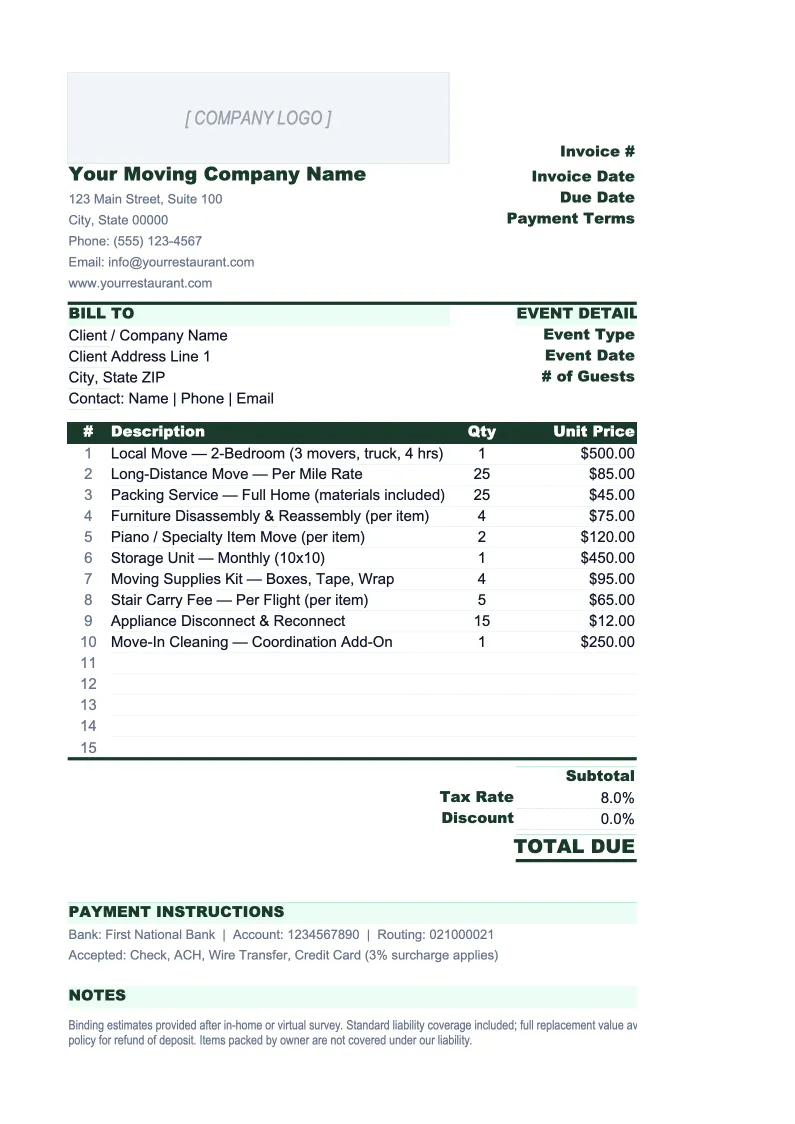
Move Invoice
The print-ready invoice for a single job.
Packing Materials Calculator
A dedicated sheet for estimating and pricing packing materials before the job.
Job Log
A running register of every job invoiced, designed to answer the three questions that matter for cash flow management: which jobs are paid, which are outstanding, and how much is owed.
Revenue Summary
A monthly and seasonal revenue summary that tracks job count, average job value, and revenue by category — labor, truck/transportation, materials, and add-ons.
Moving Company Invoice Template Features
- Labor billing by crew size and hours with automatic total calculation
- Access surcharges — stair carry, long carry, shuttle, elevator — as individual line items
- Packing materials calculator with cost vs. sale price margin tracking
- Job log with payment status tracking and overdue flagging across all invoices
- USDOT/MC number and origin-to-destination address fields pre-built in the header
- Seasonal revenue summary showing monthly job count, average job value, and gross margin
How to Use This Moving Company Invoice Spreadsheet
Setup takes about 20 minutes for your first job. Download the .xlsx file and open it in Excel or Google Sheets — no macros required. Start with the Move Invoice sheet: enter your company name, USDOT and MC numbers if you handle interstate moves, and your standard payment terms in the footer. Review the access fee rows and adjust the labels and rates to match what you charge — your stair carry rate per flight, long carry threshold and rate, and shuttle fee if applicable. These details stay locked in as your template defaults and carry forward to every new invoice.
For each new job, fill in the customer details, origin and destination addresses, and move date. Enter the crew size and hours worked — labor calculates automatically from your rate. Go to the Packing Materials Calculator, enter the room count or material quantities, and the totals pull into the invoice. Add any access fees that applied to the job: stair carries, long carry if you had to park far from the door, shuttle if a large truck couldn't access the property. Subtract the deposit paid at booking and send the invoice as a PDF with a delivery confirmation.
Invoice your next move in under 15 minutes
Enter crew hours, add access fees, pull in packing materials, subtract the deposit — and send a clean, itemized invoice that covers every charge on the job.
Why Moving Companies Need a Proper Invoice Template
Most moving companies write invoices on paper forms or basic spreadsheets that capture labor hours and a truck fee — and nothing else. That's a problem because the line items that make a job profitable or unprofitable are rarely the hourly rate. Stair carries, long carries, shuttle fees, packing materials, and valuation coverage can add $200–$600 to an average residential move, but only if they're invoiced correctly. When those charges are bundled into a vague 'miscellaneous' line or forgotten entirely, the company absorbs the cost without recovering it. An itemized invoice documents every surcharge separately, which protects you in disputes and tells customers exactly what they're paying for.
Moving is a business with high labor costs, significant insurance expenses, and one of the most seasonal revenue patterns of any service industry. Crew labor should run below 30% of revenue; if it's higher, you're either underpricing or overstaffing. Truck costs — fuel, maintenance, insurance — should stay under 10%. The gap between June revenue and January revenue can be 3:1, which means companies that don't track revenue by month have no way to plan how much cash they need to bridge the winter. A job log that shows invoiced revenue, collected revenue, and outstanding receivables is the minimum tracking infrastructure a moving business needs to stay solvent through slow months.
Moving Company Industry at a Glance
Financial templates built for moving companies — from local movers to long-distance carriers. Pre-loaded with job-based billing, labor tracking, and the KPIs that matter for seasonal service businesses.
Revenue Drivers
- Local moves (hourly billing)
- Long-distance moves (flat-rate/weight-based)
- Packing services
- Storage and SIT fees
- Specialty item handling (pianos, safes)
- Valuation and liability coverage
Key Cost Categories
- Crew labor (field)
- Truck costs and fuel
- Insurance (cargo, liability, workers comp)
- Packing materials
- Marketing and lead generation
- Administrative labor
- Equipment maintenance
Typical Margins
Gross: 25-45% · Net: 7-10%
Seasonality
Peak season May–August accounts for ~60% of annual moves. June is the single busiest month. November–February is slowest; cash reserves built in summer cover winter operations.
Key Performance Indicators
Moving Company Invoice Template FAQ
More Moving Company Templates
Moving Company Balance Sheet Template for Excel
$29
Moving Company Budget Template for Excel
$29
Moving Company Business Plan Template for Excel
$39
Moving Company Cash Flow Template for Excel
$29
Moving Company Expense Tracker Template for Excel
$29
Moving Company Financial Model Template for Excel
$29
Moving Company Income Statement Template for Excel
$29
Moving Company KPI Dashboard Template for Excel
$29
Moving Company P&L Template for Excel
$29
Moving Company Pro Forma Template for Excel
$29
Moving Company Project Budget Template for Excel
$29
Moving Company Sales Forecast Template for Excel
$29
Moving Company Valuation Template for Excel
$29
Moving Company Invoice Template
$29