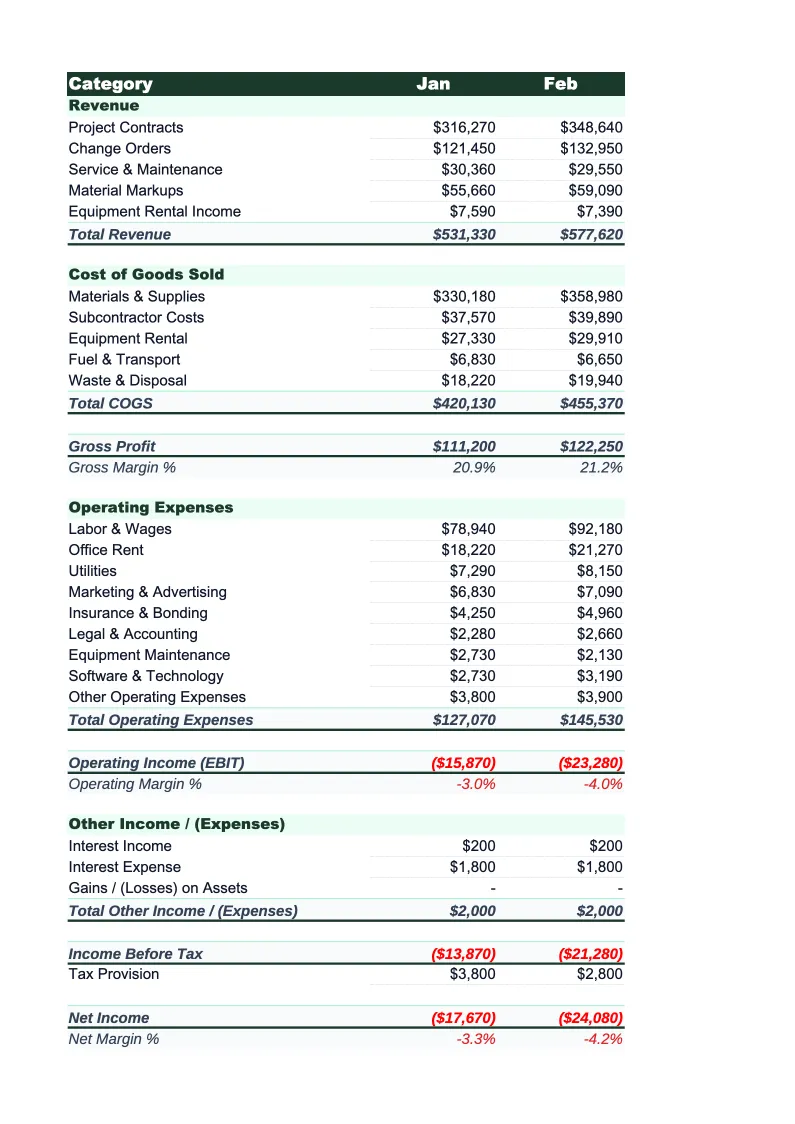
Construction Income Statement Template
Track revenue, job costs, and overhead on one income statement built for how construction companies actually operate — project contracts, subcontractors, and all.
What's Inside This Construction Income Statement Template
This template includes 4 worksheets, each designed for a specific part of your construction financial workflow:
Income Statement
The core monthly income statement structured around how construction revenue and costs actually flow.
Job Cost Summary
A project-by-project breakdown of revenue and costs for each active job.
Annual Summary
A 12-month rollup that pulls revenue, direct costs, and overhead from each monthly income statement automatically.
Dashboard
Pre-built charts and KPI cards that summarize your construction company's financial performance at a glance.
Construction Income Statement Template Features
- Revenue split by contract type — new build, renovation, service, and change orders
- Direct job costs broken out by materials, labor, subcontractors, and equipment rental
- Gross margin per project tracked in the Job Cost Summary sheet
- 12-month annual rollup with seasonal trend visibility
- Overhead categories pre-loaded for general contractors (bonding, vehicles, admin)
- EBITDA and net margin auto-calculated on the Dashboard
How to Use This Construction Income Statement Spreadsheet
Start by downloading the .xlsx file and opening it in Excel or Google Sheets — no macros or add-ins required. Open the Income Statement sheet and review the pre-loaded categories. Most general contractors and specialty trades will recognize these line items immediately; adjust any labels that don't match your chart of accounts. Enter your revenue by contract type and your direct job costs for the current month. If you're mid-year, work backwards and fill in the months you have records for — bank statements and invoices from your accounting software are the fastest source.
Move to the Job Cost Summary sheet and list your active projects. For each job, enter the contract value, your estimated costs broken out by category, and the actual costs incurred so far. This sheet is where the template earns its keep for construction businesses — seeing gross margin by project in real time lets you catch overruns before they close out. Update it weekly during active project phases: check materials invoices against your estimate, verify subcontractor billings, and flag any jobs where actual costs are running ahead of budget.
15 minutes from download to your first income statement
Download the template, enter your project revenue and costs, and get a clear picture of your construction company's gross margin, overhead, and net income.
Why Every Construction Company Needs an Income Statement Template
Construction companies operate on some of the thinnest net margins in any industry — typically 2–7% — despite gross margins that look reasonable on paper (20–35%). The gap between gross and net is almost entirely overhead: office staff, vehicles, equipment, bonding and insurance, and the cost of estimating and bidding work that doesn't always win. Without a structured income statement that separates direct job costs from overhead, it's nearly impossible to know whether a margin problem is coming from the jobs themselves or from the overhead line.
A proper construction income statement starts with revenue by contract type, because the mix matters. New construction contracts typically carry different margins than renovation work, and service and maintenance revenue often comes with lower material costs but higher labor intensity. Below revenue, direct job costs should be broken out by category — materials, direct labor, subcontractors, and equipment rental — because each one behaves differently. Subcontractor costs scale directly with revenue but are often underestimated in bids; materials fluctuate with commodity prices; and direct labor is partly fixed in practice because you can't easily lay off your core crew between jobs.
Construction Industry at a Glance
Financial templates built for construction companies — from general contractors to specialty trades. Pre-loaded with job costing categories, bid tracking, and project-based financials.
Revenue Drivers
- Project contracts
- Change orders
- Service & maintenance
- Material markups
Key Cost Categories
- Materials
- Labor (direct)
- Subcontractors
- Equipment rental
- Permits & insurance
- Overhead
Typical Margins
Gross: 20-35% · Net: 2-7%
Seasonality
Peak activity spring through fall; winter slowdown in northern climates. Year-end push to close projects.
Key Performance Indicators
Construction Income Statement Template FAQ
More Construction Templates
Construction Balance Sheet Template for Excel
$29
Construction Budget Template for Excel
$29
Construction Business Plan Template for Excel
$39
Construction Cash Flow Template for Excel
$29
Construction Expense Tracker Template for Excel
$29
Construction Financial Model Template for Excel
$29
Construction Invoice Template for Excel
$29
Construction KPI Dashboard Template for Excel
$29
Construction P&L Template for Excel
$29
Construction Pro Forma Template for Excel
$29
Construction Project Budget Template for Excel
$29
Construction Sales Forecast Template for Excel
$29
Construction Business Valuation Template for Excel
$29
More Income Statement Templates
Accounting Firm Income Statement Template for Excel
$29
Auto Repair Income Statement Template for Excel
$29
Car Wash Income Statement Template for Excel
$29
Church Income Statement Template for Excel
$29
Cleaning Service Income Statement Template for Excel
$29
Coffee Shop Income Statement Template for Excel
$29
Construction Income Statement Template
$29