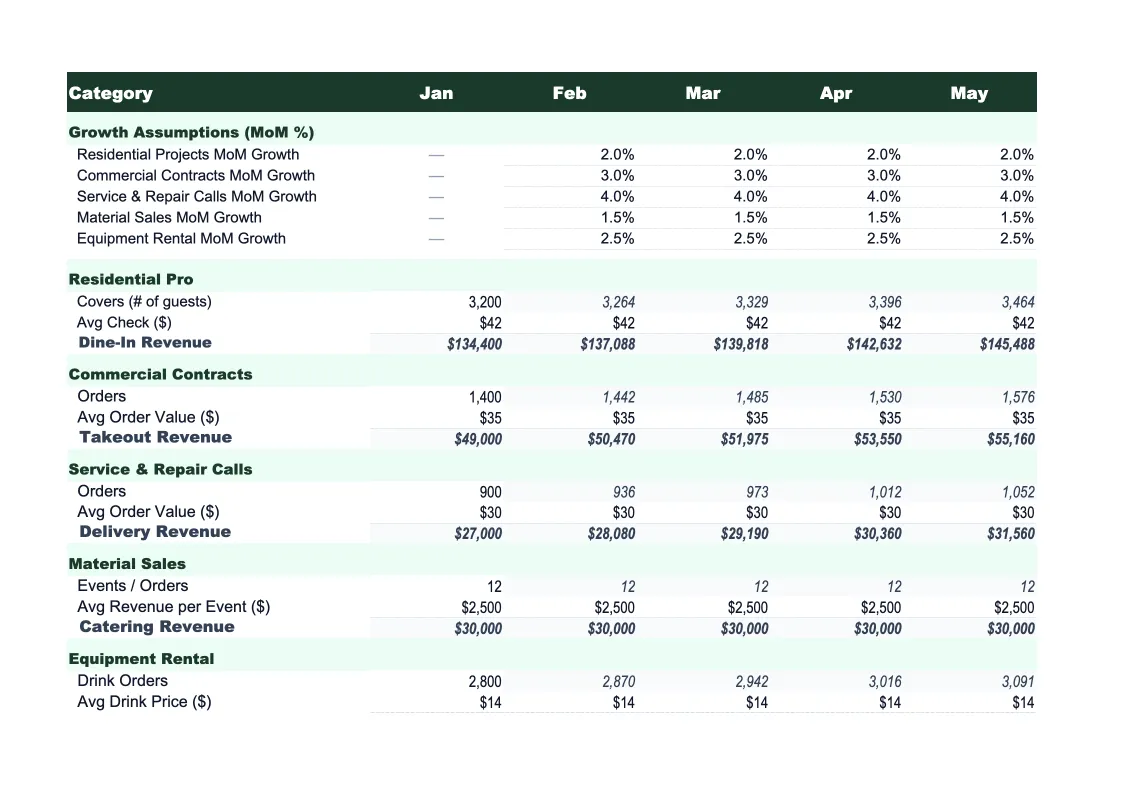
Construction Sales Forecast Template
Forecast your construction company's revenue from contracted backlog, weighted bid pipeline, and change orders — with monthly projections by project type, scenario planning, and actual vs forecast tracking.
What's Inside This Construction Sales Forecast Template
This template includes 7 worksheets, each designed for a specific part of your construction financial workflow:
Project Pipeline
The central intake sheet for all active bids and prospects.
Backlog Schedule
A month-by-month revenue recognition schedule for all contracted (signed) work.
Monthly Forecast
The full 12-month revenue projection, combining three sources: backlog schedule revenue (pulled automatically from the Backlog Schedule sheet), weighted pipeline revenue (estimated monthly conversions from the Project Pipeline sheet), and anticipated change order revenue entered as an assumption.
Annual Summary
A full-year rollup showing total projected revenue by project type for the entire forecast period, with month-by-month columns and an annual total on the right.
Actual vs Forecast
Enter your actual monthly billings alongside projections and the sheet calculates dollar and percentage variance for each month and each project type.
Scenario Comparison
Three side-by-side revenue scenarios — base case, upside, and downside — built from different pipeline win rates and backlog timing assumptions.
Dashboard
A visual summary of your forecast with pre-built charts: monthly projected revenue by project type (stacked bar), backlog vs pipeline coverage trend (line chart), actual vs forecast variance over the trailing six months, and current pipeline by stage (funnel chart showing total bids at each probability tier).
Construction Sales Forecast Template Features
- Weighted pipeline model: bid value × close probability per project
- Backlog revenue schedule spread across project timelines
- Revenue split by project type (residential, commercial, renovation, service)
- Three-scenario comparison with adjustable win rates and delay assumptions
- Actual vs forecast tracker with variance analysis and rolling accuracy score
- Visual dashboard with backlog coverage ratio and pipeline funnel chart
How to Use This Construction Sales Forecast Spreadsheet
Start with the two foundation sheets before touching the forecast. First, populate the Backlog Schedule with every project you have under signed contract — enter the project name, total contract value, start month, and estimated duration. This is your committed revenue, and it's the most accurate part of the model. Then move to the Project Pipeline sheet and enter your active bids with estimated contract values and your honest probability of winning each one. If you're not sure on probabilities, a reasonable starting point: proposals submitted and under review are 30–40%, finalists under negotiation are 60–70%, and verbal awards awaiting contract are 85–90%. Budget about 30–45 minutes for this initial setup.
Once the pipeline and backlog are entered, review the Monthly Forecast sheet to check whether the projections look realistic month by month. Construction revenue is lumpy by nature — large project starts create spikes, and scheduling gaps create troughs — so a forecast that shows perfectly smooth monthly revenue is usually wrong. Apply any seasonal adjustments for months where your region typically slows (winter weather, holiday shutdowns) or accelerates (spring construction season). The Scenario Comparison sheet is worth filling in early too: set a downside where your win rate drops 20% and two or three backlog projects slip by a quarter. If the downside still covers your fixed overhead, your pipeline is in good shape.
15 minutes from download to your first revenue forecast
Download the template, enter your backlog and active bids, and see your construction company's projected revenue — month by month, project type by project type.
Why Every Construction Company Needs a Sales Forecast Template
Construction revenue forecasting is harder than most industries because revenue isn't generated daily — it arrives in chunks tied to project milestones, progress billing cycles, and contract close dates that shift. A restaurant can forecast Tuesday dinner with reasonable confidence; a general contractor's October revenue depends on whether three projects that were supposed to start in September actually broke ground, whether a commercial client signed the contract they've been sitting on for six weeks, and whether the project manager got the September billing out before month-end. The result is that most construction companies are flying on gut feel, discovering their revenue shortfall in the last week of the month. A structured forecast — built from actual backlog and weighted pipeline — doesn't eliminate that uncertainty, but it makes it visible weeks earlier.
The two metrics that define construction revenue health are backlog coverage ratio and pipeline close rate. Backlog coverage ratio is your total contracted backlog divided by your annual revenue target — most healthy contractors carry six to nine months of backlog at any given time. Below three months means you're dependent on pipeline wins to hit your year, which is fine if your pipeline is strong and your close rate is known. Pipeline close rate is how much of your weighted pipeline actually converts to signed contracts — if you're weighting bids at 50% but only winning 30%, your forecast will systematically overstate revenue by 20%. Tracking both metrics monthly, which this template does automatically, is what separates contractors who manage their pipeline from those who react to it.
Construction Industry at a Glance
Financial templates built for construction companies — from general contractors to specialty trades. Pre-loaded with job costing categories, bid tracking, and project-based financials.
Revenue Drivers
- Project contracts
- Change orders
- Service & maintenance
- Material markups
Key Cost Categories
- Materials
- Labor (direct)
- Subcontractors
- Equipment rental
- Permits & insurance
- Overhead
Typical Margins
Gross: 20-35% · Net: 2-7%
Seasonality
Peak activity spring through fall; winter slowdown in northern climates. Year-end push to close projects.
Key Performance Indicators
Construction Sales Forecast Template FAQ
More Construction Templates
Construction Balance Sheet Template for Excel
$29
Construction Budget Template for Excel
$29
Construction Business Plan Template for Excel
$39
Construction Cash Flow Template for Excel
$29
Construction Expense Tracker Template for Excel
$29
Construction Financial Model Template for Excel
$29
Construction Income Statement Template for Excel
$29
Construction Invoice Template for Excel
$29
Construction KPI Dashboard Template for Excel
$29
Construction P&L Template for Excel
$29
Construction Pro Forma Template for Excel
$29
Construction Project Budget Template for Excel
$29
Construction Business Valuation Template for Excel
$29
More Sales Forecast Templates
Construction Sales Forecast Template
$29