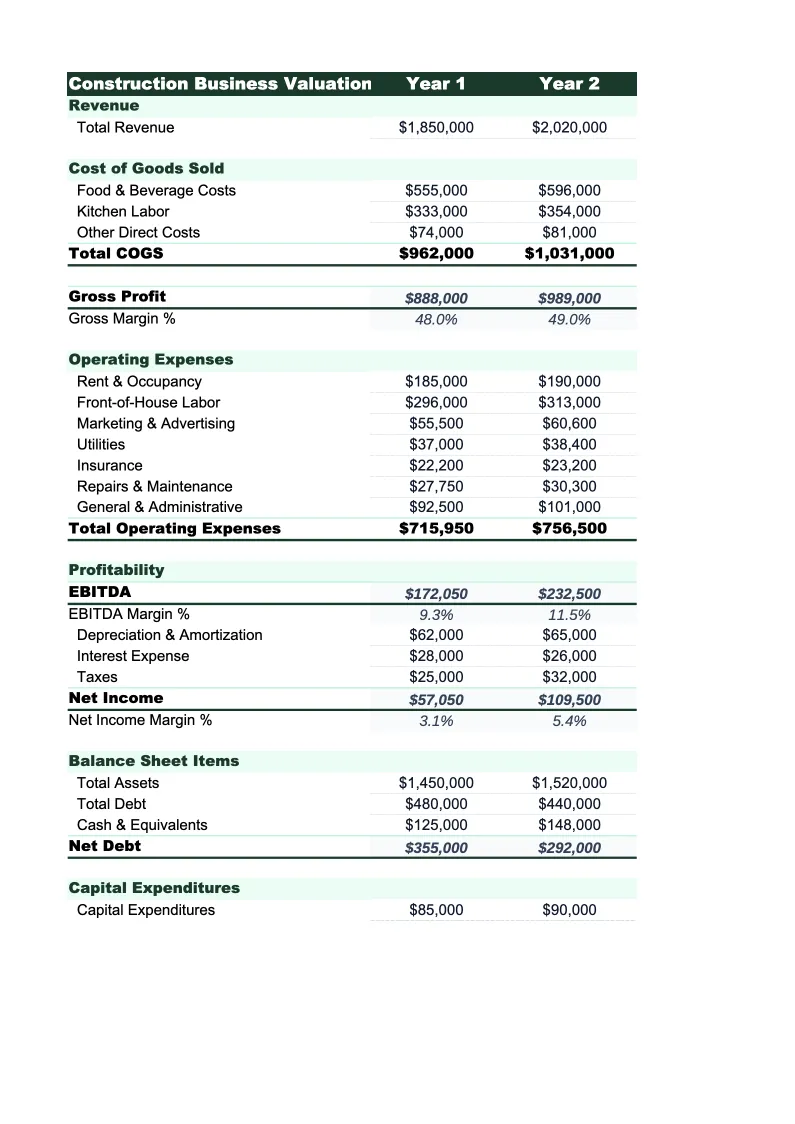
Construction Valuation Template
Calculate what your construction company is worth using the three valuation methods lenders and buyers actually use — pre-built for contractor financials.
What's Inside This Construction Valuation Template
This template includes 5 worksheets, each designed for a specific part of your construction financial workflow:
Income Approach
Values the business based on its ability to generate future earnings.
Market Approach
Values the business by comparing it to recent transactions in the construction industry.
Asset Approach
Calculates the net asset value of the business — what you'd get if you liquidated everything today.
Valuation Summary
Pulls results from all three methods and calculates a weighted average valuation.
Inputs & Assumptions
A single control panel where you enter the key business metrics that feed all three valuation methods: 3 years of revenue and EBITDA history, owner compensation adjustments, equipment list with estimated fair market values, and the discount rate for the DCF.
Construction Valuation Template Features
- Three valuation methods: income, market multiples, and asset-based
- Owner compensation normalization for accurate EBITDA
- Construction-specific EBITDA multiple benchmarks (3x–5x range)
- Equipment and fleet fair market value tracker
- Weighted average with adjustable method weights
- Valuation range and suggested asking price output
How to Use This Construction Valuation Spreadsheet
Start with the Inputs & Assumptions sheet. Pull your last three years of income statements and gather your equipment list — the valuation is only as good as the numbers you put in. For EBITDA, don't use the raw number from your tax return; most construction company owners pay themselves a below-market salary to minimize taxes, and buyers will adjust for that. The sheet walks you through the owner compensation normalization step, which often adds $50,000–$150,000 to your normalized EBITDA and directly affects your final valuation.
Once your inputs are set, work through each method sheet in order. The Income Approach will give you the most weight; review the EBITDA multiple range and select the one that matches your company — larger contractors with recurring clients and strong backlog command higher multiples than smaller project-by-project shops. The Market Approach lets you compare your numbers against recent industry transactions. The Asset Approach calculates your equipment fleet and net assets — enter each major piece of equipment at what you could sell it for today, not the depreciated book value on your balance sheet.
Know what your construction company is worth
Download the template, enter your financials, and walk into any buyer or lender conversation with a number you can defend.
How Construction Companies Are Valued
Construction companies are notoriously hard to value because the business looks different every year depending on the project mix, and much of the value walks out the door every night in the form of the owner's relationships, license, and reputation. Most construction businesses sell for 3x–5x EBITDA, but that multiple compresses or expands based on a handful of factors: the size and diversity of the backlog, whether revenue is concentrated in one or two clients, whether key estimators and project managers are locked in with employment agreements, and whether the company holds specialized licenses or certifications that competitors can't easily replicate.
The income approach is the primary method for valuing a going-concern construction business. Buyers are paying for future cash flows, not past ones, so the quality and predictability of your backlog matters more than last year's revenue. A contractor with $3M in EBITDA and 18 months of backlog from municipal contracts will command a higher multiple than one with the same EBITDA from a handful of residential projects. The asset approach sets the floor — particularly relevant for equipment-heavy specialty contractors where a $500K excavator fleet represents real liquidation value. For most sales, the market approach using recent comparable transactions cross-checks the income approach rather than driving it.
Construction Industry at a Glance
Financial templates built for construction companies — from general contractors to specialty trades. Pre-loaded with job costing categories, bid tracking, and project-based financials.
Revenue Drivers
- Project contracts
- Change orders
- Service & maintenance
- Material markups
Key Cost Categories
- Materials
- Labor (direct)
- Subcontractors
- Equipment rental
- Permits & insurance
- Overhead
Typical Margins
Gross: 20-35% · Net: 2-7%
Seasonality
Peak activity spring through fall; winter slowdown in northern climates. Year-end push to close projects.
Key Performance Indicators
Construction Business Valuation FAQ
More Construction Templates
Construction Balance Sheet Template for Excel
$29
Construction Budget Template for Excel
$29
Construction Business Plan Template for Excel
$39
Construction Cash Flow Template for Excel
$29
Construction Expense Tracker Template for Excel
$29
Construction Financial Model Template for Excel
$29
Construction Income Statement Template for Excel
$29
Construction Invoice Template for Excel
$29
Construction KPI Dashboard Template for Excel
$29
Construction P&L Template for Excel
$29
Construction Pro Forma Template for Excel
$29
Construction Project Budget Template for Excel
$29
Construction Sales Forecast Template for Excel
$29
Construction Valuation Template
$29