Ecommerce Income Statement Template
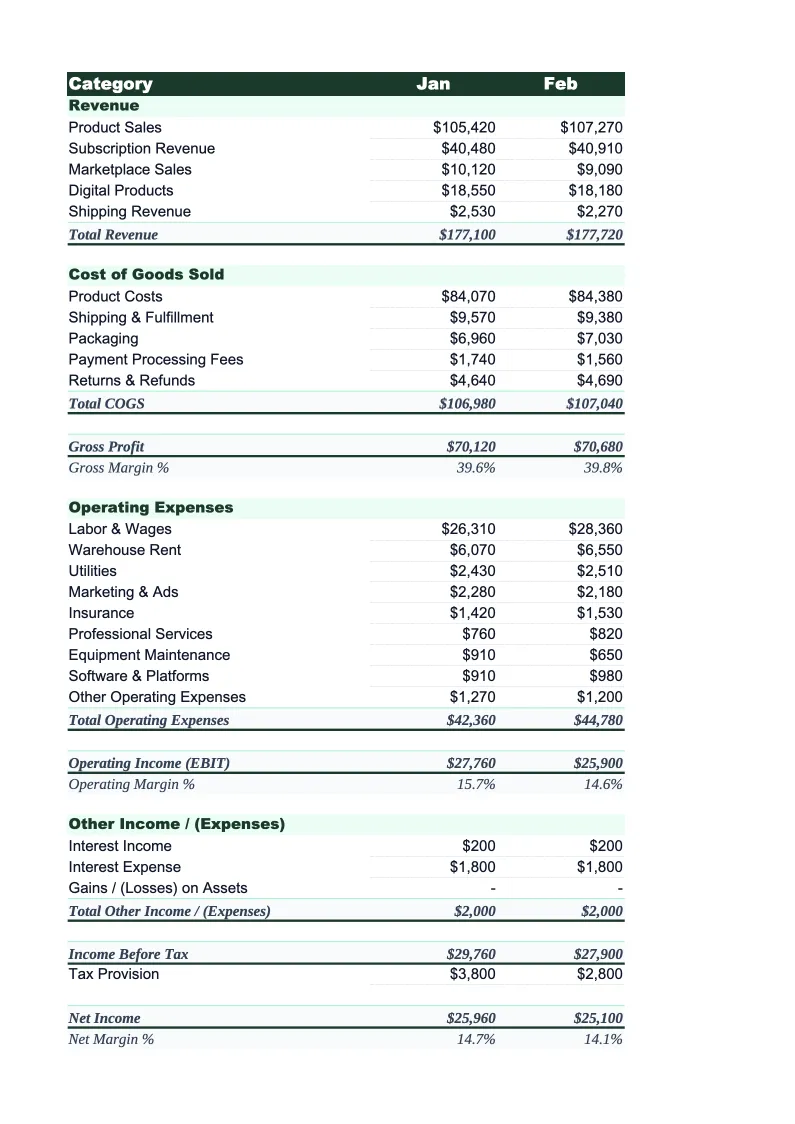
An ecommerce income statement template with platform fees, advertising, fulfillment, and returns tracked as separate line items — so you can see your store's actual margins by channel, not just total revenue.
What's Inside This Ecommerce Income Statement Template
This template includes 4 worksheets, each designed for a specific part of your ecommerce financial workflow:
Monthly Income Statement
The core P&L structured around how ecommerce businesses actually generate and spend money.
Annual Summary
A 12-month rollup that consolidates your monthly income statements into a single view.
Key Ratios
A dedicated worksheet that tracks the financial ratios most relevant to ecommerce profitability.
Channel Margin Analysis
A worksheet that breaks your income statement down by sales channel to show where your margins are actually coming from.
Ecommerce Income Statement Template Features
- Revenue split by DTC, marketplace, and wholesale channels with per-channel margin calculations
- Platform and marketplace fees (Shopify, payment processing, Amazon FBA) tracked as dedicated expense categories
- Returns and refunds tracked separately to show their true impact on net revenue
- Digital advertising and customer acquisition costs broken out from other operating expenses
- 12-month annual summary with Q4 holiday season visibility and YTD totals
- Key ratio tracker with gross margin %, blended ad cost %, return rate, and fulfillment cost % benchmarks
How to Use This Ecommerce Income Statement Spreadsheet
Start by downloading the .xlsx file and opening it in Excel or Google Sheets — no macros or add-ins required. Open the Monthly Income Statement sheet and adjust the revenue and expense categories to match your business. Remove channels you don't sell through (wholesale if you're DTC-only, for example), and add any platform-specific fee lines you track separately. Most ecommerce businesses spend 10–15 minutes customizing the structure on first use and then keep it consistent going forward. The Channel Margin Analysis sheet has a configuration section at the top where you set how shared overhead is allocated — set these percentages once based on your current channel mix.
Each month, pull your figures from your ecommerce platform (Shopify, WooCommerce, or your marketplace dashboards) and your ad platform reports. Enter revenue by channel, then work down through COGS, platform fees, ad spend, fulfillment, and returns. The order matters: entering returns accurately is especially important because they hit both revenue (if you track net revenue) and potentially COGS (if you count returned inventory as recovered). Gross profit, gross margin percentage, and net income all calculate automatically. Once the monthly sheet is complete, the Annual Summary and Key Ratios sheets update without any additional steps.
15 minutes from download to your first income statement
Download the template, enter your revenue and costs by channel, and see your store's actual margins — platform fees, ad spend, and returns all tracked separately.
Why Every Ecommerce Business Needs a Proper Income Statement
Ecommerce businesses often look profitable on top-line revenue but lose money once all the costs specific to online selling are properly accounted for. Platform fees of 3–15% depending on channel, outbound shipping at 8–15% of revenue, advertising that can run 15–30% of revenue for growth-stage brands, and return rates of 15–30% in categories like apparel all erode margins that look healthy at the gross product level. Without an income statement that separates these costs explicitly, it's easy to confuse revenue growth with profit growth — especially when scaling quickly on a channel like Amazon where fees are embedded in payouts rather than invoiced separately.
A proper ecommerce income statement follows the cost structure of online retail, not the generic template most accounting software produces by default. Revenue should be separated by channel because DTC and marketplace sales have fundamentally different economics: a DTC sale through your own Shopify store might cost 2.9% in payment processing and whatever you spent on the ad that drove it; that same sale through Amazon costs 8–15% in referral fees plus FBA fulfillment on top. Returns and refunds need their own line — not folded into revenue as a deduction — because they represent an operational metric (return rate) and a financial one (recovered cost of goods). Advertising belongs in operating expenses, not COGS, but it's the highest-leverage line item in the whole statement and deserves its own group rather than being buried in a catch-all.
Ecommerce Industry at a Glance
Financial templates built for ecommerce businesses — from Shopify stores to Amazon sellers. Pre-loaded with SKU-level line items, platform fee categories, return tracking, and the metrics that drive online retail profitability.
Revenue Drivers
- Direct-to-consumer product sales
- Wholesale and B2B orders
- Marketplace sales (Amazon, eBay, Etsy)
- Subscription or bundle revenue
Key Cost Categories
- Cost of goods sold (inventory)
- Shipping and fulfillment
- Payment processing fees
- Platform and marketplace fees
- Returns and refunds
- Digital advertising and customer acquisition
Typical Margins
Gross: 30-55% · Net: 5-15%
Seasonality
Heavy Q4 concentration around Black Friday, Cyber Monday, and holiday gifting. Many categories also spike in January (post-holiday), back-to-school (August), and Mother's Day.
Key Performance Indicators
Ecommerce Income Statement Template FAQ
More Ecommerce Templates
Ecommerce Balance Sheet Template for Excel
$29
Ecommerce Budget Template for Excel
$29
E-commerce Business Plan Template for Excel
$39
Ecommerce Cash Flow Template for Excel
$29
Ecommerce Expense Tracker Template for Excel
$29
Ecommerce Financial Model Template for Excel
$29
Ecommerce Invoice Template for Excel
$29
Ecommerce KPI Dashboard Template for Excel
$29
Ecommerce P&L Template for Excel
$29
Ecommerce Pro Forma Template for Excel
$29
Ecommerce Project Budget Template for Excel
$29
Ecommerce Sales Forecast Template for Excel
$29
Ecommerce Business Valuation Template for Excel
$29
More Income Statement Templates
Accounting Firm Income Statement Template for Excel
$29
Auto Repair Income Statement Template for Excel
$29
Car Wash Income Statement Template for Excel
$29
Church Income Statement Template for Excel
$29
Cleaning Service Income Statement Template for Excel
$29
Coffee Shop Income Statement Template for Excel
$29
Ecommerce Income Statement Template
$29