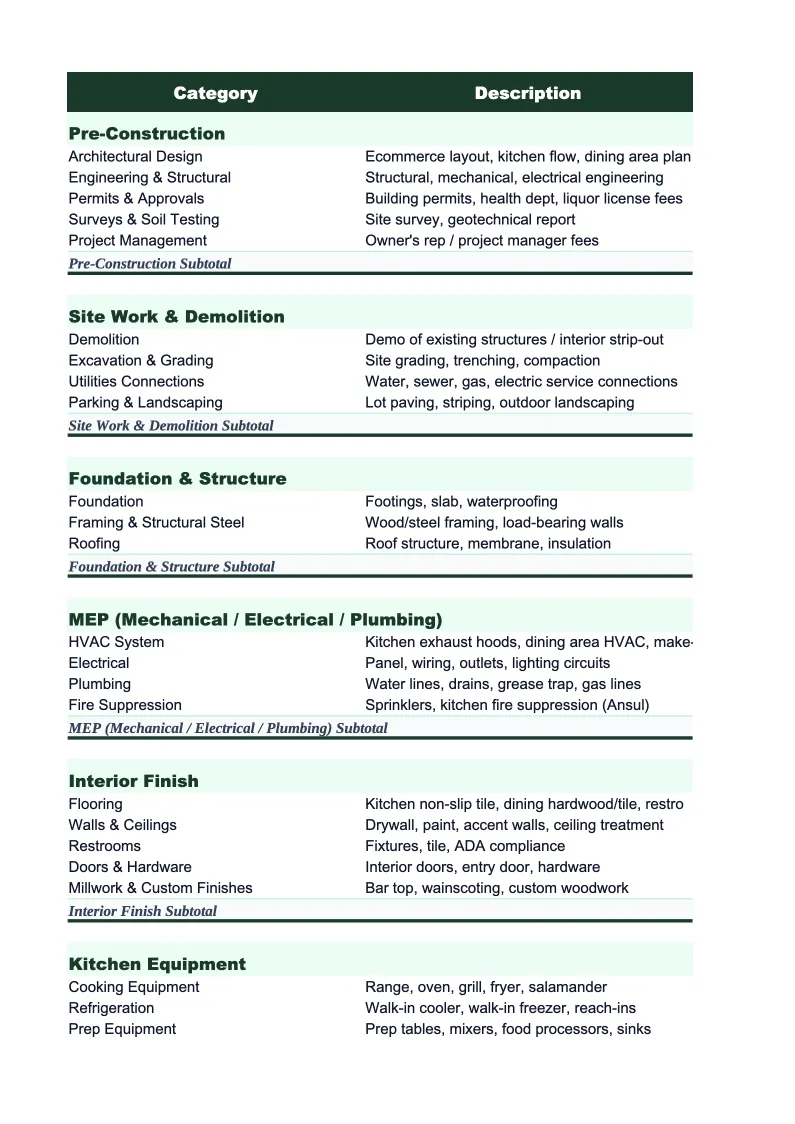
Ecommerce Project Budget Template
Plan and track every dollar of an ecommerce store launch, platform migration, or new product line — from technology and design to launch marketing, packaging, and initial inventory.
What's Inside This Ecommerce Project Budget Template
This template includes 7 worksheets, each designed for a specific part of your ecommerce financial workflow:
Project Setup
Enter your project's core details here first: store or brand name, project type (new store launch, platform migration, product line addition, site redesign), target launch date, total capital available, and how that capital is funded (owner equity, business loan, investor capital).
Technology & Platform
Detailed line-item budget for every technology cost involved in building or migrating your store: ecommerce platform setup or migration fees (Shopify, WooCommerce, BigCommerce, or custom), domain registration and SSL, web hosting, payment gateway setup fees, third-party apps and plugins (reviews, loyalty, upsell, subscription management, live chat), custom development or theme customization costs, email marketing platform setup, tax compliance software, inventory management or ERP integration, and any API or data migration work required to move from an existing platform.
Design & Content
Covers all creative and content production costs tied to the project: UX and visual design fees for a new or redesigned storefront, logo and brand identity design or refresh, product photography (per-product rates and session fees), lifestyle and campaign photography, product video production, copywriting for product descriptions and the main pages, conversion-optimized landing page design, graphic design for packaging and marketing materials, and translation costs if launching in multiple markets.
Marketing & Launch
Tracks all one-time and pre-launch marketing costs: paid advertising setup and initial launch budget (Google Shopping, Meta campaigns, TikTok), influencer or creator fees for launch campaign content, PR agency retainer or press outreach costs, affiliate program setup fees, SEO foundation work (keyword research, technical audit, initial link building), pre-launch email list building campaigns, SMS marketing platform setup, launch promotional samples or gifting to reviewers and press, grand opening discount or coupon program cost, and any marketplace setup fees (Amazon Seller Central enrollment, Etsy, eBay listing fees).
Operations & Fulfillment
Budget tracker for the operational infrastructure required to fulfill orders: 3PL setup and onboarding fees if outsourcing fulfillment, warehouse equipment or racking if self-fulfilling, custom packaging design fees and initial packaging run (boxes, mailers, tissue paper, inserts, stickers), initial shipping supplies, barcode and label printing equipment, returns management platform setup, freight and inbound shipping costs to move initial inventory to the warehouse or 3PL, and any customs, duties, or import brokerage fees if sourcing inventory internationally.
Budget vs Actual
Side-by-side comparison of your original budget against costs incurred to date, organized by the same five cost categories as the other sheets.
Dashboard
A one-page project overview with pre-built charts showing total budget versus actual spend by category, percentage of capital committed, and projected total cost at completion.
Ecommerce Project Budget Template Features
- Pre-built cost categories covering technology, design, launch marketing, operations, and working capital for ecommerce projects
- Product photography budget tracker with per-session and per-SKU cost breakdown
- Packaging design and initial-run MOQ cost tracker for branded unboxing materials
- Committed-not-yet-paid column for developer retainers, creative deposits, and packaging orders with long lead times
- Unit economics preview showing orders-to-breakeven based on AOV and gross margin inputs
- Launch readiness tracker showing budget status and completion percentage across all five project workstreams
How to Use This Ecommerce Project Budget Spreadsheet
Start with the Project Setup sheet. Enter your store name, project type, target launch date, and total available capital alongside your financing split. The setup sheet gives you a summary view of your five cost buckets before you get into individual line items, so you can quickly check whether your total estimated costs fit within your available funding. Then open the Technology & Platform sheet and review the pre-loaded categories — adjust them to reflect your specific platform choice and tech stack. Shopify builds have different line items than WooCommerce migrations, and a brand using a 3PL has different ops costs than one shipping from a home warehouse.
As vendor quotes, agency proposals, and developer estimates come in, enter them in the relevant sheets alongside the estimates you started with. The Budget vs Actual sheet shows variance as soon as a category has both a budget amount and a quote, deposit, or invoice. Enter the committed-not-yet-paid column whenever you sign a contract or place a deposit — for ecommerce projects, this includes developer retainers, photography bookings, packaging MOQ orders, and initial ad platform funding. Most ecommerce project teams find it useful to review the Budget vs Actual sheet weekly, timed around agency check-ins and any investor or lender reporting cycles.
15 minutes from download to your first project budget
Download the template, enter your platform, design, and marketing costs, and see your full ecommerce launch investment — technology, creative, ops, and marketing — in one place.
Why Ecommerce Projects Need a Dedicated Project Budget
Ecommerce project costs are more scattered than most operators expect. A new store launch involves technology setup, creative production, marketing activation, and operational infrastructure — from four different vendor categories, often running in parallel, with different payment terms and lead times. The technology bill arrives first, then photography and design in the middle, then packaging orders and launch marketing spend in the final weeks before go-live. Without a single tracker, it's common to burn through 60–70% of the budget before realizing there isn't enough left for the launch marketing that drives first-month revenue. Industry estimates for a professionally launched mid-market DTC brand on Shopify typically run $15,000–$60,000 in project costs before the first sale, and that range holds even for brands without any custom development.
Two cost categories consistently surprise ecommerce founders. The first is product photography: stores launching with professional product and lifestyle photography convert 20–30% better than stores using supplier images, but a proper catalog shoot for 30–50 SKUs with lifestyle content runs $4,000–$12,000 and takes 4–8 weeks from concept to edited finals. Building the photography budget and timeline into your project plan from day one — not as an afterthought after the platform is built — keeps launches from being delayed or going live with placeholder images. The second is packaging: branded custom packaging requires 6–12 weeks from design approval to delivery, often requires MOQs of 500–2,000 units, and involves design fees, plate fees, and the full initial-run cost all landing before a single order ships.
Ecommerce Industry at a Glance
Financial templates built for ecommerce businesses — from Shopify stores to Amazon sellers. Pre-loaded with SKU-level line items, platform fee categories, return tracking, and the metrics that drive online retail profitability.
Revenue Drivers
- Direct-to-consumer product sales
- Wholesale and B2B orders
- Marketplace sales (Amazon, eBay, Etsy)
- Subscription or bundle revenue
Key Cost Categories
- Cost of goods sold (inventory)
- Shipping and fulfillment
- Payment processing fees
- Platform and marketplace fees
- Returns and refunds
- Digital advertising and customer acquisition
Typical Margins
Gross: 30-55% · Net: 5-15%
Seasonality
Heavy Q4 concentration around Black Friday, Cyber Monday, and holiday gifting. Many categories also spike in January (post-holiday), back-to-school (August), and Mother's Day.
Key Performance Indicators
Ecommerce Project Budget Template FAQ
More Ecommerce Templates
Ecommerce Balance Sheet Template for Excel
$29
Ecommerce Budget Template for Excel
$29
E-commerce Business Plan Template for Excel
$39
Ecommerce Cash Flow Template for Excel
$29
Ecommerce Expense Tracker Template for Excel
$29
Ecommerce Financial Model Template for Excel
$29
Ecommerce Income Statement Template for Excel
$29
Ecommerce Invoice Template for Excel
$29
Ecommerce KPI Dashboard Template for Excel
$29
Ecommerce P&L Template for Excel
$29
Ecommerce Pro Forma Template for Excel
$29
Ecommerce Sales Forecast Template for Excel
$29
Ecommerce Business Valuation Template for Excel
$29
More Project Budget Templates
Ecommerce Project Budget Template
$29