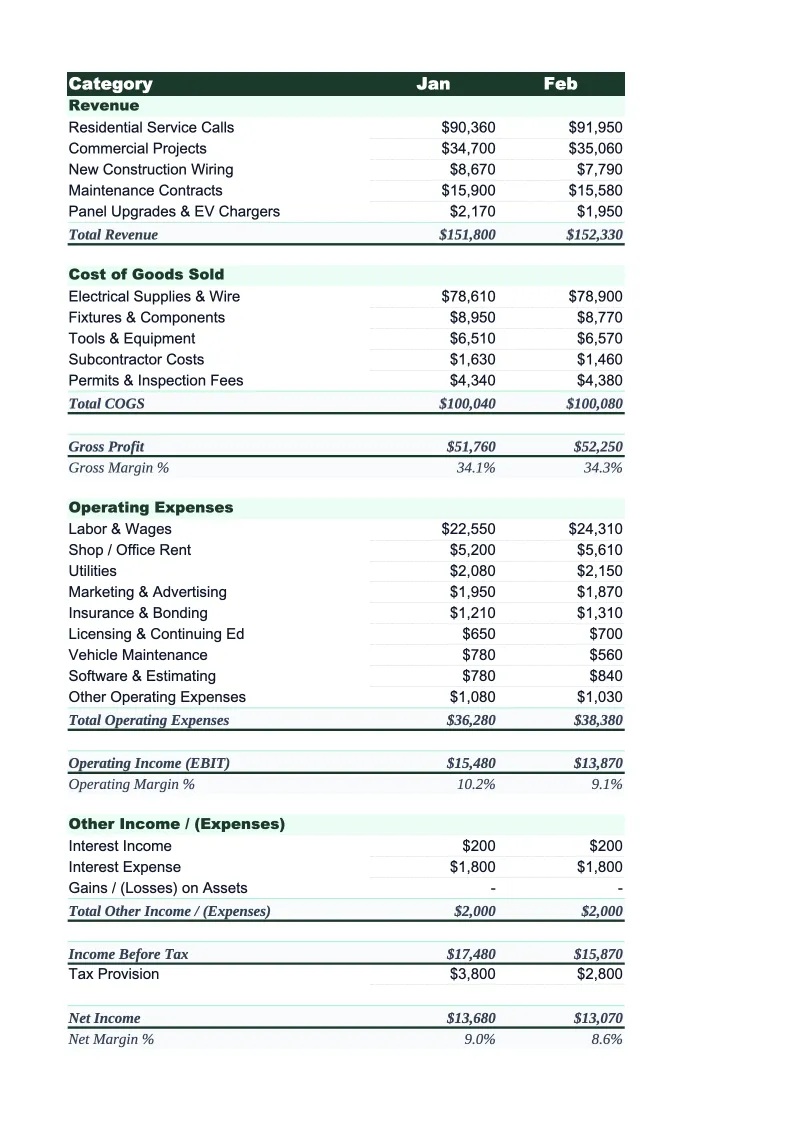
Electrical Income Statement Template
Track revenue, job costs, and overhead on one income statement built for electrical contractors — service calls, commercial projects, and residential installs all in the right structure.
What's Inside This Electrical Contractor Income Statement Template
This template includes 4 worksheets, each designed for a specific part of your electrical financial workflow:
Income Statement
The core monthly income statement structured around how electrical contractors earn and spend money.
Job Cost Summary
A project-by-project breakdown of revenue and costs for your active jobs.
Annual Summary
A 12-month rollup that automatically pulls revenue, direct costs, and overhead from each monthly income statement.
Dashboard
Pre-built charts and KPI cards that give you a financial snapshot of your electrical business without digging through individual cells.
Electrical Contractor Income Statement Template Features
- Revenue split by work type — residential service, commercial, new construction, panel upgrades, and service agreements
- Direct job costs broken out by materials and wire, journeymen labor, apprentice labor, permits, and vehicle costs
- Gross margin per job tracked in the Job Cost Summary sheet
- 12-month annual rollup with seasonal visibility across electrical work types
- Overhead pre-loaded for electrical contractors — bonding, tools, general liability, and admin
- Gross margin, EBITDA, and net margin auto-calculated on the Dashboard
How to Use This Electrical Contractor Income Statement Spreadsheet
Download the .xlsx file and open it in Excel or Google Sheets — no macros or add-ins needed. Start with the Income Statement sheet and review the pre-loaded categories. Most electrical contractors will recognize the revenue and cost line items immediately; adjust any labels that don't match your chart of accounts or how you quote work. Enter your revenue by work type and your direct job costs for the current month. If you're mid-year, work backwards and fill in prior months using your bank statements, accounting software exports, or QuickBooks reports — it doesn't need to be perfect on the first pass.
Move to the Job Cost Summary and add your active projects. For each job, enter the quoted or contract value, your estimated costs by category, and what you've spent so far. Electrical contractors with several concurrent commercial jobs or multi-phase residential builds will get the most out of this sheet — seeing gross margin per job in real time lets you catch material cost drift or labor overruns while the job is still open. Update the Job Cost Summary weekly: check wire and materials invoices against your estimates, verify any sub costs, and flag jobs where actuals are running ahead of budget.
15 minutes from download to your first income statement
Download the template, enter your job revenue and costs, and get a clear picture of your electrical business's gross margin, overhead, and net income.
Why Every Electrical Contractor Needs an Income Statement Template
Electrical contractors have gross margins that look healthy on paper — typically 35–50% — but net margins that tell a more complicated story, often landing between 5–12%. The gap is overhead: bonding and general liability insurance, a licensed electrician or master electrician on staff, vehicles and fuel, tools and equipment, and the administrative burden of permitting on every job. Without a structured income statement that separates direct job costs from overhead, it's almost impossible to know whether a margin problem is coming from the work itself or from how the business is run. Most electrical contractors who track revenue and expenses but don't use a proper income statement structure discover their overhead is 15–25% of revenue — a number that's hard to see unless it's its own line.
A proper electrical contractor income statement starts with revenue broken out by work type, because service work and project work carry different cost profiles. Service calls and panel upgrades are typically labor-intensive with lower material costs; commercial projects carry high material costs (wire, conduit, panels, fixtures) that can run 30–40% of job revenue. Below revenue, direct job costs need to be broken out clearly: materials and wire as one line, direct labor split by journeyman and apprentice rates, permit and inspection fees (which can be significant on commercial work), and vehicle costs assigned directly to jobs. This level of detail lets you calculate gross margin by work type, which is where most electrical contractors discover that their commercial jobs — which feel like big wins — are actually generating lower margins than residential service work.
Electrical Industry at a Glance
Financial templates built for electrical contractors — from solo electricians to multi-crew commercial shops. Pre-loaded with labor, materials, and overhead categories specific to the electrical trades.
Revenue Drivers
- Residential service calls
- Commercial project contracts
- New construction installs
- Panel upgrades
- Maintenance & service agreements
- Material markups
Key Cost Categories
- Materials & wire
- Labor (journeymen & apprentices)
- Permits & inspection fees
- Vehicle & fuel
- Tools & equipment
- Insurance & bonding
- Subcontractors
- Overhead & office
Typical Margins
Gross: 35-50% · Net: 5-12%
Seasonality
Commercial construction peaks spring through fall. Residential service work is relatively steady year-round, with spikes in summer (AC-related) and fall (heating season). Slowest in January–February.
Key Performance Indicators
Electrical Contractor Income Statement Template FAQ
More Electrical Templates
Electrical Contractor Balance Sheet Template for Excel
$29
Electrical Contractor Budget Template for Excel
$29
Electrical Contractor Business Plan Template for Excel
$39
Electrical Contractor Cash Flow Template for Excel
$29
Electrical Contractor Expense Tracker Template for Excel
$29
Electrical Contractor Financial Model Template for Excel
$29
Electrical Invoice Template for Excel
$29
Electrical Contractor KPI Dashboard Template for Excel
$29
Electrical Contractor P&L Template for Excel
$29
Electrical Contractor Pro Forma Template for Excel
$29
Electrical Project Budget Template for Excel
$29
Electrical Contractor Sales Forecast Template for Excel
$29
Electrical Contractor Valuation Template for Excel
$29
More Income Statement Templates
Accounting Firm Income Statement Template for Excel
$29
Auto Repair Income Statement Template for Excel
$29
Car Wash Income Statement Template for Excel
$29
Church Income Statement Template for Excel
$29
Cleaning Service Income Statement Template for Excel
$29
Coffee Shop Income Statement Template for Excel
$29
Electrical Income Statement Template
$29