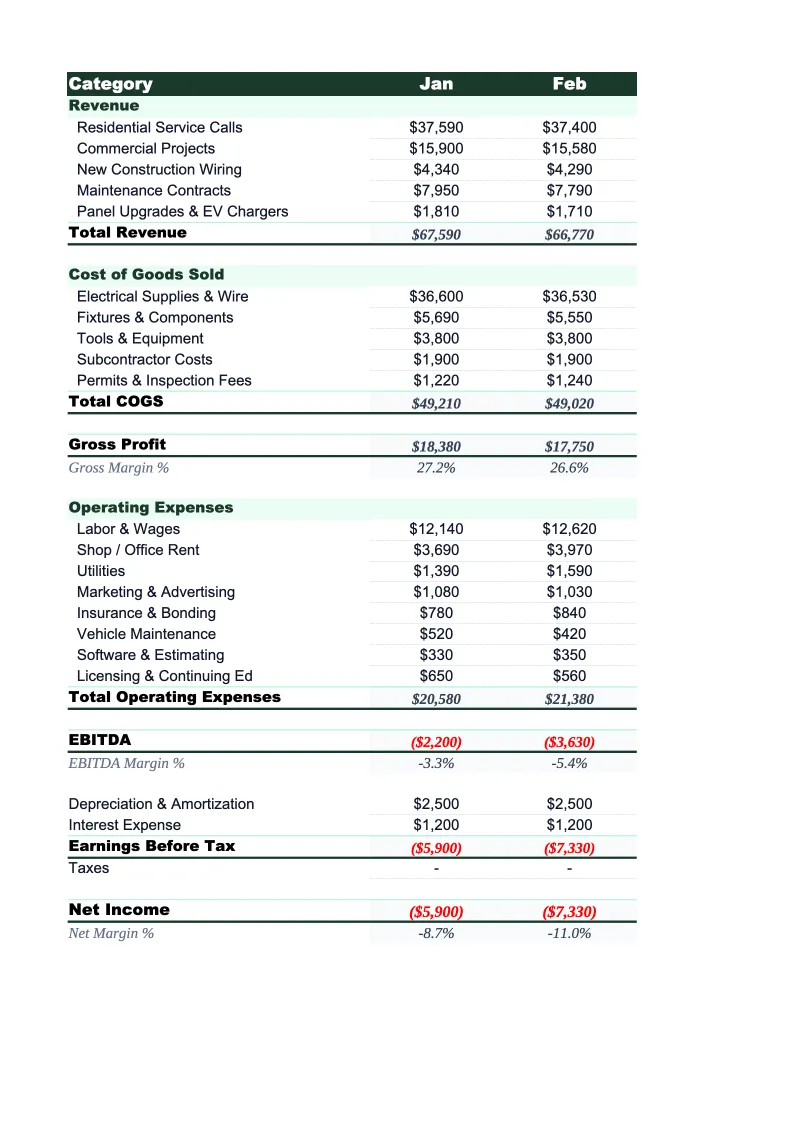
Electrical P&L Template
Track your electrical company's revenue, materials costs, labor, and net profit with a P&L built around how electrical contractors manage their financials — by job type and service category.
What's Inside This Electrical Contractor P&L Template
This template includes 4 worksheets, each designed for a specific part of your electrical financial workflow:
Monthly P&L
The core worksheet for recording each month's revenue and costs.
Annual P&L
A 12-month view that pulls from the Monthly P&L sheet automatically, with no re-entry required.
Job Cost Summary
A project-level breakdown where you enter revenue and direct costs for each electrical job.
Dashboard
A one-page summary with pre-built charts and the key financial metrics that matter for an electrical business.
Electrical P&L Template Features
- Revenue split by job type: residential service, commercial projects, new construction, panel upgrades, and maintenance agreements
- Direct costs broken out by wire and materials, journeyman and apprentice labor, subcontractors, permits, and vehicle costs
- Job Cost Summary sheet with gross margin calculated per electrical project
- 12-month Annual P&L that updates automatically from monthly entries
- Revenue per man-hour and materials markup percentage auto-calculated
- Visual dashboard with margin trends and cost breakdown charts
How to Use This Electrical P&L Spreadsheet
Download the .xlsx file and open it in Excel or Google Sheets — no macros or setup beyond your own numbers. Start with the Monthly P&L sheet. The revenue categories cover the main job types for electrical contractors: residential service calls, commercial project work, new construction installs, panel and service upgrades, maintenance agreements, and material markups. Review them and rename any line items that don't match how you classify your work. The cost section separates wire and materials, direct labor (with journeyman and apprentice lines), subcontractors, permit fees, vehicle costs, and tools. Most electrical companies find initial setup takes 15–20 minutes.
Once the structure matches your business, enter your monthly revenue and direct costs from your job cost reports or accounting software. The Job Cost Summary sheet is worth filling out project by project: enter each job's contract value, change orders, and actual costs, and the sheet calculates gross profit and margin per project automatically. This is the view that tells you whether individual jobs are performing to their estimated margins — information that gets lost when everything rolls into the monthly total. Compare your actual wire and materials cost against your bid estimates for a quick read on estimating accuracy and markup effectiveness.
15 minutes from download to your first P&L
Download the template, enter last month's job revenue and costs, and see your electrical company's gross margin and net income — with a job-by-job cost breakdown included.
Why Every Electrical Contractor Needs a P&L Template
Electrical contractors operate at gross margins of 35–50%, but net margins compress to 5–12% after overhead — a range that leaves little room for cost surprises on individual jobs. The margin gap between job types is significant: residential service calls and panel upgrades often carry 40–50% gross margins because labor is the primary cost and materials are minimal. Commercial project work and new construction typically run 25–35% gross margin due to more competitive bidding, higher subcontractor and materials costs, and longer payment cycles. Without a P&L that separates these job categories, a strong service call month can mask margin erosion on your commercial work — or vice versa.
A proper electrical P&L tracks two cost drivers that generic templates miss entirely. First, labor tracked separately by journeyman and apprentice rates, because the mix on a job directly affects your cost and your billing rate. A project staffed heavily with apprentice hours at lower billing rates will look different on margin than the same hours staffed with journeymen — and both are different from a service call where you're billing at premium rates. Second, materials markup as a distinct revenue and cost category: many electrical contractors generate meaningful revenue from materials sold to clients, and tracking markup percentage separately from labor gross margin gives you a clearer picture of your true profitability by work type.
Electrical Industry at a Glance
Financial templates built for electrical contractors — from solo electricians to multi-crew commercial shops. Pre-loaded with labor, materials, and overhead categories specific to the electrical trades.
Revenue Drivers
- Residential service calls
- Commercial project contracts
- New construction installs
- Panel upgrades
- Maintenance & service agreements
- Material markups
Key Cost Categories
- Materials & wire
- Labor (journeymen & apprentices)
- Permits & inspection fees
- Vehicle & fuel
- Tools & equipment
- Insurance & bonding
- Subcontractors
- Overhead & office
Typical Margins
Gross: 35-50% · Net: 5-12%
Seasonality
Commercial construction peaks spring through fall. Residential service work is relatively steady year-round, with spikes in summer (AC-related) and fall (heating season). Slowest in January–February.
Key Performance Indicators
Electrical Contractor P&L Template FAQ
More Electrical Templates
Electrical Contractor Balance Sheet Template for Excel
$29
Electrical Contractor Budget Template for Excel
$29
Electrical Contractor Business Plan Template for Excel
$39
Electrical Contractor Cash Flow Template for Excel
$29
Electrical Contractor Expense Tracker Template for Excel
$29
Electrical Contractor Financial Model Template for Excel
$29
Electrical Contractor Income Statement Template for Excel
$29
Electrical Invoice Template for Excel
$29
Electrical Contractor KPI Dashboard Template for Excel
$29
Electrical Contractor Pro Forma Template for Excel
$29
Electrical Project Budget Template for Excel
$29
Electrical Contractor Sales Forecast Template for Excel
$29
Electrical Contractor Valuation Template for Excel
$29
Electrical P&L Template
$29