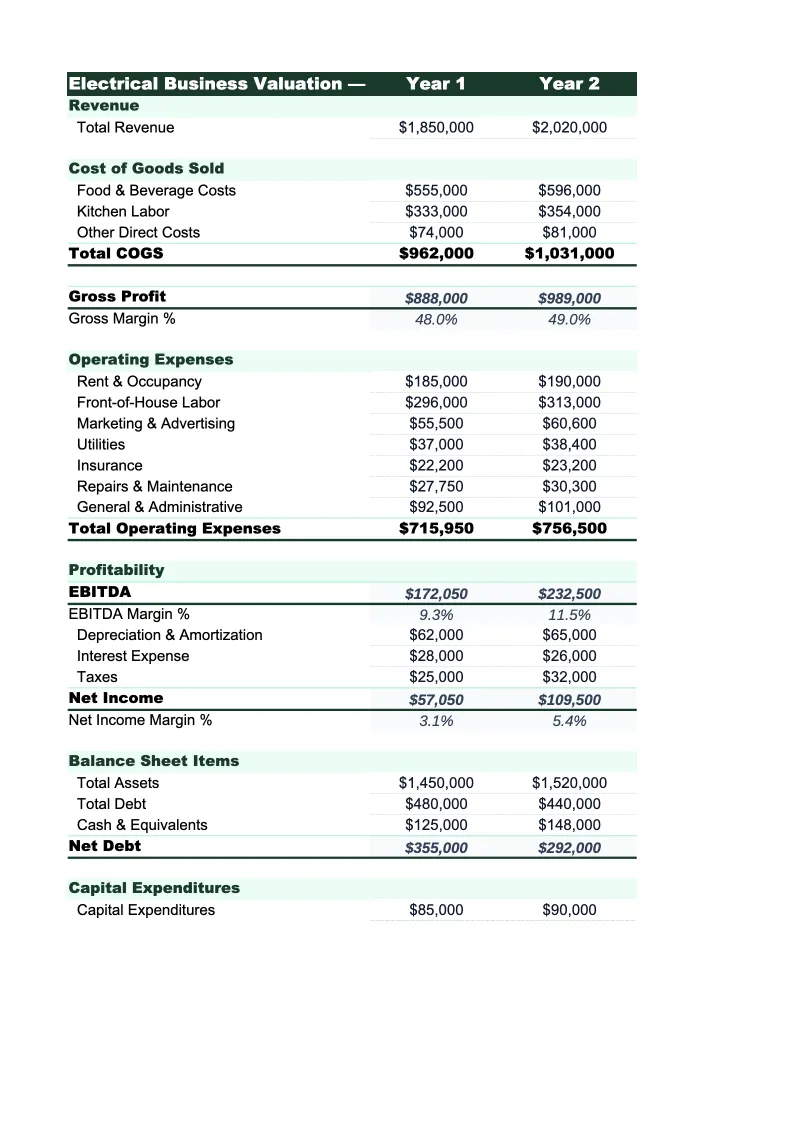
Electrical Valuation Template
Value your electrical contracting business using SDE or EBITDA multiples, a revenue quality analysis separating recurring commercial from project-based and residential service work, a license dependency assessment covering the most common value driver in electrical transactions, an equipment and fleet asset approach, and a buyer-type comparison — built around the factors that electrical contractors, commercial buyers, and acquisition platforms actually use when pricing electrical company sales.
What's Inside This Electrical Contractor Valuation Template
This template includes 5 worksheets, each designed for a specific part of your electrical financial workflow:
Business Inputs
The data entry foundation for the entire valuation model.
Revenue Quality Analysis
A structured breakdown of the electrical company's revenue by stability and predictability, because buyers apply significantly different multiples to different revenue types in electrical transactions.
Earnings Multiple Approach
Electrical contractor valuations apply different frameworks depending on the size of the operation, the revenue quality mix, and whether the selling owner holds the electrical license required to legally operate the business in the buyer's state.
Asset-Based Approach
A floor-value calculation based on the tangible assets a buyer would be acquiring in an electrical contractor transaction.
Valuation Summary
A single-page output consolidating the earnings multiple approach and the asset-based floor into one view across conservative, base, and optimistic scenarios.
Electrical Contractor Valuation Template Features
- Revenue Quality Analysis sheet categorizing trailing revenue into four buckets — recurring commercial maintenance, residential service relationships, project-based bid work, and GC-dependent new construction — with a quality mix score and customer concentration check that directly determines the applicable multiple range
- License Dependency Assessment modeling the financial impact of the owner's master electrician license on deal structure — including licensed replacement hire cost capitalization, transition timeline risk, and scenarios where the buyer is already licensed — the single most structurally unique value driver in electrical contractor transactions
- Dual earnings multiple framework covering SDE multiples for owner-operated residential and service contractors (2.0–3.5x) and EBITDA multiples for managed commercial operations (3.0–5.0x), with a six-factor scoring matrix including revenue quality, license transition risk, owner dependency, journeyman-to-apprentice ratio, customer concentration, and documented backlog
- Asset-Based Approach capturing service vans with tool inventory, cable pullers, conduit benders, test and measurement equipment, wire and materials inventory, license replacement cost, maintenance agreement intangibles, and online review and referral network value specific to residential electrical service businesses
- Customer concentration sensitivity analysis showing how valuation changes as single-account revenue dependency shifts, with flagging when any client exceeds 15% of total revenue — a threshold that consistently triggers buyer price adjustments in electrical transactions
- Three-scenario Valuation Summary with individual versus strategic buyer comparison, license transition adjustment, GC dependency normalization, seller employment arrangement modeling for license transition periods, and an earnings multiple sensitivity table calibrated to maintenance agreement percentage and revenue quality mix
How to Use This Electrical Business Valuation Spreadsheet
Start with the Business Inputs sheet. Pull your trailing twelve-month revenue by work category from your accounting system or job management software — separating residential service, residential installations, commercial maintenance, commercial projects, new construction, and any specialty categories matters because buyers weight these differently. For the expense section, use actual numbers from your P&L; the labor breakdown between journeymen and apprentices and the workers' comp premium are the line items buyers will ask about specifically. Enter owner compensation completely and accurately — salary, vehicle, health insurance, and any personal expenses run through the business. For the asset section, walk through your service vans and document year, mileage, and estimated resale value for each; a search on commercial vehicle dealer sites gives reasonable estimates. Before moving to the next sheet, be clear about one question that shapes the entire valuation: does the selling owner hold the only master electrician license associated with the business, and if so, who among the existing team could hold that license post-sale? The answer to this question runs through the entire model.
The Revenue Quality Analysis sheet requires honest categorization of how your revenue was generated, not just what category it falls into. Go through your trailing twelve-month job list and sort each revenue source into the four buckets: recurring commercial maintenance with signed agreements, residential service relationships from repeat customers who call you specifically, project work won through competitive bidding, and new construction work that depends on GC relationships. If you have commercial maintenance agreements, document them in detail — copies of agreements, annual billing amounts, renewal terms, and which staff the commercial client interacts with — because this documentation directly increases the defensible value of that revenue category. Calculate your customer concentration percentages honestly: if a single commercial client, property management group, or GC represents more than 15% of your trailing revenue, flag it in the sheet and prepare to explain the relationship's continuity and contractual basis. Document your backlog by category — signed commercial contracts not started, residential work accepted and scheduled, and the renewal value of maintenance agreements for the next twelve months.
Know what your electrical business is worth before you sell
Enter your revenue by work category, license situation, owner compensation, maintenance agreement base, customer concentration, and equipment assets — and get a defensible valuation range with the license dependency analysis, revenue quality scoring, and earnings multiples that buyers use when structuring offers on electrical contractor businesses.
How Electrical Contractors Are Valued When They Sell
Electrical contractor valuations are shaped more than most trades by a structural issue that has nothing to do with revenue size or profitability: the electrical license. In most states, electrical contracting work above a certain dollar or scope threshold must be performed under the supervision of a licensed master electrician or licensed electrical contractor, and this license is issued to a person, not to a business entity. When the selling owner holds that license personally and no other licensed electrician works for the company, a buyer faces a genuine operational problem — the business legally cannot perform electrical work without a licensed qualifier after the owner steps away. Buyers who understand electrical contractor transactions will identify this immediately, model the cost of hiring a licensed master electrician to serve as the qualifying licensee, and reduce what they can offer accordingly. Understanding this dynamic before beginning a sale process is the most important preparation a selling electrical contractor can do, because the solutions — hiring a licensed employee, structuring the seller's post-sale role to include a transition period, or finding a buyer who is themselves a licensed master electrician — all have better outcomes than encountering the issue as a surprise during due diligence.
Beyond the license question, the specific variables that drive electrical contractor multiples up or down are well understood by industry brokers and experienced buyers. Revenue quality is the primary lever: commercial maintenance agreements and service contracts with documented renewal terms command a premium over project-bid revenue because they provide a buyer with a visible, recurring income stream that doesn't require winning new bids. Owner dependency in estimating and key client relationships is the second major factor — if the owner is the primary estimator, the person who builds relationships with commercial facility managers and property management contacts, and the face of the business for the top accounts, a buyer is acquiring revenue that may be partially relationship-dependent on the seller rather than on the business itself. Customer and GC concentration is a third factor buyers consistently act on: a single commercial client or general contractor representing more than 15–20% of revenue is flagged as concentration risk, and buyers either require seller-employment periods, earnouts tied to account retention, or a direct price reduction to account for the revenue that might not transfer. The journeyman-to-apprentice ratio indicates scalability — a business with several journeymen capable of running their own jobs and training apprentices beneath them is operationally more scalable than one where all meaningful work flows through the owner or a single lead journeyman.
Electrical Industry at a Glance
Financial templates built for electrical contractors — from solo electricians to multi-crew commercial shops. Pre-loaded with labor, materials, and overhead categories specific to the electrical trades.
Revenue Drivers
- Residential service calls
- Commercial project contracts
- New construction installs
- Panel upgrades
- Maintenance & service agreements
- Material markups
Key Cost Categories
- Materials & wire
- Labor (journeymen & apprentices)
- Permits & inspection fees
- Vehicle & fuel
- Tools & equipment
- Insurance & bonding
- Subcontractors
- Overhead & office
Typical Margins
Gross: 35-50% · Net: 5-12%
Seasonality
Commercial construction peaks spring through fall. Residential service work is relatively steady year-round, with spikes in summer (AC-related) and fall (heating season). Slowest in January–February.
Key Performance Indicators
Electrical Contractor Business Valuation FAQ
More Electrical Templates
Electrical Contractor Balance Sheet Template for Excel
$29
Electrical Contractor Budget Template for Excel
$29
Electrical Contractor Business Plan Template for Excel
$39
Electrical Contractor Cash Flow Template for Excel
$29
Electrical Contractor Expense Tracker Template for Excel
$29
Electrical Contractor Financial Model Template for Excel
$29
Electrical Contractor Income Statement Template for Excel
$29
Electrical Invoice Template for Excel
$29
Electrical Contractor KPI Dashboard Template for Excel
$29
Electrical Contractor P&L Template for Excel
$29
Electrical Contractor Pro Forma Template for Excel
$29
Electrical Project Budget Template for Excel
$29
Electrical Contractor Sales Forecast Template for Excel
$29
Electrical Valuation Template
$29