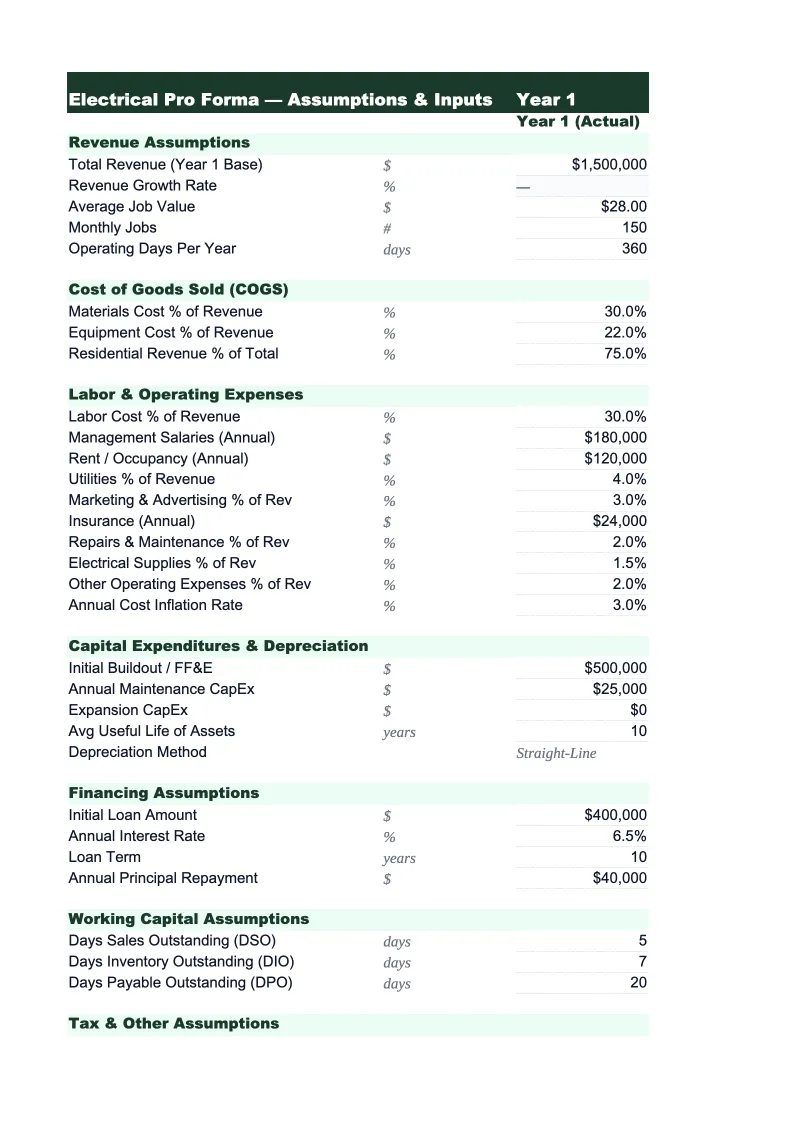
Electrical Pro Forma Template
Project an electrical contracting business's revenue, job costs, overhead, and net income across 5 years — with pre-built formulas for service vs. project mix, material markup, revenue per man-hour, and break-even analysis.
What's Inside This Electrical Contractor Pro Forma Template
This template includes 7 worksheets, each designed for a specific part of your electrical financial workflow:
Assumptions
The control panel for the entire model.
Revenue Projections
Projects total revenue by month for year one and annually through year five, broken out by five work types: residential service calls, commercial project contracts, new construction installs, panel upgrades and specialty work, and maintenance and service agreements.
Job Cost Model
Breaks out direct job costs by the categories that determine gross margin in electrical work: materials and wire (entered as a cost percentage of contract or ticket value), direct labor (journeymen wages, apprentice wages, and burden — FICA, workers' comp, and benefits — modeled separately because burden rates differ by role), subcontractor costs for work outside your trade scope, and permit and inspection fees.
Overhead & G&A
Covers all costs not allocated to a specific job: vehicle fleet (lease or depreciation, insurance, fuel, and maintenance per truck), tools and test equipment (capital purchases and replacements), general liability and commercial auto insurance, workers' comp insurance (modeled as a percentage of direct labor, which is how it's actually priced), electrical contractor license renewal fees and continuing education, accounting and legal fees, software subscriptions (service dispatch, estimating, and accounting tools), and office rent and administrative staff if applicable.
5-Year P&L Summary
An annual summary showing total revenue, total job costs, gross profit, gross margin percentage, total overhead, EBITDA, and net income side by side for each of the five projected years.
Cash Flow Projection
A monthly cash flow model for year one and an annual summary through year five.
Break-Even Analysis
Calculates the annual revenue required to cover all fixed and variable costs.
Electrical Pro Forma Template Features
- Revenue model by work type (residential service, commercial contracts, new construction, panel upgrades, service agreements) with separate volume and average ticket inputs
- Job cost breakdown by materials, direct labor (journeymen vs. apprentice), subcontractors, and permits as percentages of revenue by work type
- Revenue per man-hour calculation across all five projected years — the core productivity metric for electrical contractors
- Cash flow model with fast-pay service work vs. net-60 commercial billing and optional retainage tracking
- 5-year annual P&L with gross margin, overhead percentage, EBITDA, and net margin by year
- Break-even analysis with technician headcount modeling under variable gross margin scenarios
How to Use This Electrical Contractor Pro Forma Spreadsheet
Start with the Assumptions sheet. Enter your current technician count, your service vs. project revenue split, and your average revenue per service call and per commercial contract. If you're projecting for a new business, use industry benchmarks as a starting point: most residential service-focused electrical shops generate $80,000–$120,000 in annual revenue per technician at healthy utilization rates, while commercial contractors often run higher because of larger contract values. Set a realistic ramp schedule for the first 12–24 months — customer acquisition in electrical contracting is driven by relationships and reputation, not advertising, so growth in year one is almost always slower than year two.
Once assumptions are in place, review the Job Cost Model and adjust the cost percentages to match your actual experience. This is the most important customization step — the default percentages are industry averages, but your actual material costs depend on your supplier pricing and the type of work you do, and your labor burden rate depends on your benefits structure and your workers' comp classification. Enter the actual gross margins you see on your best job type and your worst job type. Then review the Overhead & G&A sheet and enter your real overhead costs — vehicle fleet costs and insurance are typically the largest line items for electrical contractors and they vary significantly based on how many trucks you run.
From download to lender-ready projections in under an hour
Enter your technician count, work type mix, and cost structure — the model builds your 5-year revenue, job margin, overhead, and cash flow analysis automatically.
Why Every Electrical Contractor Needs a Pro Forma
Electrical contractors face a financial planning challenge that's distinct from most service businesses: the gap between when you spend money and when you get paid grows significantly as you move from residential service work to commercial projects. A residential service call closes and gets paid the same day — material cost plus labor plus markup, collected within a week. A commercial lighting retrofit on a 90-day project has the same cost structure but generates invoices on a net-60 cycle with 10% retainage held until final inspection. For a shop doing $1.5 million a year split between service and commercial work, understanding that cash timing difference — and planning for it — is the difference between a thriving business and one that struggles to make payroll in months when commercial collections are slow.
The two metrics that define electrical contractor financial health are revenue per man-hour and overhead as a percentage of revenue. Revenue per man-hour tells you whether your pricing, efficiency, and technician utilization are producing the returns the business needs — most well-run electrical shops target $75–$120 per man-hour on residential service and $60–$90 on commercial project work (the range reflects regional labor cost differences and market competitiveness). Overhead percentage tells you whether the business is scalable — most profitable electrical contractors keep total overhead under 20% of revenue, and the ratio almost always improves as revenue grows because license fees, insurance minimums, and dispatch software costs don't scale linearly with the number of trucks on the road. A pro forma that models both metrics across five years gives you a clear picture of when the business becomes self-sustaining and at what revenue level each additional technician becomes accretive.
Electrical Industry at a Glance
Financial templates built for electrical contractors — from solo electricians to multi-crew commercial shops. Pre-loaded with labor, materials, and overhead categories specific to the electrical trades.
Revenue Drivers
- Residential service calls
- Commercial project contracts
- New construction installs
- Panel upgrades
- Maintenance & service agreements
- Material markups
Key Cost Categories
- Materials & wire
- Labor (journeymen & apprentices)
- Permits & inspection fees
- Vehicle & fuel
- Tools & equipment
- Insurance & bonding
- Subcontractors
- Overhead & office
Typical Margins
Gross: 35-50% · Net: 5-12%
Seasonality
Commercial construction peaks spring through fall. Residential service work is relatively steady year-round, with spikes in summer (AC-related) and fall (heating season). Slowest in January–February.
Key Performance Indicators
Electrical Contractor Pro Forma Template FAQ
More Electrical Templates
Electrical Contractor Balance Sheet Template for Excel
$29
Electrical Contractor Budget Template for Excel
$29
Electrical Contractor Business Plan Template for Excel
$39
Electrical Contractor Cash Flow Template for Excel
$29
Electrical Contractor Expense Tracker Template for Excel
$29
Electrical Contractor Financial Model Template for Excel
$29
Electrical Contractor Income Statement Template for Excel
$29
Electrical Invoice Template for Excel
$29
Electrical Contractor KPI Dashboard Template for Excel
$29
Electrical Contractor P&L Template for Excel
$29
Electrical Project Budget Template for Excel
$29
Electrical Contractor Sales Forecast Template for Excel
$29
Electrical Contractor Valuation Template for Excel
$29
Electrical Pro Forma Template
$29