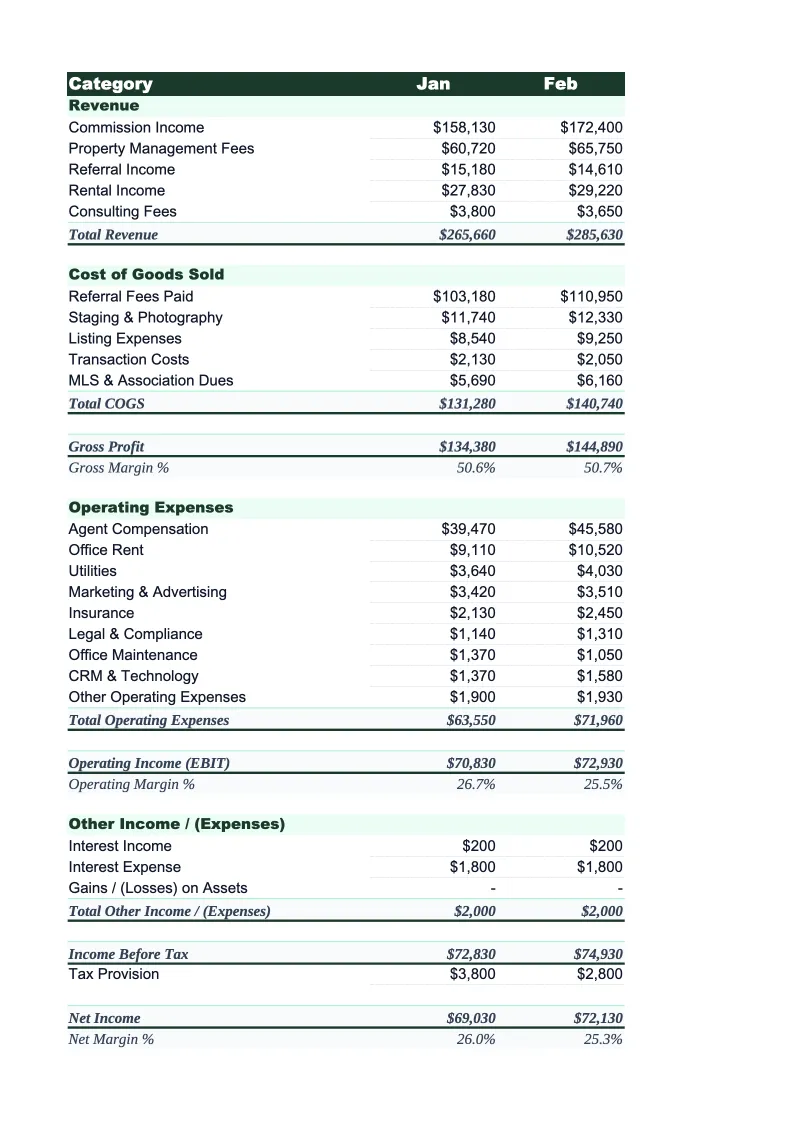
Real Estate Income Statement Template
Track gross commission income, broker splits, and operating expenses with an income statement built for real estate agents, brokers, and property managers.
What's Inside This Real Estate Income Statement Template
This template includes 4 worksheets, each designed for a specific part of your real estate financial workflow:
Monthly Income Statement
The core worksheet where you report each month's revenue and expenses using real estate-specific line items.
Annual Summary
A 12-month view that pulls from the monthly sheet automatically, giving you a full-year picture of commission income, broker costs, operating expenses, and net income.
Transaction Log
A running ledger of every closed deal for the year, with columns for closing date, property address, sale price, commission rate, gross commission earned, broker split percentage, and net commission to agent.
Dashboard
A visual snapshot of your financial performance built from the data in the other sheets.
Real Estate Income Statement Template Features
- Gross commission income (GCI) tracking with broker split calculations
- Transaction log that feeds monthly revenue automatically
- Expense categories built for real estate — MLS dues, E&O, CRM, brokerage fees
- Monthly and annual income statement views
- Net commission and net income auto-calculations
- Dashboard with GCI trends, expense breakdown, and year-to-date totals
How to Use This Real Estate Income Statement Spreadsheet
Start by setting up the template for your specific practice. Download the .xlsx file and open it in Excel or Google Sheets — no macros or add-ins required. On the Monthly Income Statement sheet, review the pre-loaded revenue and expense categories and adjust them to match how you operate. Solo agents typically simplify the revenue section to GCI and referral income. Teams and brokerages may want to expand the expense categories to separate agent-paid marketing from company marketing. Most users spend about 15 minutes on this initial setup.
Enter your closed deals in the Transaction Log as they happen. Each row captures the closing date, sale price, commission rate, and broker split, and the sheet calculates your net commission automatically. At month end, the monthly income statement pulls from the log, so your revenue figures are always current without manual entry. Fill in operating expenses once a month — log your MLS renewal, CRM subscription, advertising spend, and any other costs as they hit your account. The whole monthly update takes about 20 minutes.
15 minutes from download to your first income statement
Download the template, log your closed deals, and see your real estate business's true net income — commissions, splits, expenses, and all.
Why Every Real Estate Agent Needs an Income Statement
Real estate is a business where income looks high on paper but disappears fast once you account for all the costs. A top-producing agent with $150,000 in GCI might net $70,000 after broker splits, MLS fees, E&O insurance, marketing, and technology costs — and that's before taxes. The gap between gross commission and take-home income is real, and it's the kind of thing that sneaks up on agents who don't track expenses carefully. An income statement built for real estate makes that gap visible so you can manage it.
A proper real estate income statement separates costs into two layers. The first is direct costs — your broker split and any referral fees you've paid out. These come off the top of every deal and determine your net commission income before you've spent a dollar on running your business. The second layer is operating expenses — the recurring costs that don't change deal to deal: MLS and board dues, E&O insurance, CRM and transaction management software, marketing and advertising, vehicle expenses, and continuing education. Understanding both layers lets you set a realistic GCI target for the year, knowing exactly how much it costs to operate before you see any profit.
Real Estate Industry at a Glance
Financial templates built for real estate professionals — agents, brokers, property managers, appraisers, and inspectors. Pre-loaded with commission tracking, management fee structures, and transaction-based billing.
Revenue Drivers
- Sales commissions
- Property management fees
- Lease-up / tenant placement fees
- Appraisal & inspection fees
Key Cost Categories
- MLS & licensing fees
- Marketing & advertising
- E&O insurance
- Transaction coordination
- Technology & CRM
- Office & brokerage fees
Typical Margins
Gross: 40-70% · Net: 15-35%
Seasonality
Peak activity spring through summer (March–August); winter slowdown, especially December–January. Commercial real estate has less pronounced seasonality.
Key Performance Indicators
Real Estate Income Statement Template FAQ
More Real Estate Templates
Real Estate Balance Sheet Template for Excel
$29
Real Estate Budget Template for Excel
$29
Real Estate Business Plan Template for Excel
$39
Real Estate Cash Flow Template for Excel
$29
Real Estate Expense Tracker Template for Excel
$29
Real Estate Financial Model Template for Excel
$29
Real Estate Invoice Template for Excel
$29
Real Estate KPI Dashboard Template for Excel
$29
Real Estate P&L Template for Excel
$29
Real Estate Pro Forma Template for Excel
$29
Real Estate Project Budget Template for Excel
$29
Real Estate Sales Forecast Template for Excel
$29
Real Estate Business Valuation Template for Excel
$29
More Income Statement Templates
Accounting Firm Income Statement Template for Excel
$29
Auto Repair Income Statement Template for Excel
$29
Car Wash Income Statement Template for Excel
$29
Church Income Statement Template for Excel
$29
Cleaning Service Income Statement Template for Excel
$29
Coffee Shop Income Statement Template for Excel
$29
Real Estate Income Statement Template
$29