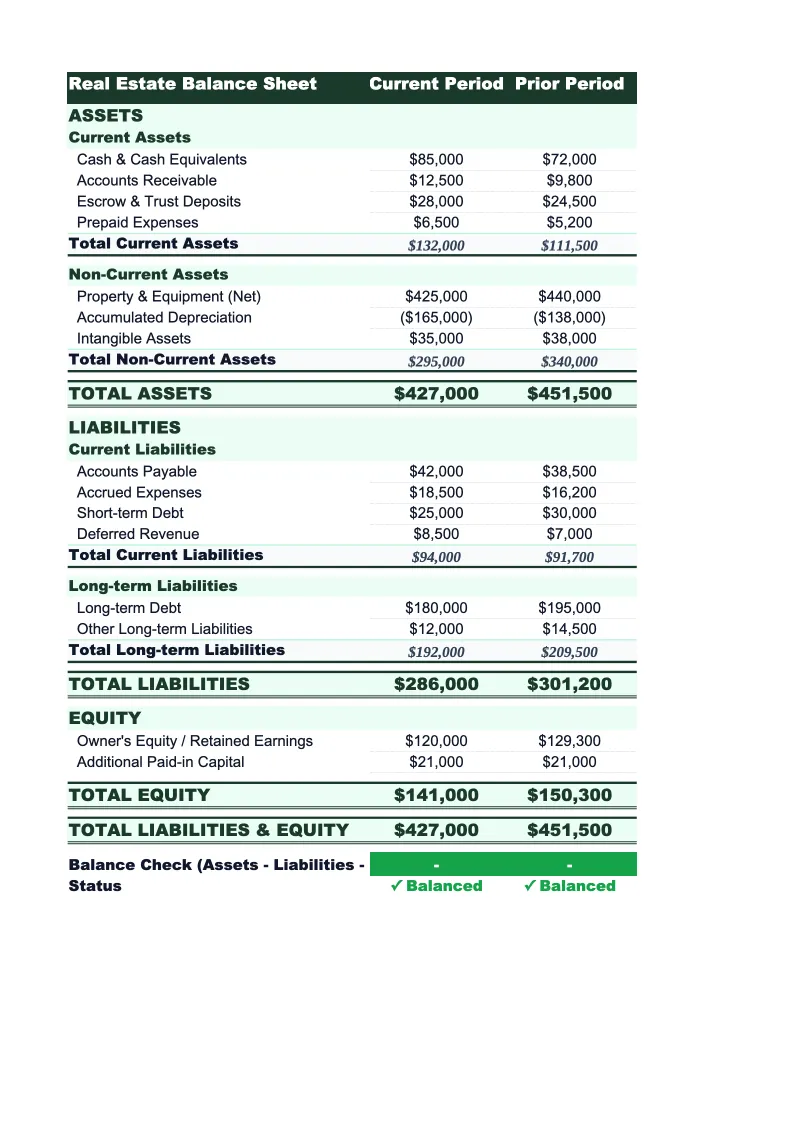
Real Estate Balance Sheet Template
See exactly what your real estate business owns, owes, and is worth — a balance sheet built for agents, brokers, and property managers.
What's Inside This Real Estate Balance Sheet Template
This template includes 4 worksheets, each designed for a specific part of your real estate financial workflow:
Balance Sheet
The core statement organized into assets, liabilities, and equity — the standard structure any lender, investor, or accountant expects to see.
Assets Detail
A dedicated worksheet for itemizing your asset accounts before they roll up to the main balance sheet.
Liabilities Detail
A supporting worksheet that breaks down your liability accounts in the same structured way as the assets side.
Period Comparison
A side-by-side view comparing two balance sheet dates — typically month-end to prior month, or year-end to prior year.
Real Estate Balance Sheet Template Features
- Current and non-current asset classification with auto-totals
- Commissions receivable and escrow/trust fund line items
- Equipment and vehicle book value with depreciation tracking
- Client trust and security deposit liability tracking
- Period-over-period comparison for trend analysis
- Accounting equation check — flags any imbalance automatically
How to Use This Real Estate Balance Sheet Spreadsheet
Download the file and open it in Excel or Google Sheets — no plugins or macros required. Start with the Assets Detail sheet: list every bank account by name and current balance, then move to vehicles, computers, and any other equipment your business owns. If you've had those assets for a while, enter their original cost and accumulated depreciation separately — the sheet calculates book value for you. For most solo agents, this step takes about 20 minutes on the first pass.
Next, work through the Liabilities Detail sheet. Enter any outstanding invoices you owe, tax liabilities, and — critically — any client funds you're holding. Earnest money deposits and tenant security deposits belong on this sheet as liabilities because they're not your money until disbursed or earned. Once both detail sheets are complete, the main Balance Sheet pulls all figures automatically and checks that assets equal liabilities plus equity. If the equation doesn't balance, a flag appears and you can trace back to whichever entry is off.
15 minutes from download to your first balance sheet
Download the template, enter your accounts, and see your real estate business's full financial position — assets, liabilities, equity, and net worth all in one place.
Why Every Real Estate Business Needs a Balance Sheet
Real estate professionals rarely think about balance sheets until a lender, partner, or buyer asks for one — and by then, the numbers are hard to pull together quickly. Most agents track their income and expenses reasonably well, but the balance sheet tells a different story: it shows whether the business is actually building value. A real estate business that generates strong gross commission income but carries high vehicle loans, unpaid tax liabilities, and no cash reserves may be profitable on paper while remaining financially fragile. The balance sheet is what reveals that gap.
For real estate agents and small brokerages, the asset side is usually simpler than other industries — you're a service business, so there's no inventory. But a few line items need specific attention. Commissions receivable can be significant during busy seasons, and they're real assets until collected. Client trust funds and earnest money held in escrow are an asset in one sense but must be matched dollar-for-dollar on the liability side — confusing these categories is a common error. Vehicles and technology equipment depreciate, and tracking book value separately from purchase price gives you a more accurate picture of what you actually own.
Real Estate Industry at a Glance
Financial templates built for real estate professionals — agents, brokers, property managers, appraisers, and inspectors. Pre-loaded with commission tracking, management fee structures, and transaction-based billing.
Revenue Drivers
- Sales commissions
- Property management fees
- Lease-up / tenant placement fees
- Appraisal & inspection fees
Key Cost Categories
- MLS & licensing fees
- Marketing & advertising
- E&O insurance
- Transaction coordination
- Technology & CRM
- Office & brokerage fees
Typical Margins
Gross: 40-70% · Net: 15-35%
Seasonality
Peak activity spring through summer (March–August); winter slowdown, especially December–January. Commercial real estate has less pronounced seasonality.
Key Performance Indicators
Real Estate Balance Sheet Template FAQ
More Real Estate Templates
Real Estate Budget Template for Excel
$29
Real Estate Business Plan Template for Excel
$39
Real Estate Cash Flow Template for Excel
$29
Real Estate Expense Tracker Template for Excel
$29
Real Estate Financial Model Template for Excel
$29
Real Estate Income Statement Template for Excel
$29
Real Estate Invoice Template for Excel
$29
Real Estate KPI Dashboard Template for Excel
$29
Real Estate P&L Template for Excel
$29
Real Estate Pro Forma Template for Excel
$29
Real Estate Project Budget Template for Excel
$29
Real Estate Sales Forecast Template for Excel
$29
Real Estate Business Valuation Template for Excel
$29
More Balance Sheet Templates
Real Estate Balance Sheet Template
$29