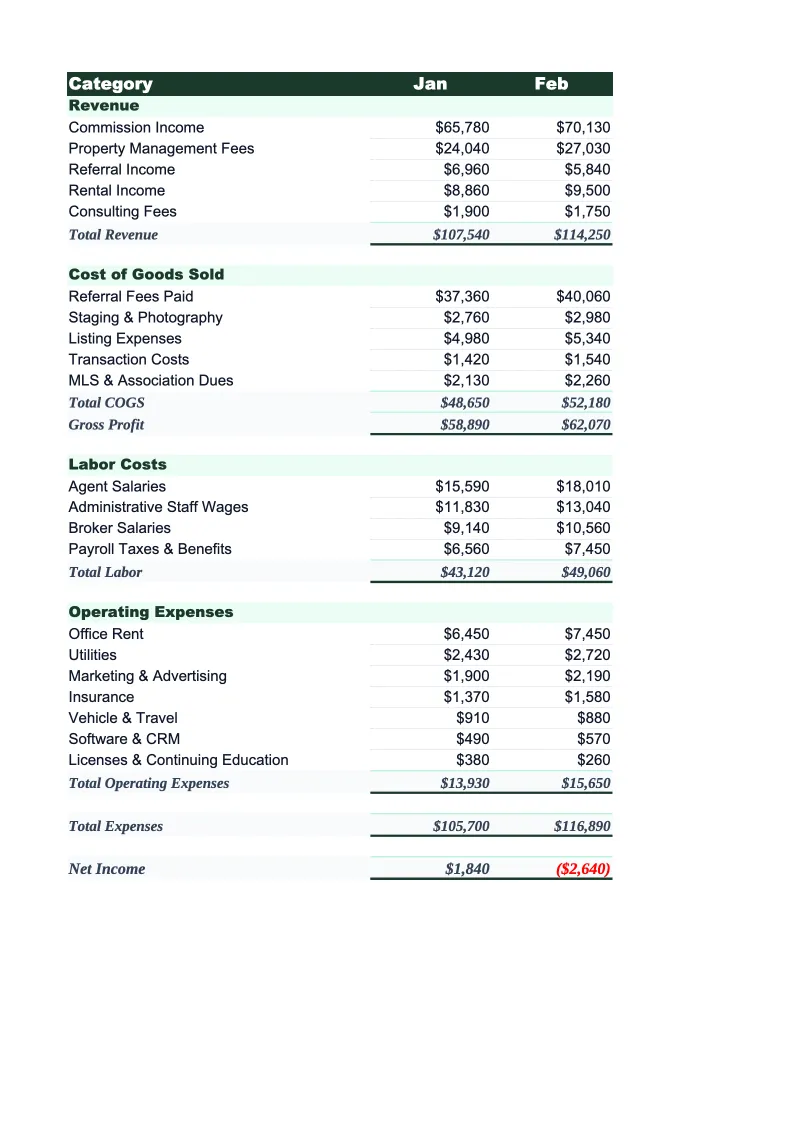
Real Estate Budget Template
Budget your real estate business like a business — track GCI projections, commission splits, marketing spend, and operating expenses in one pre-built spreadsheet.
What's Inside This Real Estate Budget Template
This template includes 4 worksheets, each designed for a specific part of your real estate financial workflow:
Monthly Budget
The core planning sheet where you project each month's gross commission income and operating expenses.
Annual Summary
A full-year view that rolls up all 12 monthly sheets automatically.
Budget vs Actual
Track planned income and expenses against what actually happened each month.
Dashboard
A visual overview showing your most important real estate business metrics at a glance.
Real Estate Budget Template Features
- GCI projection by transaction with commission rate and broker split
- Pre-loaded expense categories for agents, brokers, and property managers
- 12-month annual rollup with transaction count and income tracking
- Budget vs actual variance tracking with color-coded alerts
- Visual dashboard with GCI target, expense breakdown, and net income charts
- Expense ratio calculation to see what percentage of GCI goes to business costs
How to Use This Real Estate Budget Spreadsheet
Download the .xlsx file and open it in Excel or Google Sheets — no macros or add-ins required. Start with the Monthly Budget sheet and review the pre-loaded expense categories. Most real estate agents keep the categories as-is and only add a few custom line items specific to their market or niche. Then set your GCI target for the month by entering your expected closings — sale price, commission percentage, and broker split — and the sheet calculates your projected net income before expenses.
Once your income projection is set, fill in your expected expenses for the month. Fixed costs like MLS dues, E&O insurance, and CRM subscriptions are easy to enter since they don't change. Variable costs like marketing spend and transaction coordination fees will vary by volume. If you're not sure what to budget for lead generation, start with your last 90 days of actual spending and use that as the baseline. Copy the monthly setup forward and adjust for months where you expect more or fewer closings.
15 minutes from download to your first real estate budget
Download the template, enter your expected closings and monthly expenses, and see your real estate business finances clearly for the first time.
Why Every Real Estate Agent Needs a Budget Template
Real estate income is unpredictable in a way that most business budgets aren't built to handle. You might close three deals in April and none in May, but your MLS dues, CRM subscription, and marketing spend continue every single month regardless. Most agents think about their finances in terms of individual commissions — this transaction paid $8,000, the next one pays $12,000 — rather than as a business with monthly revenue and expenses. That transaction-by-transaction mindset is what leads to cash flow problems even in years with strong volume.
A proper real estate budget separates your business income from your personal income and forces you to plan for the dry months. On the income side, that means tracking GCI before and after broker split, and projecting forward based on your pipeline rather than just counting closed deals. On the expense side, it means categorizing spend into fixed costs — MLS fees, licensing, E&O insurance, technology — and variable costs that scale with volume — marketing, lead generation, transaction coordination, and signage. Most agents spending 15–20% of GCI on marketing and 5–10% on technology are operating within normal ranges, but the only way to know is to track it.
Real Estate Industry at a Glance
Financial templates built for real estate professionals — agents, brokers, property managers, appraisers, and inspectors. Pre-loaded with commission tracking, management fee structures, and transaction-based billing.
Revenue Drivers
- Sales commissions
- Property management fees
- Lease-up / tenant placement fees
- Appraisal & inspection fees
Key Cost Categories
- MLS & licensing fees
- Marketing & advertising
- E&O insurance
- Transaction coordination
- Technology & CRM
- Office & brokerage fees
Typical Margins
Gross: 40-70% · Net: 15-35%
Seasonality
Peak activity spring through summer (March–August); winter slowdown, especially December–January. Commercial real estate has less pronounced seasonality.
Key Performance Indicators
Real Estate Budget Template FAQ
More Real Estate Templates
Real Estate Balance Sheet Template for Excel
$29
Real Estate Business Plan Template for Excel
$39
Real Estate Cash Flow Template for Excel
$29
Real Estate Expense Tracker Template for Excel
$29
Real Estate Financial Model Template for Excel
$29
Real Estate Income Statement Template for Excel
$29
Real Estate Invoice Template for Excel
$29
Real Estate KPI Dashboard Template for Excel
$29
Real Estate P&L Template for Excel
$29
Real Estate Pro Forma Template for Excel
$29
Real Estate Project Budget Template for Excel
$29
Real Estate Sales Forecast Template for Excel
$29
Real Estate Business Valuation Template for Excel
$29
Real Estate Budget Template
$29