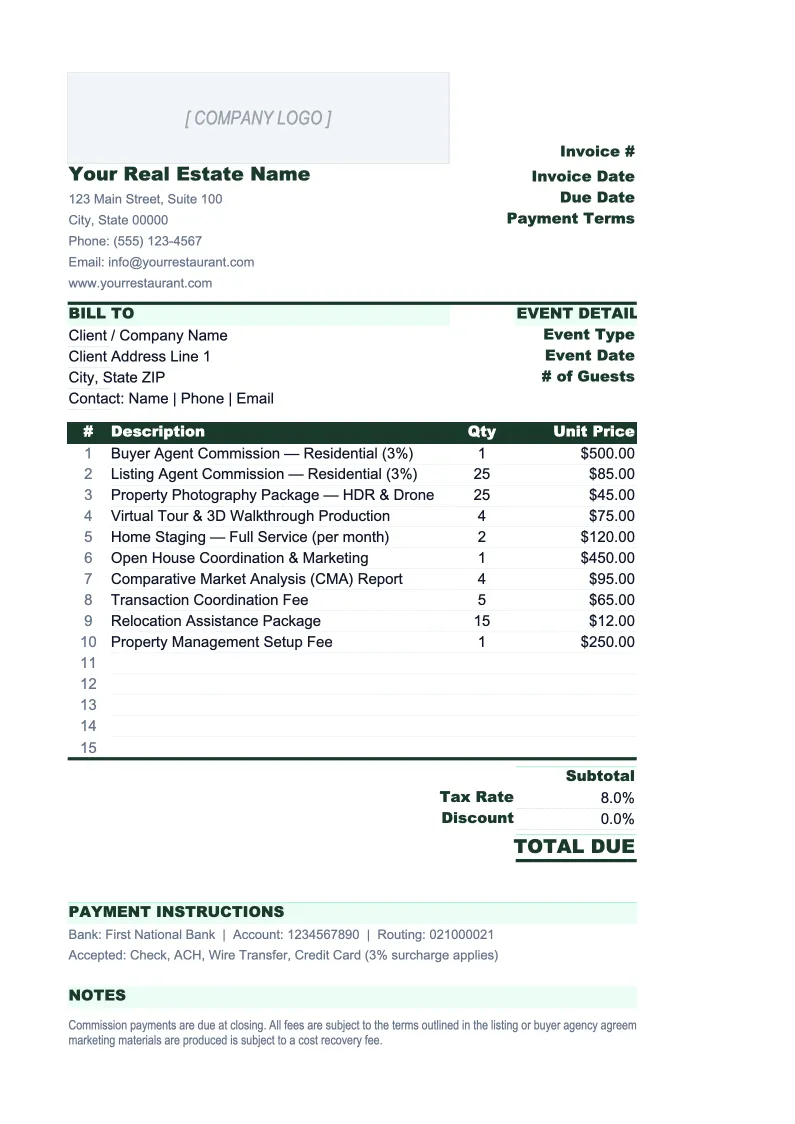
Real Estate Invoice Template
Invoice clients for commissions, management fees, appraisals, and inspections with a template built for how real estate businesses actually bill — including property address, license disclosure, and a full invoice tracker.
What's Inside This Real Estate Invoice Template
This template includes 2 worksheets, each designed for a specific part of your real estate financial workflow:
Invoice
A print-ready invoice formatted for real estate billing.
Invoice Tracker
A running register of every invoice you've sent, organized by property and client.
Real Estate Invoice Template Features
- Dedicated Property Address field on every invoice — not buried in a notes section
- License number and brokerage disclosure in the company header block
- Commission, management fee, lease-up, and appraisal line items pre-populated
- Transaction reference fields: MLS number, escrow number, closing date, and property type
- Invoice Tracker with overdue flagging, YTD commission total, and payment status by transaction type
- Payment terms include 'Due at Closing' — a real estate-specific option not in generic templates
How to Use This Real Estate Invoice Spreadsheet
Setup takes about 20 minutes. Download the .xlsx file and open it in Excel or Google Sheets. Start with the Invoice sheet header: enter your company name, brokerage name, license number, and contact details. This information stays fixed across all invoices — you won't need to re-enter it. Review the pre-populated line items and adjust them to match the services you typically bill: agents billing commissions will use different rows than property managers invoicing landlords for monthly fees. Set your default payment terms in the dropdown (Due at Closing, Net 15, Net 30, or Due Upon Receipt) to match the most common arrangement with your clients.
To create an invoice, enter the client name and address in the Bill To block, then add the property address in the dedicated property field — this is the field that ties the invoice to the transaction. Fill in the MLS or escrow number and the closing date if applicable. Then enter your line items: for a commission invoice, enter the sale price as the base and the commission percentage as the rate, or enter a flat commission amount directly. For property management, the pre-built rows for monthly management fee, lease-up fee, and maintenance markup make recurring monthly invoices fast to generate. When the invoice is complete, export to PDF and send — the layout is designed to print cleanly on a single page.
Send your next real estate invoice in under 10 minutes
Download the template, enter your license number and company details once, and create commission or management fee invoices with the property address, transaction reference, and payment terms already built in.
Why Real Estate Professionals Need an Industry-Specific Invoice Template
Real estate billing has structural requirements that generic invoice templates don't account for. Every real estate invoice is tied to a specific property — that address belongs at the top of the document, not in a notes field. Most state licensing boards require the agent's or broker's license number to appear on billing documents, especially commission invoices and appraisal invoices. And real estate has payment terms you won't find in templates built for freelancers or consultants: 'Due at Closing' is the standard for commission invoices, where payment is collected from proceeds at settlement rather than on a net-30 schedule. A generic template that doesn't include these fields creates invoices that look unprofessional and may not meet state disclosure requirements.
The range of services that real estate professionals invoice for is broader than most people realize. Agents and brokers bill commissions (2.5–3% per side post-NAR settlement) plus transaction coordination fees ($300–$600), which are now standard in most markets. Property managers invoice landlords monthly for management fees (8–12% of collected rent for residential, 4–7% for commercial), lease-up fees (often one month's rent), lease renewal fees ($150–$300), and maintenance coordination markups (10–15% on vendor invoices). Appraisers invoice lenders for residential reports ($400–$700 for a standard 1004) and commercial appraisals ($1,500–$10,000+). Each of these billing types has different line item structures, and a real estate invoice template should support all of them without requiring the user to rebuild the layout each time.
Real Estate Industry at a Glance
Financial templates built for real estate professionals — agents, brokers, property managers, appraisers, and inspectors. Pre-loaded with commission tracking, management fee structures, and transaction-based billing.
Revenue Drivers
- Sales commissions
- Property management fees
- Lease-up / tenant placement fees
- Appraisal & inspection fees
Key Cost Categories
- MLS & licensing fees
- Marketing & advertising
- E&O insurance
- Transaction coordination
- Technology & CRM
- Office & brokerage fees
Typical Margins
Gross: 40-70% · Net: 15-35%
Seasonality
Peak activity spring through summer (March–August); winter slowdown, especially December–January. Commercial real estate has less pronounced seasonality.
Key Performance Indicators
Real Estate Invoice Template FAQ
More Real Estate Templates
Real Estate Balance Sheet Template for Excel
$29
Real Estate Budget Template for Excel
$29
Real Estate Business Plan Template for Excel
$39
Real Estate Cash Flow Template for Excel
$29
Real Estate Expense Tracker Template for Excel
$29
Real Estate Financial Model Template for Excel
$29
Real Estate Income Statement Template for Excel
$29
Real Estate KPI Dashboard Template for Excel
$29
Real Estate P&L Template for Excel
$29
Real Estate Pro Forma Template for Excel
$29
Real Estate Project Budget Template for Excel
$29
Real Estate Sales Forecast Template for Excel
$29
Real Estate Business Valuation Template for Excel
$29
Real Estate Invoice Template
$29