Real Estate Pro Forma Template
Project rental income, operating expenses, NOI, and investor returns for any property — residential, multifamily, or commercial — with a spreadsheet built around how real estate deals actually get evaluated.
What's Inside This Real Estate Pro Forma Template
This template includes 5 worksheets, each designed for a specific part of your real estate financial workflow:
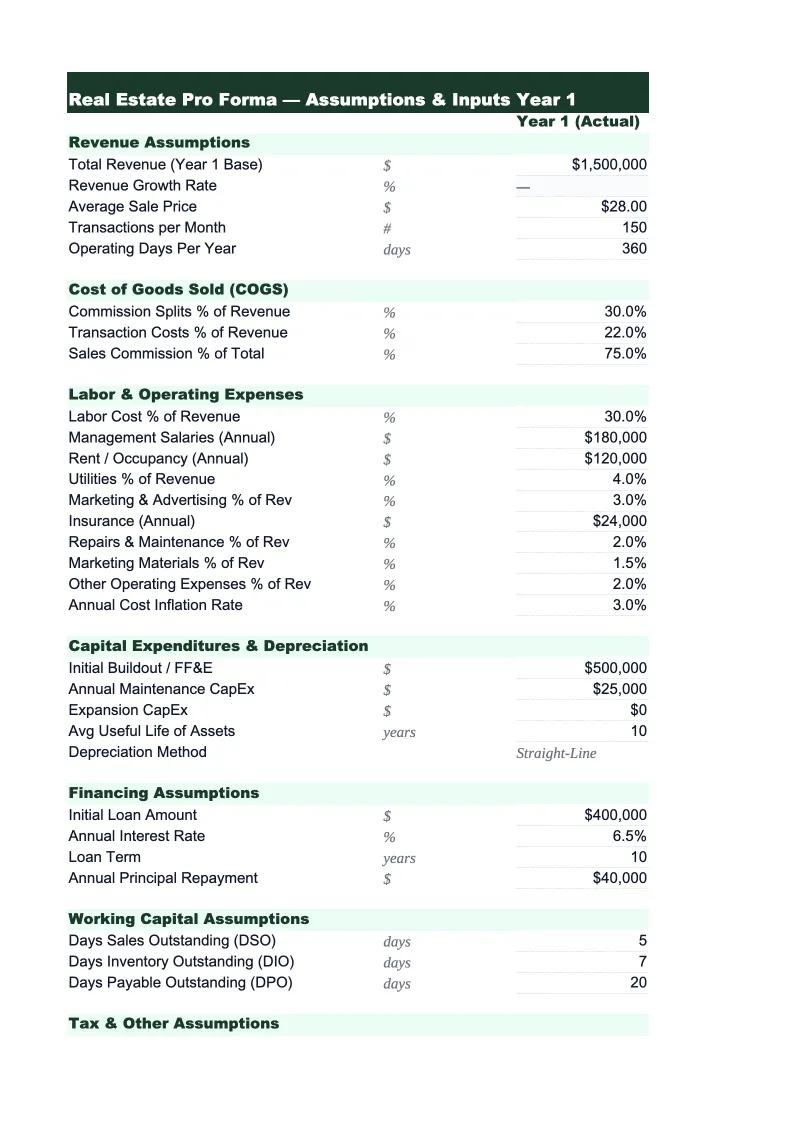
Deal Assumptions
The control panel for the entire model.
Income & Expense Projections
A 10-year projection of the property's income statement.
Debt Service
A full loan amortization schedule for the holding period, showing each year's beginning balance, annual principal payment, annual interest payment, and ending loan balance.
Cash Flow Analysis
Brings together NOI and debt service to show cash flow after financing for each year of the holding period.
Returns Summary
A one-page investor summary that aggregates all the key return metrics from the model.
Real Estate Pro Forma Template Features
- 10-year NOI and cash flow projections with adjustable rent and expense growth
- Full loan amortization schedule with optional interest-only period
- Automatic IRR, equity multiple, and cash-on-cash return calculations
- Going-in and exit cap rate analysis with projected sale proceeds
- Debt service coverage ratio (DSCR) tracked annually for lender review
- Single-page investor returns summary ready to share with partners or lenders
How to Use This Real Estate Pro Forma Spreadsheet
Start with the Deal Assumptions sheet. Enter the purchase price, your anticipated down payment, and loan terms (rate, amortization period, any interest-only months). Then fill in your projected gross monthly rent, your vacancy assumption (a standard residential vacancy rate is 5–8%), and your estimated annual operating expenses. The model is pre-loaded with typical real estate expense categories, so most users keep the structure and just adjust the numbers to match their specific property. This first pass takes about 20 minutes if you have a rent survey and tax bill in front of you.
Once the assumptions are in, flip to the Income & Expense Projections and Cash Flow Analysis sheets to review the outputs. Check that Year 1 NOI looks reasonable relative to the purchase price — if your going-in cap rate on the Returns Summary is wildly off from comparable properties in the market, go back and revisit your expense assumptions or rent estimate. Use the scenario feature by saving a copy and running a stress test: what happens if vacancy runs at 10% instead of 5%? What if rents grow at 2% instead of 3%? This is where the model earns its value — not in the base case, but in the downside.
15 minutes from download to a complete deal analysis
Download the template, enter your property's numbers, and get NOI, cap rate, cash-on-cash return, and IRR — all calculated automatically.
Why Every Real Estate Investor Needs a Pro Forma Template
Real estate deals get made or passed on pro formas. A lender won't approve a loan without seeing projected NOI and DSCR. A private equity partner won't write a check without seeing IRR and an equity multiple. And an experienced investor won't close without stress-testing the downside scenarios. The pro forma is the document that ties together all the moving parts of a deal — purchase price, financing, operating projections, and exit — into a single model that tells you whether the numbers work before you're committed.
A well-built real estate pro forma separates real analysis from wishful thinking. The biggest mistake first-time investors make is underestimating expenses. Industry benchmarks put total operating expenses for a stabilized rental property at 35–50% of gross potential rent, depending on property type and location — a figure most pro formas built on napkins dramatically undercount. The model should include property taxes (look up the actual assessed value and mill rate), insurance, management fees (typically 8–10% of collected rents for residential, 3–6% for commercial), maintenance reserves ($100–200 per unit per year minimum), and capital expense reserves ($150–300 per unit per year for older properties). Get those right, and the NOI number is defensible.
Real Estate Industry at a Glance
Financial templates built for real estate professionals — agents, brokers, property managers, appraisers, and inspectors. Pre-loaded with commission tracking, management fee structures, and transaction-based billing.
Revenue Drivers
- Sales commissions
- Property management fees
- Lease-up / tenant placement fees
- Appraisal & inspection fees
Key Cost Categories
- MLS & licensing fees
- Marketing & advertising
- E&O insurance
- Transaction coordination
- Technology & CRM
- Office & brokerage fees
Typical Margins
Gross: 40-70% · Net: 15-35%
Seasonality
Peak activity spring through summer (March–August); winter slowdown, especially December–January. Commercial real estate has less pronounced seasonality.
Key Performance Indicators
Real Estate Pro Forma Template FAQ
More Real Estate Templates
Real Estate Balance Sheet Template for Excel
$29
Real Estate Budget Template for Excel
$29
Real Estate Business Plan Template for Excel
$39
Real Estate Cash Flow Template for Excel
$29
Real Estate Expense Tracker Template for Excel
$29
Real Estate Financial Model Template for Excel
$29
Real Estate Income Statement Template for Excel
$29
Real Estate Invoice Template for Excel
$29
Real Estate KPI Dashboard Template for Excel
$29
Real Estate P&L Template for Excel
$29
Real Estate Project Budget Template for Excel
$29
Real Estate Sales Forecast Template for Excel
$29
Real Estate Business Valuation Template for Excel
$29
Real Estate Pro Forma Template
$29